Zheng Qinwen's Remarkable Comeback at the US Open
If this US Open has taught anyone anything, it is this: do not, under any circumstances, lead 5-0 against Zheng Qinwen and think the job is done.
Madison Keys learned it first. Iga Swiatek has now felt it even more brutally.
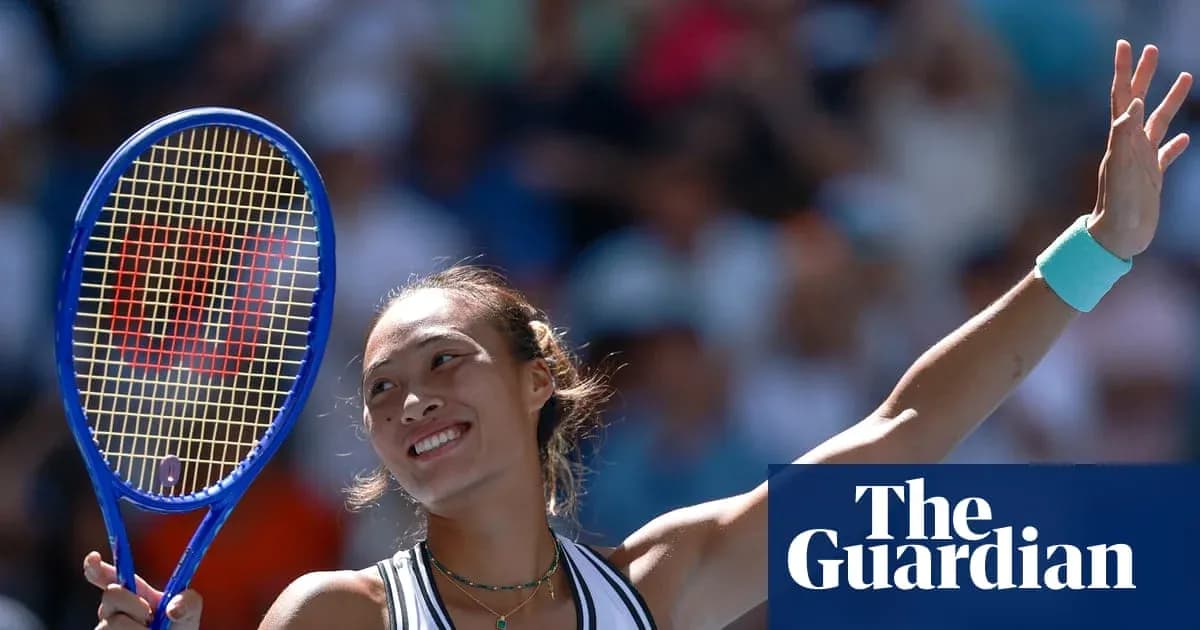
Two days after ripping seven straight games from 0-5 down in a deciding set to stun Keys, Zheng walked into Louis Armstrong Stadium and did it again – this time against the six-time grand slam champion many still see as the sport’s gold standard. Down 5-0 in the opening set to Swiatek, Zheng simply shut the door on her own errors, tightened the screws, and ran off seven games in a row. She never let go of the momentum, finishing a 7-5, 6-3 victory to reach the US Open quarter-finals.
The comeback itself was outrageous. To do it twice in consecutive matches, from 0-5, against two major winners, belongs in the realm of the almost impossible. At this level, players don’t just cough up seven straight games from that position. Certainly not twice in three days. Certainly not Swiatek.
Yet Zheng turned the match into a test of nerve and clarity, and she passed both.
“At one moment, I even forgot the score in the first set at 4-5,” Zheng said afterwards. “That shows how I am focused. I guess, to come back 0-5 [again] is not lucky, that’s [what] I can say.”
For Swiatek, this was supposed to be a statement fortnight. She arrived in New York as one of the clear favourites after finally lifting her first trophy of the year in Toronto, hinting that the familiar, relentless rhythm of her best tennis was returning. For five games, it was all there: heavy topspin, depth, control, the familiar suffocation of an opponent pinned behind the baseline.
Then the control vanished.
Once Zheng broke through, Swiatek’s game fell apart in a blur of misfires. The Pole, who has spoken openly about anxiety and stress affecting her recent form, simply could not feel the ball, spraying unforced errors from positions she usually dominates. Rallies that should have ended with Swiatek dictating instead ended with her staring at the strings of her racket, baffled.
“I wouldn’t say it had anything to do with mentality. It was more that I started making mistakes from easy balls and Qinwen stopped doing mistakes,” she said. Zheng’s clean hitting and refusal to back off only magnified that contrast.
This win, though, is about far more than a single upset. It feels like a hinge point in Zheng’s career.
She walked on court having beaten Swiatek only once in eight meetings, but that one cut deep: the semi-final of the 2024 Paris Olympics at Roland Garros, where Swiatek had just completed a hat-trick of French Open titles. Zheng went on to win gold, a result that instantly catapulted her into the top tier of Chinese sport.
The rise seemed set to be linear. An Australian Open final in 2024. A career-high ranking of No 4. A game that looked built for the biggest stages.
Then the elbow went.
Surgery halted everything. The ranking slid, brutally. By June, Zheng had fallen to No 160, stripped of rhythm and confidence, reduced to grinding through early rounds with no guarantee of deep runs. Coming into New York, her 2026 record sat at 11-13, the numbers of a player searching for herself.
So she parked the ego and went into qualifying. No fanfare, no shortcuts. Seven wins later in New York, she is back in the last eight of a major, and the way she has done it – absorbing pressure, flipping matches from impossible positions – suggests this is more than a fleeting surge. It looks like a reassertion.
The road now gets no easier. Standing between Zheng and a semi-final is the second seed, Elena Rybakina, who played like a looming world No 1 in a clinical 6-1, 6-4 dismantling of Naomi Osaka.
On Louis Armstrong, Rybakina needed only 66 minutes to underline why she is one victory away from the top ranking. She cracked 29 winners against just 17 unforced errors, faced only a single break point – which she erased – and never allowed Osaka to settle into any kind of rhythm. Her first strike tennis, the flat, searing groundstrokes, and the weight of her serve left Osaka constantly scrambling.
Osaka, a two-time US Open champion, needed her very best level simply to stay in touch. It never quite arrived. Struggling with achilles pain and unable to find her usual pop and precision on serve, she spent most of the afternoon firefighting. Against this version of Rybakina, that was nowhere near enough.
On the other side of the women’s draw, Mirra Andreeva continued her own rapid ascent. The fifth seed and reigning French Open champion fought past Anastasia Potapova 5-7, 6-4, 6-3 to book a first quarter-final at Flushing Meadows. It was not the cleanest performance, but it did not need to be; Andreeva’s ability to adjust mid-match and wrestle back control underlined why she already carries the aura of a player built for the long haul.
The men’s event had its own breakthrough story. Alexander Blockx, seeded 28th, reached a grand slam quarter-final for the first time with a 6-3, 4-6, 7-5, 7-5 win over the 24th seed Francisco Cerundolo. It was tight, edgy, decided by a handful of points late in each of the final two sets, and Blockx held his nerve when it mattered most.
Yet the image that lingers from this day belongs to Zheng Qinwen, staring down a 0-5 deficit against the most dominant player of her generation and treating it as nothing more than a starting point.
Opponents may soon learn the lesson: against Zheng, 5-0 is not a cushion. It is a warning.