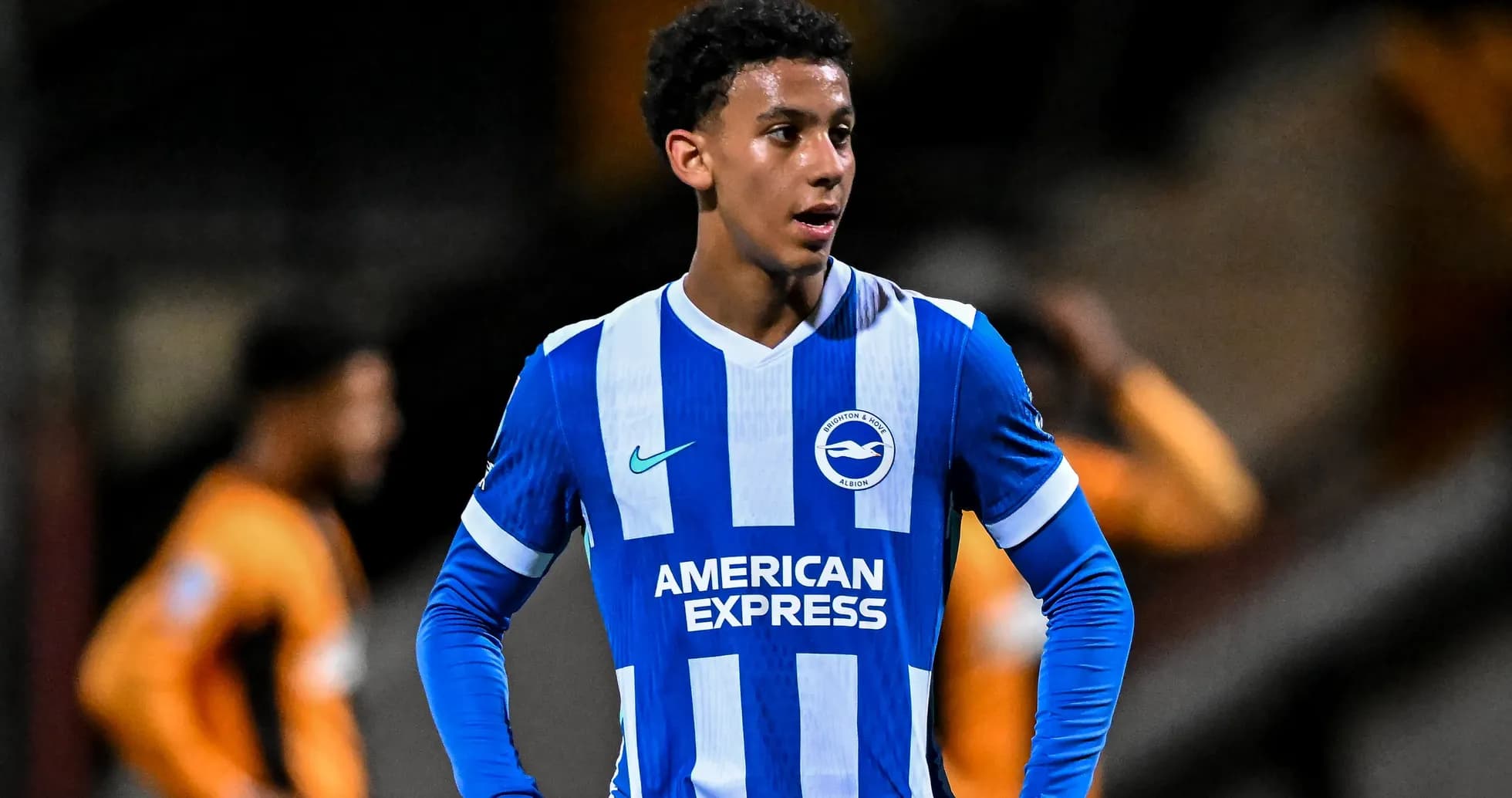
Younes Ibrahim's Journey from Academy Star to Brighton's First Team
Last Sunday did not feel like academy football.
Forty-eight hours earlier, Younes Ibrahim had been just that: an under-21 standout, his latest goal lighting up Brighton’s youth channels and group chats, another clip shared, liked, and bookmarked by those who track these things closely. Then the phone rang.
You’re with the first team tomorrow.
For some clubs, that sort of call can be ceremonial, a pat on the back dressed up as opportunity. Brighton are not that club. This is the operation that moved Moisés Caicedo for £115 million, that polished Alexis Mac Allister and Marc Cucurella into elite-level assets, that lives off knowing exactly when a player is ready to step into the light. They do not hand out tracksuits for sentiment.
So when Ibrahim sat on the bench against Coventry, it carried weight. He did not play a minute, but that wasn’t the point. His name on the teamsheet, his place among senior professionals, was a statement from Fabian Hürzeler and his staff: we are not imagining your future here. We are planning for it.
The numbers behind that faith are already stacking up. This season, 2026–27, Ibrahim has appeared three times for Brighton’s youth sides across different competitions, scoring once and setting up another. Solid, but not yet spectacular.
The real surge came last year.
Nine goals. Five assists. A season that turned him from a promising forward into one of the most influential figures in the club’s youth structure. He did it not only as a penalty-box striker, but as a player happy to drift between the lines, attack from wide, or operate as a false nine. Coaches noticed his movement. Team-mates trusted his decisions. Defenders stopped enjoying their afternoons.
None of this arrived overnight. Ibrahim’s path has been built on patience and a kind of professional stubbornness.
He began at Luton Town’s modest academy, where the basics of English football culture – discipline, work rate, physical duels – are drilled in early. From there came the jump to Chelsea, one of Europe’s most intense talent factories. At Cobham, he faced a different reality: multiple footballing philosophies, relentless internal competition, and a tempo that never drops, even in training.
The real pivot, though, came when he left Chelsea for Brighton’s under-15s. On paper, it looked like a step down. Fewer headlines, less glamour.
In reality, it was a calculated move.
Brighton have quietly become the only club in England offering a genuinely clear, consistently used pathway from academy to first team. For Ibrahim, that path has been almost textbook: under-15, under-18, under-21. No skipping levels, no shortcuts. At each step, he had to prove he could handle the physical jump, the tactical demands, the mental grind.
Last July brought the first major reward. His first professional contract. A signature that changed his status and underlined Brighton’s belief that this wasn’t just another academy graduate passing through the system.
Academy director Ian Buckman framed it as a milestone not only for Ibrahim but for those around him, calling it “an exciting moment for the players and their families alike.” It was, Buckman stressed, recognition of “the great efforts they have made during their time at the academy so far,” followed by a challenge: seize the opportunities, keep learning, keep developing. The contract was not a destination. It was permission to aim higher.
That is where Ibrahim’s story starts to stretch beyond Brighton and into the corridors of power in national-team headquarters across the world.
He was born in Australia. That puts the Socceroos on alert, a country permanently searching for its next front-line striker. He has spent the last eight years in England, which makes him eligible for the Three Lions, and England’s scouting network does not ignore emerging talent in Premier League academies. His Egyptian and Moroccan heritage opens two more doors – Egypt’s Pharaohs and Morocco’s Atlas Lions, both federations now highly proactive in recruiting dual-national players raised in Europe.
Four national teams. Four distinct footballing cultures. One teenager whose name is already on multiple lists.
Ibrahim has not chosen yet, and that restraint may be the most mature decision of all. At 18, the real battle is not between flags, but for minutes. For a place in Brighton’s matchday squads. For the moment when a late cameo replaces the view from the bench, and a first Premier League touch leads, eventually, to a first Premier League goal.
If he gets that right, the dynamic flips. The calls will not be from Brighton inviting him to sit among the seniors. They will be from national-team coaches, from technical directors, from federations eager to persuade rather than simply monitor.
That afternoon against Coventry, then, was not just a name on the substitutes’ list in a routine fixture. It felt like the soft launch of a bigger project: an international footballer in the making, tested in the quiet spaces of academy grounds, now edging into the noise of the professional stage.
A journey that started in Sydney’s youth pitches, sharpened in London’s pressure zones, has reached the south coast with intent. The next time Ibrahim’s phone rings, it may not simply be Brighton calling.