Wasim Akram's Message on India-Pakistan Cricket Rivalry: It's Just a Game
Wasim Akram has lived the full weight of India–Pakistan cricket. The packed stands, the noise, the pressure, the feeling that an entire subcontinent is breathing down your neck every time you mark your run-up.
And yet, the greatest left-arm fast bowler Pakistan has produced now wants everyone to calm down.
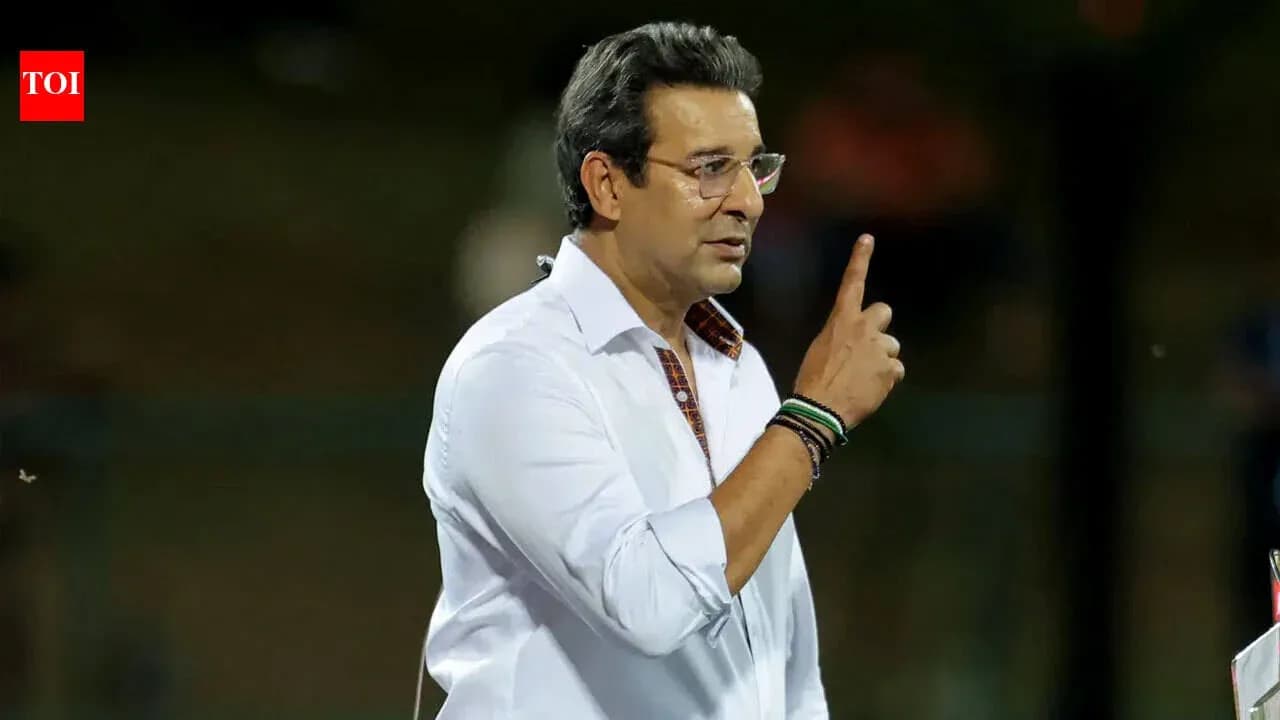
Speaking on the 1 Mint podcast, Akram urged fans on both sides to stop dragging history and politics into a contest he insists should be treated for what it is: a sport.
“People have too much time. Why can’t they understand? It’s only a frikkin game,” he said, cutting through the hysteria that routinely engulfs every India–Pakistan clash. “At the end of the day, it’s just a match. Somebody has to win, somebody has to lose. And move on to the next one.”
That last line is the core of his argument. For Akram, the scorecard closes when the game ends. The rest is noise.
‘Revenge is so 1970’
Akram played in some of the most emotionally charged encounters between the neighbours, from Sharjah thrillers to World Cup blockbusters. He knows better than most how the rivalry can swell into something far bigger than bat and ball.
But he has little time for the idea that a cricket match can carry the weight of decades-old grievances.
“What happened many moons ago still lingers,” he said, clearly exasperated. “Revenge and all is so 1970. It’s the classic ‘an empty mind is a devil’s workshop’ thought process.”
The modern battleground, in his eyes, is not just the pitch. It’s the timeline.
Every India–Pakistan fixture now spills over into social media wars, with fans, ex-players and pundits locked into endless back-and-forths long after the last ball has been bowled. Akram sees that swell of online rage and shrugs. The game, he insists, doesn’t deserve that kind of baggage.
One team wins. One team loses. That’s it. Move on.
A young fan in Australia
In the middle of this heavy subject, Akram reached for a lighter, more personal memory – his first meeting with Irfan Pathan.
The year was 2004. India were touring Australia. Akram had moved to the commentary box. Pathan was the new left-arm hope, a teenager who had grown up watching Pakistan’s legendary quicks.
“Irfan met me in 2004 on his first tour to Australia; I was commentating. He was a big fan. Grew up watching us,” Akram recalled. “I gave him a few tips here and there, but he did well early on in his career.”
Pathan’s action always drew comparisons with Akram’s. The smooth gather, the left-arm angle, the late swing. But Akram stressed that his advice wasn’t about remodelling a run-up or tinkering with a load-up. By the time you play for your country, he said, the body knows what it’s doing.
“His action was similar to mine from the very beginning. But when players ask you about something, what you tell them is mostly about the mindset,” Akram explained. “Action and all is fine, because at that stage, you have reached that level where you’re representing the country.”
So the conversations went deeper. “Things like wrist position and how to suss out a batsman. When to use variations, when not to,” he said. “So yeah, it was good fun. Irfan is a good boy; he still keeps meeting me.”
Pathan took that knowledge and ran with it. Across the 2000s, he became one of India’s most effective left-arm quicks, his ability to swing the new ball at pace making those Akram comparisons inevitable. His batting then turned him into a genuine all-rounder.
Pathan, Pakistan and the hat-trick in Karachi
If Akram was the childhood idol, Pakistan became the stage on which Pathan etched some of his finest work.
Across formats, Pathan picked up 67 wickets in 36 internationals against Pakistan: 27 in Tests, 34 in ODIs and six in T20Is. Those numbers tell a story of a bowler who relished the rivalry, who seemed to find an extra yard of zip when the opposition wore green.
One day stands out above the rest.
Karachi, 2006. Pathan with the new ball. Pakistan 0 for 0. Within minutes, the scoreboard had been ripped open. Salman Butt, Younis Khan, Mohammad Yousuf – all gone. A Test hat-trick in the very first over of the innings. Pathan became only the second Indian to achieve the feat.
Moments like that fuel the rivalry. They live in highlights packages, in fan debates, in the collective memory.
And yet, they sit alongside Akram’s central plea: enjoy it, argue about it, remember it, but don’t turn it into a proxy war.
Banter, backlash and the online crossfire
Pathan’s story doesn’t end with his last over. Since retirement, he has become one of the most outspoken former Indian cricketers on television and social media, unafraid to take strong positions – including on Pakistan and its players, especially after high-profile clashes.
Akram is fully aware of that.
“It’s a different thing that he keeps tweeting some or the other thing against Pakistan,” he said with a smile in his voice. The remark wasn’t a rebuke, more a nod to the modern cycle of banter and blowback.
If Pathan fires, the replies come in waves.
“But our fans are ready too. They don’t have the tendency to ignore either. They just have to reply,” Akram noted.
That, in a nutshell, is the ecosystem he is pushing back against. Former players trade jabs, fans pile in, and the original game gets buried under layers of outrage.
Akram isn’t asking for silence. He’s asking for perspective.
Drawing the line
For the former Pakistan captain, the principle remains disarmingly simple. India–Pakistan will always be big. It will always be emotional. It will always matter.
But it should not become an extension of old wounds or a canvas for modern-day anger.
“Somebody has to win, somebody has to lose. And move on to the next one,” he repeated, as if hoping the message might finally cut through the noise.
The next time the two sides walk out under the lights, the decibels will rise, the timelines will explode and the pressure will spike again.
The question is whether anyone will remember the most decorated left-arm quick of his era saying, with typical bluntness, that it’s still “only a frikkin game.”