Varun Aaron's Journey from Fast Bowler to Bowling Coach
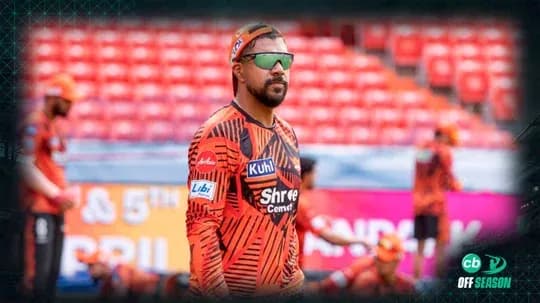
Varun Aaron was done chasing speed. Or so he thought.
Earlier in 2025, at 35, he had slipped out of the grind, eased into broadcasting, and parked any grand plans for the next phase of his life. No five-year coaching blueprint. No carefully curated transition. Just the simple idea of enjoying a game that had battered his body for more than a decade.
Then Daniel Vettori called.
The Sunrisers head coach wanted to know if Aaron would be interested in joining the franchise as a bowling coach. It wasn’t a conversation Aaron had been preparing for, but in truth, he’d been coaching in some form for years.
A fast bowler who had to coach himself
Injuries had forced him there. Stress fractures, long rehab stints, constant tinkering with his action – all of it turned Aaron into his own private coach.
"I think I've coached myself quite a bit because of the amount of injuries I've had," he says. That self-study extended beyond his own body. While still playing for Jharkhand, teammates regularly sought him out for feedback on their bowling. He enjoyed the exchange, the satisfaction of making a small but clear difference.
Coaching, then, wasn’t a career plan. It was a habit.
It also took shape in more formal ways. The new MRF Pace Foundation High Performance Center was his project from the ground up – design, protocols, programme, even the redevelopment of the ground and gym. It was a way of giving back to the academy that had shaped him. Later, he worked with the Jharkhand State Cricket Association as a bowling consultant.
Yet when retirement came, he deliberately avoided mapping out the next step.
"After retiring, I really was not setting out any targets. I was not thinking, 'I want to coach, I want to commentate.' After having a journey which was hampered by injuries throughout, all I wanted to do was enjoy myself after retiring, and whatever came about after that just happened on its own. And then one day, Dan rang me up and asked me if I was interested to coach Sunrisers."
The answer changed his year. And potentially his career.
Building a pace unit from scratch
In his first season with Sunrisers, Aaron wasn’t just handed a group and told to make it work. He was invited into the auction room, trusted with shaping the bowling core and, crucially, with identifying young quicks who could be moulded.
Praful Hinge and Sakib Hussain were two of the names he pushed for.
"What I saw was not what they were doing, but what they could do," Aaron says. He had a clear picture in his head of where their actions and skill sets could go, and believed he could bridge the gap between present and potential. "I'm glad it just worked out."
It worked out spectacularly, and fast. Against Rajasthan Royals, Hinge and Sakib ripped through the opposition with four-wicket hauls each in their first IPL game. Those spells weren’t accidents. They were the result of weeks of preparation, much of it squeezed into an already crowded calendar.
Aaron was on commentary duty for the T20 World Cup at the same time, which meant days that didn’t look like a typical coaching schedule. He would bring Sakib to Mumbai, broadcast in the morning and coach in the evening, or flip the order depending on the match timings. As the tournament progressed and his travel load increased, he needed help to keep the work going.
He turned to someone he trusted completely: SS Rao at the Rao Cricket Academy.
Rao, his former Jharkhand captain, became an extension of Aaron’s plans. "Me and SS Rao have a brotherly relationship," Aaron says. He sent Hinge and Sakib there with specific instructions, knowing Rao would follow the programme to the letter while adding his own presence and experience.
Hinge and Sakib may have grabbed the early headlines, but they weren’t the only young quicks that excited him.
"I think Shivang [Kumar] was unbelievable as well. And then you had Onkar [Tarmale] who hadn't played. He just got injured at the right time, so people didn't see him, but he's somebody who can move 145. We had some really good, interesting picks."
For a first-year coach in a high-pressure league, that level of influence is rare. Aaron knows it.
"When you're empowered by the head coach and the team owner in that fashion, I really feel your job becomes all that much easier," he says. "I think I was really lucky to be a part of a brilliant team, because it's not very common that in your first year you get an almost free hand to do what you want to. Through that, I just felt I could express myself creatively in whatever I did and it was a lot of fun."
The art of simplifying pace
Aaron’s playing career was built on one thing: speed. He burst into wider view when he clocked 153kph in the 2010/11 Vijay Hazare Trophy final, at a time when genuine pace in India was still a novelty. That number on the speed gun changed his life.
It also nearly broke his back. Three stress fractures after his Ranji debut in 2008/09. A Test debut in 2011, then another long gap because of back trouble before his second Test in 2014. Every fast bowler flirts with the edge; Aaron lived on it.
Now, as a coach, he tries to keep his young quicks away from that cliff.
"Fast bowling is really simple, but I think as a player you complicate it a lot," he explains. The temptation is always to search for something extra – a tweak, a new drill, a different angle. For Aaron, the job now is to strip all that noise away.
At the core, he says, fast bowling comes down to timing and sequencing.
"Fast bowling is all about timing," he says. He compares it to batting: just as a batter needs to time the initial movement to stay balanced and stable, a bowler needs to hit the right positions before release. Get that sequence right and everything else follows – speed, accuracy, and, crucially, durability.
"If your timing and the sequencing of your action is right, I think you've won the battle. You will bowl as fast as you can, you won't be injured and you bowl the ball where you want to. And you can only bowl as fast as you can. You can't bowl faster than your body is going to allow."
The speed gun still dominates conversations with young bowlers. They want numbers. He wants rhythm. His message is blunt: your body sets the limit, your timing decides how close you get to it.
One method? No chance
For all his talk of simplicity, Aaron rejects the idea of a one-size-fits-all coaching template.
"There's no set method to coaching. It completely depends on the individual," he says. Every bowler arrives with a different package – action, musculature, coordination, mindset, injury history. The first task, in his view, is to identify what makes that bowler unique and amplify it, then quietly clean up the inefficiencies.
"Some bowlers just present with a beautiful action and they're able to execute whatever they want. And some bowlers just have injury history, have different actions which don't make it easy for them. So, that's when you have to do some work."
That individualised approach extends to how he reads performances. He has little time for surface-level judgments.
"I genuinely think that you can't look at somebody's performance and be like, 'Oh, that was a bad performance' or 'that was a good performance'," he says. For Aaron, the value lies in the why. What made a spell work? What broke down in a bad day? If a bowler leaves training or a match without those answers, the opportunity is wasted.
"If it's a good performance, you should make sure that the bowler remembers why he or she performed well. And if it's a bad performance, it's something to take away from. You can learn from it. But if you just meander along day after day, just bowl, go home, bowl, go home, then it doesn't really add up to anything."
Between commentary boxes and training nets
Aaron’s calendar now is a juggling act. Franchise commitments, academy work, and a growing commentary portfolio pull him in different directions. The strain is real, especially away from the field.
"How do I balance that? That's a question you have to ask my girlfriend because she's not the happiest customer – I'm hardly at home," he says, half-joking, fully aware. "But, yeah, I'm trying to give her and my family more time. It is quite hectic, but it is very enjoyable."
The two roles, though, feed each other.
Coaching gives him a deeper read on players – their habits under pressure, their preferred fields for certain deliveries, their go-to balls when the game tightens. That insight sharpens his work in the commentary box, where he can anticipate decisions because he’s seen the thought process from the inside.
"It gives me a lot more insight. Obviously, you know a lot of players from before, but when you coach them, you know the inner depths of their mind. It helps you be a lot more predictive in your commentary because you know what the player does when he's under pressure."
The reverse is true as well. Broadcasting keeps him plugged into tournaments and trends across formats and competitions. He sees more players, more often, and that broadens his coaching eye.
A new obsession
For someone who never plotted a path into coaching, Aaron sounds like a man who has found his next obsession.
"What it has taught me about myself is that coaching gives me immense happiness," he says. The joy is specific, not abstract – a bowler walking off after a session having ticked off every single goal, a technical cue landing, a young quick suddenly feeling the ball fly out of the hand the way it should.
There was a time when Varun Aaron’s career was measured in kilometres per hour. Now, it’s measured in the pace of someone else’s progress.
And he looks in no hurry to step away from that race.