Tiafoe and Shelton: A Historic US Open Semifinal
NEW YORK — The name on the front of Arthur Ashe Stadium has always carried weight. On Friday night, it will feel heavier than ever.
Under the lights at Flushing Meadows, Frances Tiafoe and Ben Shelton will walk into the world’s biggest tennis arena knowing they are not just playing a US Open semifinal. They are stepping into a lane Arthur Ashe carved out with a wooden racket and an iron will, a lane that for decades seemed far too empty.
The winner will become the first Black American man to reach a US Open singles final since Ashe himself in 1972, and the first Black American man in any Grand Slam singles final since MaliVai Washington at Wimbledon in 1996. When the new rankings land, both will sit at career highs: Shelton at No. 4, Tiafoe at least No. 8, with a shot to climb to No. 4 if he lifts the trophy on Sunday.
For Washington, watching from a distance, the stakes are obvious.
"I think it’s an exciting time," he told USA TODAY Sports. "If one of them goes on to win the US Open, it will be the greatest sports story certainly of this year, and certainly of this decade." Coming from a man who knows what it means to stand alone as a Black man in a Grand Slam final, that is not hyperbole. It’s lived experience.
He sees something bigger than a one-off breakthrough.
"I think it shows how the growth and progression of tennis is going in the right direction. They are two great representatives of what tennis can be and what American tennis can be. This match and the finals will likely be the two most watched tennis matches in a long, long time."
On a fortnight already rich with storylines, this one cuts through.
A moment even Coco Gauff didn’t expect
Coco Gauff, the 2023 US Open champion who fell in this year’s semifinals to Elena Rybakina, has grown up with the legacy of Althea Gibson, Venus Williams and Serena Williams as a constant backdrop. She understands the power of visibility. Even so, this semifinal stopped her in her tracks.
"Especially on the men’s side, I never thought I’d have the chance to see an all-Black semifinal between the guys in my lifetime," she admitted. "Even growing up, just look at who was playing. I just never thought that would be able to happen."
She had her own deep run to manage, yet she still zoomed out to see the bigger picture.
"To have also me in the semis, I think it’s really cool. I have so much respect for both Ben and Frances. I’m just rooting for a good match. Hopefully, whoever wins can bring it home."
On a single night in New York, three Black American players reached the last four of the season’s final major. For a sport that has long struggled with representation on the men’s side, it felt like overdue validation.
Ashe’s vision, delayed but alive
Arthur Ashe always believed more Black players would follow him. He shattered the glass and expected others to walk through the opening. The reality was more complicated.
He won the 1968 US Open, the 1970 Australian Open and Wimbledon in 1975, then retired in 1980 because of heart issues. From the outside, it looked like the start of a wave. It wasn’t.
In 1988, long after his peak, Ashe told the Los Angeles Times, "What we need is an American Yannick Noah," invoking the charismatic Frenchman who won the 1983 French Open. Ashe, typically self-critical, did not see himself as the ideal template.
"In many respects, I wasn’t a very good role model," he said. "We need someone who’s got flair and can play in-your-face tennis. And he should comport himself like Julius Erving."
The next major Black male breakthrough did not arrive for another eight years, when Washington reached the Wimbledon final in 1996. By then, the Williams sisters were already changing the sport from the women’s side. Venus turned pro in 1994 and reached the US Open final in 1997. Serena followed a year later, storming the game’s biggest stages and altering its landscape.
Washington lost that Wimbledon final to Richard Krajicek, 6–3, 6–4, 6–3, but his run stood alone for nearly three decades. He is thrilled by what Shelton and Tiafoe have done, yet refuses to romanticize it as a magic turning point.
"I don’t believe that just one match or one final or even this occasion, all of a sudden you are going to see this flood of players coming on to the tour," he said. "To come on to the tour, it’s a 15-year process."
That word — process — matters to him more than any single scoreboard.
"If there is not an infrastructure to bring up these young players, to encourage and to impact these young players for an extended period of time, there will not be an increase of interest in the sport."
Inspiration is not enough
Washington, now 57, talks about champions as the product of systems, not just dreams. Junior programs, college tennis, professional pathways — they all have to line up.
"Though this match is extremely significant and it plays a role and it will be very positive for getting Black kids, but not just Black kids, but white kids, Hispanic kids, Asian kids, Native kids, it will play an important role in just getting more involved and interested in the sport," he said.
He has seen the grind up close. He picked up a racket at 5, reached the tour in 1989 and made his first big splash by beating world No. 2 Ivan Lendl at the Volvo International in 1990. His reward? A three-set loss in the next round to Bryan Shelton — Ben’s father.
The threads of history in this semifinal run deep.
Tiafoe knows the barriers too. He grew up around the Junior Tennis Champions Center in College Park, Maryland, where his father worked as a maintenance man and where Frances eventually trained as a teenager. He has become one of the sport’s most engaging personalities, but he never forgets how hard it is for kids, especially Black kids, to get in the door.
"Try to reach out to one of the local clubs where they give you a chance to play," he said. That’s the first step. The rest is on the player.
"And then once you get in that door, man, just come in there hungry, especially when you're young. You gotta be obsessed with this thing, man, because tennis is such a repetitive sport. You gotta really get them reps in. But mostly, you have to love it."
The love, he insists, has to outlast the obstacles.
Building the pipeline
Martin Blackman, CEO of the Junior Tennis Champions Center and former senior director for talent identification and development at the USTA, sees Friday night as both a celebration and a call to action.
For him, the blueprint was already there before the coronavirus pandemic disrupted junior pathways in 2020. The job now is to restore and strengthen it.
The model was simple in theory, demanding in practice: bring kids in from local, regional and national camps, expose them and their families to high-level training, and make sure their fundamentals are sound by 12 or 13. Do that consistently and the sport starts to look different.
Blackman believes Shelton vs. Tiafoe can supercharge that effort.
"It’s something to celebrate: two amazing players, two amazing representatives of sport. But it’s two guys who will inspire thousands of kids to pick up rackets and try our sport. It's a watershed moment," he said.
Washington, who reached a career-high ranking of No. 11 and won four singles titles, circles back to the same theme: discipline stretched over years.
"You can work your but off for years, and that doesn’t guarantee you will become a professional tennis player," he said. "You have to have the infrastructure and the passion. A lot of things go into it, you just have to give yourself the best chance."
No promises. No shortcuts. Just a better shot.
‘You only need one’
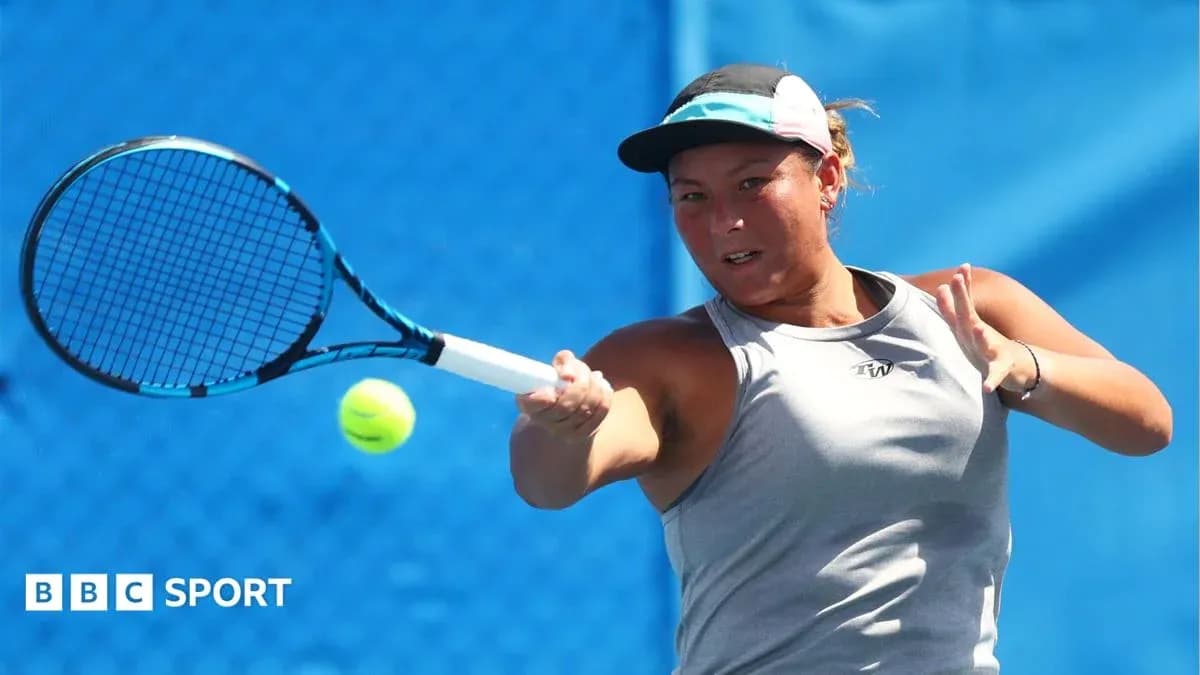
Taylor Townsend, fresh off completing a career Grand Slam in women’s doubles with her US Open title alongside Katerina Siniakova, sees the semifinal through a slightly different lens. She has lived the power of representation and the weight that comes with it.
"You only need one," she said. "You need somebody to be able to see that it's possible, that you can."
Her point is simple: belief often starts with a picture on a screen.
"I've said this where if you don't see it, then it's harder to believe it, but also, you have to be a certain type of person to want to take on that feat and say, Well, I'm going to carve this path for myself or for someone else or for the others who come after me."
She rattles off the names with pride — Robin Montgomery, herself, Gauff — and sees this US Open as a landmark for players of color.
"So for me, I'm so proud to be able to click on the TV and watch Frances and Ben, and one of them is going to be able to be in a Grand Slam final, and that's a beautiful thing. You know, Robin (Montgomery), myself, you know, it's been Coco, it's been a phenomenal US Open for people of color, and just being able to show people, like, it's possible, you know?"
The images matter. The names matter. The timing, on Ashe’s court, feels almost scripted.
Ashe’s clock is ticking again
Arthur Ashe once told the Los Angeles Times, "For some people, the future is next year. But for me it’s this afternoon."
On Friday afternoon, his words will hang over the grounds in Queens. By Friday night, as Tiafoe and Shelton stride into the stadium that bears his name, they will feel less like a quote and more like a challenge.
The future Ashe talked about is no longer theoretical. It’s walking out of the tunnel, racket in hand, under the lights of his court. The question now is whether tennis, beyond the noise and the headlines, is ready to build a sport that matches the moment.