Taylor Fritz's Heartbreaking Collapse at US Open
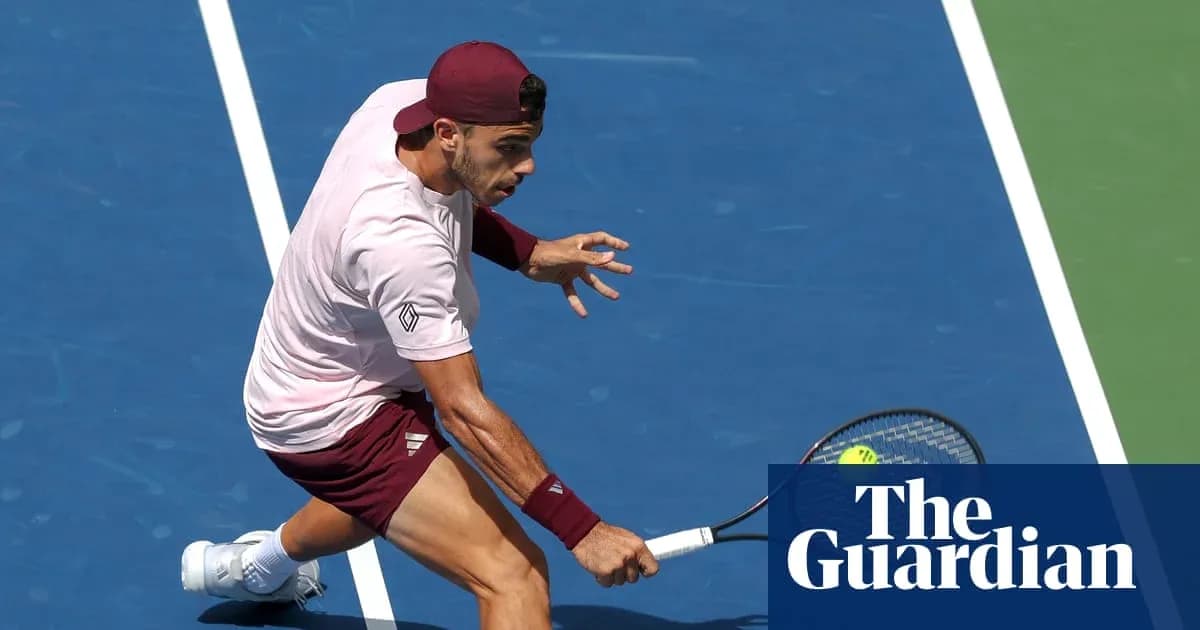
Taylor Fritz sank into his hands as the last, wild backhand flew long, the sound of it thudding into the back wall swallowed by the murmur inside Arthur Ashe Stadium. He knew exactly what he had let slip.
For two sets, the leading American hope at this US Open had been in command. He bullied Francisco Cerundolo from the baseline, took a two-set lead, then broke in the opening game of the third. The path looked clear. The draw, stripped of its usual monsters, had opened up. His moment seemed to have arrived.
Then one loose service game cracked everything.
From 3-6, 4-6, 0-1 down, Cerundolo found air. Fritz never truly found his way back. Over the next two hours, the match twisted away from the No 1 American, point by point, game by game, until it ended in a brutal 3-6, 4-6, 6-3, 6-4, 6-4 defeat in the third round.
This one will sting more than most. Not just because it came in New York, not just because it came from two sets and a break up, but because of what this US Open represents.
For years, Fritz has been the standard-bearer for American men. He climbed as high as No 4 in the world last season. He made the US Open final in 2024, the first American man to do so since Andy Roddick in 2006, squeezed between two quarter-final runs halted by Novak Djokovic in 2023 and 2025. His career has been defined by effort and incremental gains, by wringing every last drop from a game that has always run into someone just a little better. Usually an all-time great. Usually on the other side of the net when the trophies are handed out.
This fortnight is different. Or was supposed to be.
Jannik Sinner, world No 1 and a four-time grand slam champion, is out with injury. Djokovic, now 39, crashed out in the first round. Carlos Alcaraz, seven majors to his name and defending champion here, is feeling his way back after four months off. The usual script has been shredded. There is no obvious runaway favourite, no dominant force in full flow.
For players like Fritz, that changes everything. The ceiling of “deep run” becomes the possibility of “title”. The opportunity grows. So does the pressure.
In the fifth set against Cerundolo, that pressure sat heavy. Even then, Fritz had his chance. At 4-3, with the Argentine serving, he earned three break points. Convert one, and he serves for the match at 5-3, the kind of position he has closed out so often on tour. Instead, Cerundolo held firm, dragged himself out of the hole, and never gave Fritz another opening.
“I don’t even know what to say,” Fritz admitted afterwards. “I don’t really want to talk to anybody, see anybody. I kind of just need to get out for a couple days and then just get back to work. I don’t know how I let that happen today.”
His anguish echoed beyond his own box. At the start of the day, seven American men were still alive in singles: Ben Shelton, Fritz, Frances Tiafoe, Learner Tien, Tommy Paul, Alex Michelsen and Michael Zheng. In the bottom half of the draw, where Friday’s play decided the last 16, there is an American in each of the four fourth-round matches. The door is ajar for a home champion for the first time since Roddick lifted the trophy in 2003.
But Fritz’s collapse is a stark reminder: when the path clears, the weight of expectation can crush as easily as it can inspire. Over the next week, this draw will test not just forehands and serves, but nerve, resilience and appetite for the moment.
The American struggles were not confined to the men.
On Thursday, Madison Keys produced one of the great escapes of her career, saving five match points to edge Anna Bondar in a three-set epic. Two days later, on the same courts, she suffered the kind of unraveling that can haunt a player for months.
Keys led Zheng Qinwen 5-0 in the deciding set of their third-round match. She had the match by the throat. Then it slipped. Games began to bleed away, errors creeping in, tension tightening every swing. Zheng refused to go away. Keys could not stop the slide. Ten games later, the scoreboard read 1-6, 7-6 (3), 7-5 to Zheng.
“I think she started playing better; I started playing poorly,” Keys said. “Then I felt like I couldn’t play tennis any more, and it just was – it just felt like it was a much bigger deal than just playing a tennis match all of a sudden.”
This is not a player unused to big stages. Keys is the 2025 Australian Open champion, a grand slam winner who has weathered storms before. Yet she admitted this result had been looming, the product of issues she has been carrying for some time.
“I just feel like I’ve been struggling for a while now and I feel like I was able to kind of play through it for a bit,” she said. “I’m sure everyone could kind of see that I was struggling a little bit, but inside it felt probably even bigger than that. Some weeks are easier than others, and this week is obviously one of the harder ones just because you care so much. Yeah, I’m going to have to make some changes.”
Where Keys saw crisis, Zheng saw a lifeline.
The 23-year-old Chinese star owns an Olympic gold medal and reached the top 10 in 2024, but an elbow surgery stalled her rise and dragged her down the rankings. She had to slog through qualifying just to earn her place in the main draw here. Now she has a signature win in a stadium that has broken many before her.
“Tennis sometimes feels like a rollercoaster,” Zheng said. “You see many times that people have a match point, but at the end [their opponent] makes a comeback. Like today was just happening. So this also gives me a lesson that in a tennis match you always have to be there. It doesn’t matter if you are winning or losing, you have a match point or you don’t have a match point – you just need to be concentrated for every single point as long as you can.”
Her reward is as tough as it gets: a fourth-round meeting with Iga Swiatek.
The world No 1 seed had her own scare against Marie Bouzkova, forced to save three set points in the second set. Swiatek steadied at the critical moments, tightening her patterns and defending with trademark intensity to pull out a 7-6 (3), 7-6 (3) win. It was not smooth, but it was clinical when it counted.
For Amanda Anisimova, the day brought only frustration. The American, who lit up the summer of 2025 with runner-up finishes at Wimbledon and the US Open and climbed to No 3 in the world, fell 6-2, 7-5 to 24th seed Anastasia Potapova. The loss means Anisimova will drop out of the top 10, another jolt in a campaign that has struggled to match last year’s surge.
So the story of this US Open, at least for now, is one of opportunity and unease. The giants are missing or wounded. The draw is wide open. Yet as Fritz and Keys discovered on a sobering Saturday in New York, an open door is only an invitation.
You still have to walk through it.