Steve Smith's Return to South Africa: Eight Years After Sandpapergate
Steve Smith is back in South Africa, and the ghosts have travelled with him.
Eight years on from the grainy footage, the furtive movements and the yellow strip of sandpaper that detonated a scandal, Australia have returned for their first Test series here since ‘sandpapergate’. The last time they toured, Smith was captain, David Warner his vice-captain, Cameron Bancroft the junior enlisted to do the job. A piece of sandpaper on a cricket ball, a clear breach of the laws, and a team culture laid bare.
The bans came, the tears followed, and then came the long road back. What lingers is not just what they did to the ball, but what they did to the game – and what the fallout has done to them.
Two paths from the same scandal
Smith has spoken of being “traumatised” by the reaction to his cheating. The word is striking. Not ashamed by what he did to his team or the sport. Traumatised by what the world did to him in response.
Yet when he returned to Test cricket in 2019, he walked into a storm and batted as if he fed off the lightning. Edgbaston turned on him with a venom rarely seen in modern sport: boos, songs, masks, the constant reminder of disgrace. He answered with 144 in the first innings and 142 in the second. Over the Ashes series he piled up 774 runs, a performance dripping with defiance and technical genius. It was a tale of guts and gumption, the kind of series that cements a legacy.
Was that the beginning of redemption, or the closing argument for a player whose cricketing greatness must forever sit beside an asterisk?
Warner’s path has been more jagged. In the same Ashes, he scraped together 95 runs across 10 innings, seven of those dismissals claimed by Stuart Broad. He looked haunted, technically scrambled, mentally frayed. Then, against Pakistan, he exploded: an unbeaten 335, the highest score by an Australian against that opposition, a brutal reminder of his capacity to dominate.
Yet the public narrative split. As Geoff Lemon, who chronicled the sandpaper saga, observed, opinion “firmly settled on Warner being the criminal and Smith the innocent bystander.” The mastermind versus the reluctant accomplice. The street-fighter versus the batting savant.
One became the villain. The other, oddly, the wounded genius.
Greatness, guilt and a blind spot
Strip away the emotion and Smith’s numbers still dazzle. Among players with over 10,000 Test runs, he owns the best average. For a long stretch he hovered above 60, second only to Don Bradman in the sport’s history. He is, by any serious measure, a modern great.
Yet the way his story is framed reveals something uncomfortable. The focus so often lands on what the scandal did to Smith – his mental health, his image, his journey – rather than what his decisions did to his teammates, his opponents, or the game’s fragile sense of fair play. That gap between self-obsession and self-awareness is telling.
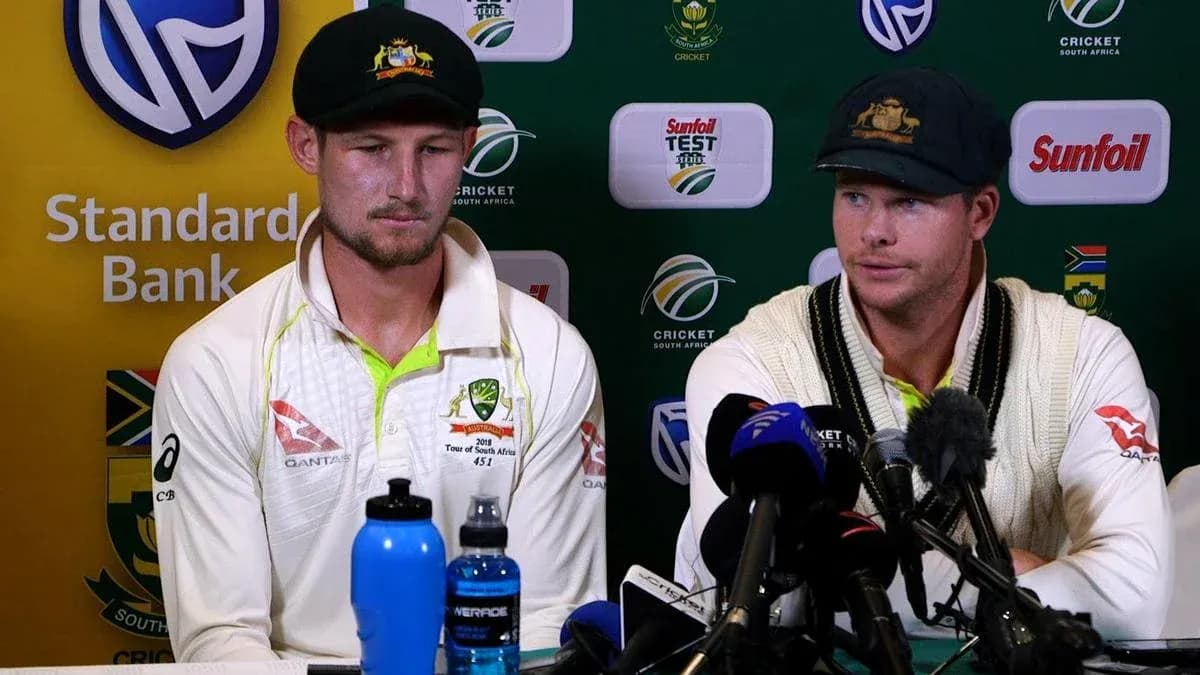
Cricket writer Gideon Haigh captured the deeper unease when he reflected on that infamous press conference in Cape Town, where Smith and Bancroft fronted the media. “What is extraordinary,” Haigh said, “is how it was done and how easily it was agreed to by the team and how, not unapologetic, but sort of oblivious to the consequences Smith and Cameron Bancroft seemed to be at the press conference.”
That obliviousness was not a momentary lapse. It was the logical end point of a mindset: entitlement, a ‘win-at-all-costs’ doctrine, a system in which victory meant ratings, sponsors and applause. As long as the team kept winning, everything else could be rationalised away. Until, suddenly, it couldn’t.
Thrown to the wolves – or shielded by them?
“I was thrown to the wolves,” Smith complained later, framing himself as the sacrificial lamb in a scandal that devoured reputations. The line was meant to draw sympathy, to underline the personal trauma.
Yet it lands awkwardly when you remember the power dynamic. This was the captain, the most senior figure in the dressing room, asking a younger teammate, Bancroft, to carry out the dirty work. Responsibility was outsourced; risk was delegated. When the scheme unravelled, the same leader spoke of being devoured by forces beyond his control.
The dissonance is hard to ignore.
It is easy, though, to understand how a player so consumed by batting and winning can be reshaped by suffering. Sport has always traded on the idea of redemption arcs. A fall, a reckoning, a return. Every person deserves a second chance once the debt has been paid. The bans were long, the public shaming relentless.
Even this writer, who once argued for a life ban, has had to confront a more basic truth: cricket is, in the end, just a game. An artificial construct, however much meaning we load onto it. We treat it as a moral theatre, a reflection of society’s best values. Yet its very artificiality allows us to demand a standard of behaviour that often feels impossible beyond the boundary rope.
Spirit, rules and the age we live in
Sport itself is morally neutral. A ball bowled, a shot played, a catch taken – none of it carries inherent virtue or vice. The actions of athletes do.
Cricket’s attempt to bolt on a “spirit of cricket” preamble to its laws tells its own story. The unwritten codes that once defined the game – pride, restraint, a sense of what was acceptable even if not illegal – were being stretched, bent and gamed. That addendum was a plea as much as a principle: stop exploiting the gaps between law and ethics.
That says more about the players, and the times, than about the game. The sandpaper scandal was not born in a vacuum. It came from a culture that blurred the line between hard-nosed and hard-hearted, between competitive and corrosive.
Many international cricketers felt the punishments for Smith, Warner and Bancroft were harsh. They pointed to the broader ‘Australian way’ of playing – aggressive, confrontational, unapologetically combative – and argued that the system, not just the individuals, should share the blame.
Trevor Chappell knows what it is to become a symbol of a nation’s shame. His underarm delivery against New Zealand, bowled under orders to prevent a last-ball six, has followed him for nearly four decades. “(Smith and the others) will struggle for the rest of their lives,” he said. “I haven’t been able to shake off what happened to me in 37 years. I come up on Google as the man who took the lead role in Australian cricket’s darkest day. It’s a relief I can finally drop that title.”
The line is half-wry, half-wounded. If Chappell can finally pass on that unwanted crown, who will eventually relieve Smith and Warner, the current holders in the public imagination?
The jeer that never quite fades
When Smith returned to South Africa on a white-ball tour, the reception was surprisingly muted. No baying mobs, no carnival of scorn. Perhaps time had dulled the anger. Perhaps the spectacle had simply moved on.
Still, he knows the sound that can cut deepest. Not the crack of leather on willow, but the quick, sharp jeer from a stand. The mocking chant. The reminder that for many, he is not just a great batter but the face of a great betrayal.
That, more than any suspension or fine, has become his lasting punishment – a sentence served every time he walks out to bat, waiting to see whether the crowd will let him be just a cricketer again.