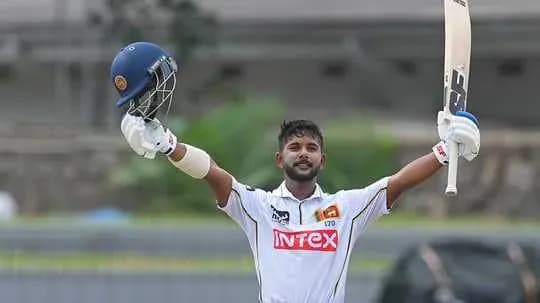
Sonal Dinusha: From School Cricket to Test Success
Sonal Dinusha remembers the bouncers.
Darwin, July 2025. Sri Lanka A up against Australia A, and a tall, hostile pace unit that decided the shortest man at the crease would get the shortest stuff. Mitchell Perry, Liam Scott, Henry Thornton – all over six feet, all quick, all unrelenting. Ball after ball whistled past his helmet. For a while, the left-hander looked stuck.
He went searching for answers.
Avishka Gunawardene, then Sri Lanka A coach, watched the struggle and stepped in. A few balls, a quiet chat, a tactical reset. No grand reinvention, no drama. Just problem, solution, execution.
The response was brutal in its simplicity. A 145-ball 105 in the first unofficial Test. A 191-ball 88 in the second. First time batting in Australia. First time facing that kind of sustained short-pitched barrage. Same outcome: he found a way.
To those who had tracked his journey, this was not a breakout. This was the pattern. Identify the flaw. Fix it. Move on.
Built in the schools, hardened in the grind
Dinusha is not an accident of talent. He is a product of Sri Lanka’s most reliable production line: school cricket.
He started at De La Salle College in Colombo, a modest cricket nursery compared to the giants of the capital. From there he moved to Mahanama College, a step up in profile and pressure, the same school that shaped his current Test captain, Dhananjaya de Silva. At both institutions, he found the same guiding voice: Sonal Dulshan Elwalage.
Dulshan, an SLC Level 2 coach only eight years older than his pupil, saw something early.
“Dinusha began playing cricket there at the age of 12, and I worked with him from that time onwards. I was drawn to the enthusiasm he showed at such a young age,” he recalls. His own playing career had been cut short by family difficulties; coaching Dinusha became his way of staying in the game, and then his mission.
He watched the boy turn into a run-maker who loved responsibility, not just runs. One innings, in particular, refuses to fade.
Under-19 Division 1, February 2020, against Richmond College, Galle. Mahanama wobbling at 20 for 3 in the eighth over of a two-day game. Dinusha walks in, digs in, and simply refuses to leave. By the time he’s done, he has 159 not out off 227 balls, with 15 fours and four sixes, and Mahanama have secured a first-innings win in the 82nd over.
He batted through the innings. He controlled the tempo. He managed the chase with the No.11, shielding him from the strike when needed, trusting him just enough when the moment demanded. Nisal Akash, from Colombo Cricket Club, faced only 11 balls in a last-wicket stand that lasted 7.3 overs. Dinusha did the rest.
Those long, stubborn hours at the crease as a teenager are echoing now in Test cricket. The temperament was not born in Galle or Darwin or the Caribbean. It was forged on slow school pitches, under unforgiving sun, with futures on the line in front of sparse crowds and anxious coaches.
Out of position, always in control
By 2018, while still at Mahanama, Dinusha stepped into first-class cricket with Colombo Cricket Club. The transition could have overwhelmed him. It didn’t.
Ashan Priyanjan, a former Sri Lanka international and a long-time CCC man, remembers the first impression vividly.
“I still remember he batted out of position at No.3. He’s a No.6 batter but for the team’s balance he batted at No.3 and got a half-century against a good bowling attack,” Priyanjan says.
That detail matters. A teenager, pushed up the order, facing better bowlers than he had ever seen, in a role that wasn’t his natural fit – and still he found a way to make it work. The scoreboard tells you he made a fifty. The story behind it tells you he already understood compromise, adaptability, and the value of doing the unfashionable job for the team.
Around him, a procession of mentors kept sharpening his game: Kalum Gangodawila, Felix Dias, Alan Rodrigo, Tharanga Dhamika. Different voices, same conclusion. This was not just a player with flair. This was a professional in the making.
Gunawardene saw it up close.
“The main thing that I saw in him was he was a very organised cricketer. He was very methodical. He works hard, he knows exactly what he wants. He knows what areas he needs to work on. If there's any doubt, then he'd come and ask me. But if not, he knows exactly what he needs to do in training. He's a very smart cricketer,” the former Sri Lanka opener says.
The talent is obvious. The structure around it, less glamorous but just as vital, has been relentless.
The sweep that won a series – and took years to build
In the recent two-Test series against India, one shot kept repeating, like a drumbeat. Over and over again, Dinusha went down on one knee and swept. Conventional sweep, slog sweep, fine sweep – the variations kept coming, the runs kept flowing.
The numbers are startling. He scored 173 runs from the sweep shot alone across the two Tests.
Asked about it after Day 4, his answer was almost dismissive in its brevity: “I am good at sweep shot, so I play it. That's all.”
Of course, it isn’t all.
Priyanjan lifts the curtain a little. “He loved playing the sweep shot. He'd train separately in the nets for it. He would finish batting and then take throwdowns just to play the sweep shot,” he reveals from their days together at CCC.
Those extra throwdowns matter. They explain how a young batter can walk into a high-pressure series against a world-class attack and repeatedly trust one high-risk stroke. This is not blind bravado. It is rehearsed conviction.
Gary Kirsten, Sri Lanka’s current head coach, saw that conviction crystallise much earlier, in the West Indies.
“The first time I really watched him bat properly was in the first innings in the West Indies. He came in at seven and we were 110 for five. And he put on a hundred (99) with the captain. And I thought, ‘jeez, this guy can play.’ And then in the second match he got 92,” Kirsten says.
The South African, who has worked with some of the modern greats, quickly picked up on the cerebral side of Dinusha’s game.
“I love the way he plays Test cricket. He thinks about it. He plays to his strengths. And he is a smart cricketer. So he understands what the bowlers are trying to do to him. And then he uses his skillsets to communicate that. I think this innings (133 off 264)... what he was able to achieve, I would say would go down in Sri Lankan Test cricket history as one of the great saves.”
That 133, carved out over 264 balls, was not just a score. It was an act of defiance, a statement that Sri Lanka had found a batter who could both absorb pressure and score with clarity, not chaos.
No time for laurels
Three centuries in four Test innings would tempt many young players into a brief stroll on the clouds. Not Dinusha.
Even as he inched towards his third hundred of the series, his mind had already shifted. The next tournament. The next training block. The next chance to refine, not just repeat.
This is where Sri Lanka’s cricket structure comes back into the frame. The school system gave him discipline and exposure. The clubs offered him first-class rigor. The A-team circuit toughened his technique and temperament. A chain of coaches – Dulshan, Gunawardene, Priyanjan and others – kept demanding more, not merely admiring what was already there.
Now the equation changes.
Sri Lanka Cricket has on its hands a rare blend: a precocious talent wrapped in an adult’s work ethic. A batter who enjoys batting time, who embraces tactical problem-solving, who will spend extra hours perfecting a single shot if it wins him a session six months later.
The system has done its job in producing him. The question now is not whether Sonal Dinusha is ready for the highest level.
It is whether Sri Lanka will give him the space, the backing and the continuity to become the kind of cricketer opponents plan for years in advance, rather than one they remember as just another promise that never quite took flight.