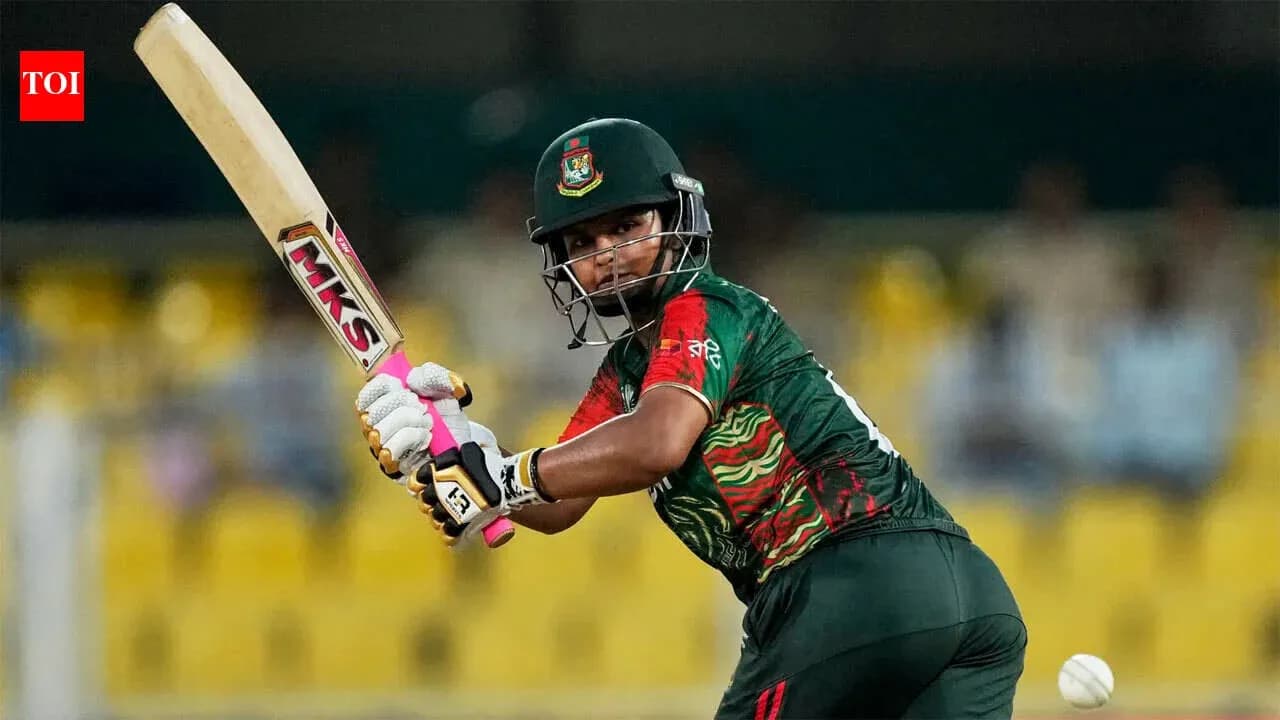
Sobhana Mostary: Bangladesh's Cricket Journey Since 2018
Sobhana Mostary still remembers the noise.
Not the roar in Kuala Lumpur when Jahanara Alam scampered back for the second run off the last ball in 2018, sealing Bangladesh’s first Women’s Asia Cup title and stunning India. Not just that, anyway. It’s the noise that followed her home.
The phone calls. The celebrations. The sudden realisation that women’s cricket in Bangladesh would never again be treated as a sideshow.
“After 2018, we beat India and won the Asia Cup, so it was a huge change in Bangladesh women's cricket. Everything changed. They started giving us lots of facilities, money, everything. There was a lot of change,” Sobhana told TimesofIndia.com ahead of the 2026 edition.
For her, that night in Kuala Lumpur is not just a memory. It is a reference point.
Chasing another India moment
The 2026 Women’s Asia Cup has already begun, and Bangladesh walk into it with a familiar mix of hope and hunger. The draw keeps them apart from India in the group stage this time. Bangladesh sit in Group B with Sri Lanka, Indonesia and the UAE. India are in Group A alongside Pakistan, Thailand and Hong Kong.
If the rivalry is to be renewed, it will be in the knockouts.
Inside the Bangladesh dressing room, that possibility hangs in the air. Sobhana knows exactly what it would mean.
“We think this Asia Cup, we fight for the title, because if we beat India, so maybe we own the Asia Cup,” she said.
It’s a simple equation in her mind. Beat India, and everything else takes care of itself. That was the script in 2018, when Bangladesh toppled India twice in the same tournament: first by seven wickets in the group stage, then in that gripping final where they chased 112/9 off the very last ball.
The impact back home was immediate and tangible. The Bangladesh Cricket Board announced a 2 crore Bangladeshi Taka reward for the squad. Facilities improved. Contracts strengthened. Respect followed.
For Sobhana, that’s the real legacy of 2018. A final that went down to the last ball rewrote the future.
From village academy to the national crest
Sobhana’s own story began far from the spotlight that now follows her.
As a child she played everything she could get her hands on – football, badminton, cricket – until her father took a decision that changed her life. At 10, he walked her into a cricket academy in their village. Six months later, she went for trials at Bangladesh Krira Shiksha Pratisthan (BKSP).
She got in. And everything shifted.
She moved to Dhaka without her parents, a teenager chasing a dream that had no guarantees. The call-up to the national side came early; she debuted for Bangladesh at just 16.
The fairytale stopped there for a while.
Sobhana spent the next three to three-and-a-half years travelling with the national team, often without seeing her name on the team sheet. Same hotels, same nets, same meetings – but no regular place in the XI.
“It was very difficult. I always travelled with the team, but couldn't play. I just waited and thought that someday the opportunity would come and I could show my strength,” she said.
The grind was invisible to most. For her, it was everything.
‘Day by day, I improve’
The opportunities did arrive, slowly at first. Enough for the ICC, in 2023, to tag her as a bright future prospect. Labels like that can weigh heavy. Sobhana treats it as a challenge.
“I don't think I have fulfilled my dream and that bright future yet, but day by day, I improve,” she said.
Those words sum up her career as neatly as any statistic. No shortcuts. No overnight transformation. Just accumulation – of runs, of experience, of belief.
The 16-year-old who once left home for cricket now talks like a player who understands the long game. “I struggled for three or four years, but now I have improved,” she said, matter-of-factly.
Harmanpreet on the wall, India in the mind
The twist in Sobhana’s journey is that one of her greatest inspirations wears the colours of a rival.
Her childhood idol is Harmanpreet Kaur.
She still remembers watching Harmanpreet’s extraordinary 171* against Australia at the 2017 Women’s World Cup. The ball-striking. The control. The way Harmanpreet dragged India through a knockout game almost by herself.
“That match inspired me a lot, I followed her batting, everything how she controls the match, and now the time how she captains. I just followed everything,” Sobhana admitted.
It makes the Bangladesh–India contest more layered for her. The rivalry is fierce, the stakes high, but the emotion is not fear.
“For Bangladeshi fans, playing India is a very good match. They are crazy fans and lots of supporters come to watch. It is a normal match, but normally playing India is very interesting and always very exciting for us,” she said.
On the field, her admiration extends to India’s attack. Asked which Indian bowler she would most like to face, she didn’t hesitate: Deepti Sharma.
“Deepti Sharma is always the top bowler in the Indian side, she has played consistently for so many years and improved day by day. I love her bowling,” Sobhana said.
A batter who grew up copying Harmanpreet, now wanting to test herself against Deepti. For a generation that once only watched India from afar, that is progress in itself.
Learning from the best
Harmanpreet may be the childhood poster on the wall, but there is another modern great Sobhana would love to share a net with: South Africa captain Laura Wolvaardt.
“I want to practise with Laura Wolvaardt, I really like her batting, and she's also a good human being,” she said.
It’s a small window into how she thinks. She studies technique, temperament, and character. She doesn’t just want to face the best; she wants to learn from them.
Cricket over medicine
There is an alternate universe where Sobhana never walks into that village academy, never sits the BKSP trial, never picks up a Bangladesh cap.
In that world, she might be wearing a white coat.
“Maybe a doctor, because my mother wanted me to be a doctor,” she said when asked what she might have done without cricket.
Her life went another way. She chose the uncertainty of sport over the stability of medicine. Or perhaps cricket chose her the day her father took her to that academy.
Now, years into an international career, she stands on the brink of another Asia Cup, still driven by the echoes of 2018 and the possibilities of 2026.
India are again somewhere in Bangladesh’s path. The groups keep them apart for now, but the tournament has a habit of setting up big collisions at the sharp end.
If they meet again with a title on the line, one question will follow Sobhana Mostary and her teammates into the middle: can Bangladesh conjure another last-ball moment that changes everything all over again?