Serena Williams Challenges Women's Health Norms After Childbirth Trauma
Serena Williams has spent a career refusing to accept limits. On court, that meant comebacks, Grand Slams, and a legacy that rewrote tennis history. Off court, it meant surviving childbirth.
Now, at 44, she is turning that survival into a direct challenge to how the world treats women’s health.
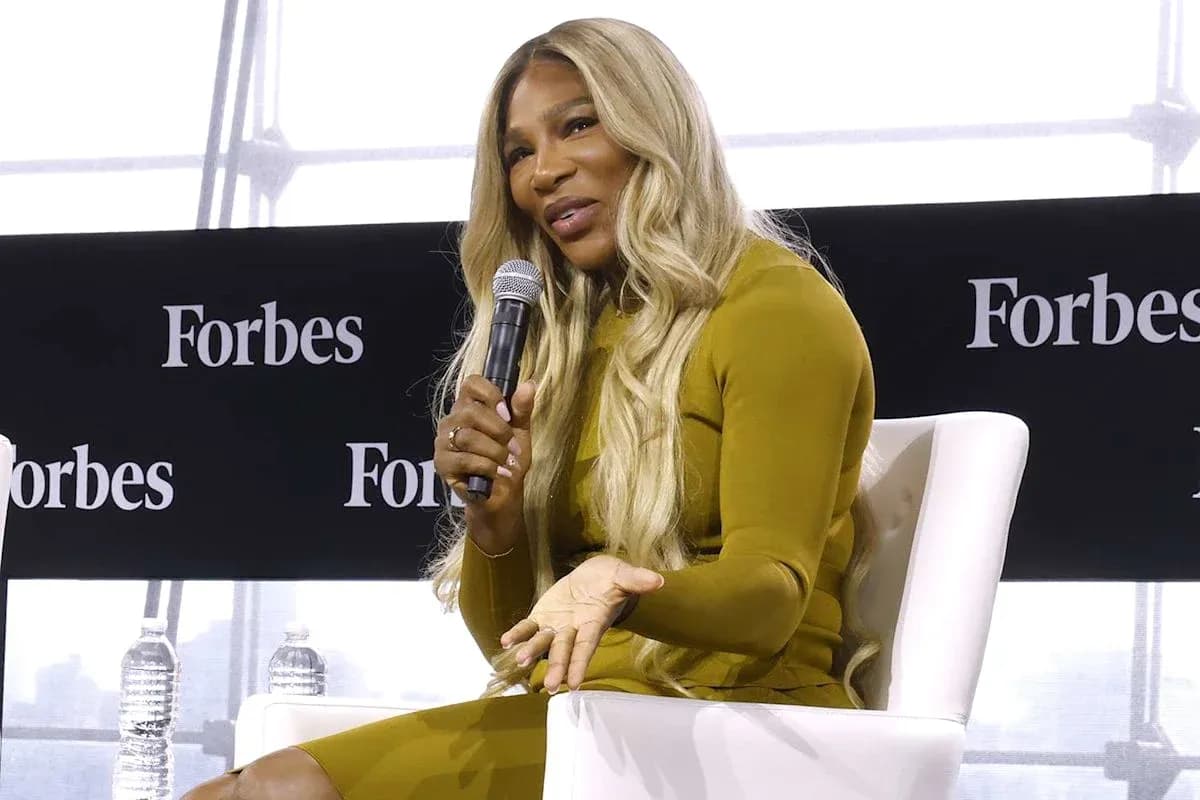
Speaking at the Forbes Power Women's Summit 2026 on Thursday, Sept. 10, Williams revisited the trauma that followed the birth of her first daughter and the uncomfortable truth it revealed.
"When I told my story, I didn't realize how many people could relate," she said on stage. At first, she thought it reflected a problem facing minority women. Then the responses poured in. Stories from every corner, every background. Stories that sounded like hers.
"And then at first I thought it was just a minority problem, but then I realized it's a women's problem," she said.
A Champion Fighting for Her Own Life
Williams’ crisis began in 2017, when she delivered her daughter, Alexis Olympia, via emergency C-section. The birth alone would have been dramatic enough. What followed was far worse.
After delivery, a coughing fit caused her surgical wound to reopen. Doctors then discovered a large hematoma in her abdomen — a swelling of clotted blood — that demanded urgent attention. The complications did not stop there.
She entered a six-day fight against a pulmonary embolism, a condition in which one or more arteries in the lungs become blocked by a blood clot. It led to multiple surgeries and a stark realization: even one of the most famous athletes on the planet had to insist on being heard.
"I knew something was wrong with me and it was super important that I was heard," Williams told the audience. "Thankfully, my doctor listened to me. The nurses did, but I was so fortunate enough to have a doctor that did and literally saved my life."
Her survival hinged on persistence and access. She knows many women never get that chance.
From Personal Crisis to Public Mission
The experience did not fade into a private memory. It hardened into purpose.
Williams began using her platform to highlight the dangers women face in childbirth and postpartum care, especially when they are not believed, not listened to, or not given basic resources. Her story, first shared in depth in a 2018 opinion piece for CNN, became a rallying point.
In that piece, she spelled out how preventable many maternal deaths and complications can be. She pointed to simple, proven solutions: access to midwives, functional health facilities, breastfeeding support, skin-to-skin contact, clean water, basic drugs, and good nutrition.
"We know simple solutions exist," she wrote then. "Yet we are not doing our part. We are not rising to the challenge to help the women of the world."
The gap between what is possible and what is provided still drives her.
On Thursday, she talked about how shocked she was by the volume and breadth of women’s stories — “nightmare's tale” after “nightmare's tale” of birth — that reached her once she spoke publicly. The pattern was impossible to ignore.
She also cut the tension with a sharp, pointed joke. If men were the ones giving birth?
"Well, gosh, if men were giving birth, they would have sweets [and] like all kinds of medicines," she said with a laugh. "So it wouldn't be the same problem at all."
The room laughed. The message did not.
Building Pathways, Not Just Headlines
Williams has not limited herself to speeches and essays. She stepped into a formal role in the fight to change systems.
After giving birth, she became the first entrepreneur-in-residence for the Reckitt Catalyst program, a global social impact and innovation initiative that backs female and underrepresented entrepreneurs focused on health, hygiene, water, and sanitation solutions.
For Williams, this is not abstract policy talk. It is about the women who hold families together.
"What these women are doing is they're really letting us know that women's healthcare is so important, and healthcare in general, because also we're talking about women who take care of the kids, you know, I take care of my kids mostly," she explained.
She spoke about the program as a way to connect ideas, money, and communities — not just to launch companies, but to break down barriers that keep basic care out of reach.
"With the program, we're able to actually solve a lot of issues, make, like I said, make those connections that are really vital, that are really important to open so many doors," she said. "Because every time we open a door, we're solving another problem that's closer to helping us all in this room and helping our kids."
This is the same competitive instinct that once chased down impossible points. Only now, the court is global, and the stakes are measured in lives, not trophies.
Still a Mother, Still a Force
Williams’ advocacy has grown alongside her family.
In August 2023, she and her husband, Alexis Ohanian, welcomed their second daughter, Adira River Ohanian. Ohanian announced the news with a family photo and a message that captured both relief and awe.
"Welcome, Adira River Ohanian," he wrote, noting that their home was "teaming [sic] with love: a happy & healthy newborn girl and happy & healthy mama." He called Serena the "GMOAT" — the Greatest Mother of All Time — a twist on the sporting acronym she long ago made her own.
The contrast is striking: a woman whose body has carried her through 23 Grand Slam singles titles still had to fight to survive childbirth. She has chosen to keep retelling that story, not to relive the fear, but to force change.
"Together, we can make this change," she wrote in 2018. "Together, we can be the change."
Years later, on a stage filled with powerful women, she showed she has no intention of stepping away from that fight. The question now is not whether Serena Williams will keep pushing.
It is whether the rest of the world will finally catch up.