Serena and Venus Williams: A Historic Night at Arthur Ashe Stadium
On a humid New York night, a women’s doubles first-round match carried the prime-time billing on Arthur Ashe Stadium. That almost never happens.
But Serena and Venus Williams are not “women’s doubles”. They are an era.
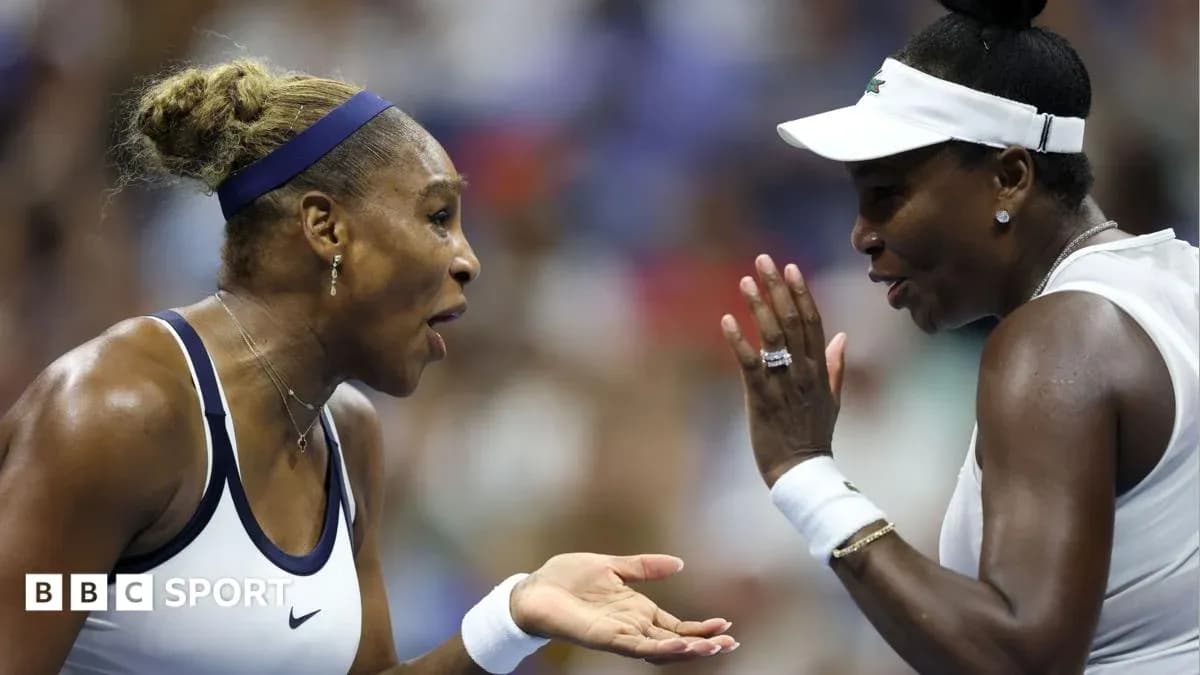
A combined age of 90 walked into the world’s biggest tennis arena, and the place reacted as if it had just seen them for the first time. Four years since they last shared this court, the sisters emerged again to a rapturous roar, returning to the scene of eight singles titles between them and two more together as a team.
They did not win. They still owned the night.
A Scoreline That Barely Tells the Story
The numbers say Hao-Ching Chan and 20-year-old Maya Joint, the 14th seeds, beat the Williams sisters 6-3 6-7 (6-8) 7-6 (10-7). The numbers are technically accurate. They are also wildly inadequate.
For a set, the script looked familiar and slightly cruel. The crowd came to celebrate, but the tennis took time to catch up. The decibel level on Ashe outstripped the quality from the home favourites in an underwhelming opener, the Williamses surrendering the first set with little of the menace that once terrified locker rooms.
Chanda Rubin, who knows exactly what it feels like to face the sisters in a US Open doubles final, watched from the commentary booth and summed it up bluntly.
“It was unbelievable how competitive that was,” she said. “After the first set you wondered if Serena and Venus would be able to find their mojo – but, boy, they did.”
They did. And the stadium followed.
The Old Fire Returns
Once Serena’s level rose to meet Venus’s, the match changed shape. The groundstrokes tightened, the returns bit, the movement sharpened in bursts that seemed to roll back time. The second set turned into the kind of absorbing, high-quality doubles that once made them the most feared team in the sport.
Chan and Joint pressed, created chances, stood firm under pressure in a partisan cauldron. The Williamses batted away four break points in the fifth and seventh games of the second set, refusing to let the match drift away. The rallies grew longer, the gasps louder, the crowd fully locked in.
They forced a tie-break, then forced it further still, edging it 8-6 and dragging the match into a decider that felt less like a first round and more like a farewell tour headliner.
For once, the usually chatty Ashe crowd fell silent during points. The sight of Serena and Venus back on court together in New York – perhaps for the final time – commanded an almost reverential hush, followed by waves of noise that crashed over the court whenever they landed a big return or found an angle only they would dare.
One Last Rally
The third set looked gone at 4-1 to Chan and Joint. The energy dipped, the scoreline threatened to flatten the occasion. Then the thing that has defined the Williams sisters’ careers reappeared: resistance.
They clawed their way back, point by point, game by game, leaning on the same indomitable spirit that has carried them through three decades of pressure and expectation. They dragged the match into a first-to-10 match tie-break and, suddenly, the years fell away.
They raced to a 5-0 lead. Arthur Ashe shook. The second round loomed.
But this time, the comeback belonged to the other side of the net.
Chan and Joint, who had every excuse to fold under the weight of history and noise, refused to blink. They chipped away, then surged, helped by a double fault from each sister at critical moments. The tie-break turned. The veteran champions, so close to another storybook win, faltered.
The final score: 10-7 to Chan and Joint in the breaker. A narrow defeat, and a performance that still felt like a statement.
“The atmosphere was surreal,” Joint said. “It was something we’ve never experienced before, and to play against such legends of the game was super special.”
She and Chan deserved every bit of credit. Their focus in that kind of environment was elite.
Legends Who Still Hold the Stage
The Williams sisters changed tennis when they arrived as teenagers in the 1990s, smashing down doors and rewriting what dominance looked like. Thirty Grand Slam singles titles between them. Fourteen doubles majors as a pair. Power, swagger, presence – and a blueprint that countless players now follow.
Three decades later, the sport still stops when they walk on court.
Serena’s return from retirement this summer reignited a fanbase that spans generations: those who lived every major with her, and those who only know the highlight reels. Venus never left. She did not “evolve away” from tennis, as Serena once put it about herself. She kept going, sustained by wildcards and willpower, a seven-time major champion refusing to let the sport move on without her.
Some questioned those invitations. Not here. Not in this stadium, not on this night. Flushing Meadows welcomed them back without hesitation.
Their planned reunion at Wimbledon disappeared when Serena injured her knee in a singles loss – ironically to Joint – but they finally found each other again in Cincinnati. That comeback ended in a match tie-break defeat to Marta Kostyuk and Peyton Stearns. New York delivered the same cruel format, the same cruel ending.
Four years ago, their last appearance together on Ashe brought a straight-sets loss to Lucie Hradecka and Linda Noskova in the first round. This felt different. This was not a quiet exit. This was proof that, even in their mid-40s, they can still trouble seeded teams with solid groundstrokes, sharp instincts at the net and a refusal to concede anything cheaply.
What Comes Next?
When it was over, the initial silence from the stands gave way to something else: gratitude. The crowd rose, the volume surged again, and the farewell – if that is what this was – carried more warmth than sorrow.
Serena had hinted earlier in the week, in an interview with Good Morning America, that she wanted to play singles again. Venus, after her singles defeat on Monday, said she should not “have to” think about her future beyond the doubles.
On this night, they chose not to answer the questions. Tournament organisers said the sisters were “not available” for media after the match. No declarations. No retirement speeches. Just a wave, a walk off court, and another layer added to a legacy that no scoreline can quite capture.
They left Arthur Ashe Stadium the way they have occupied it for so long: on their own terms, with 20,000 people on their feet, and the sport still wondering how much longer it can hold on to them.