Aryna Sabalenka Dominates Jessica Pegula to Reach U.S. Open Final
NEW YORK — On a night when the air hung heavy over Arthur Ashe Stadium, Aryna Sabalenka cut straight through it.
She bullied her way past Jessica Pegula 7-5, 6-2 to reach yet another U.S. Open final, one win from a third straight title in New York and a place in a very small corner of tennis history. Waiting for her: Elena Rybakina, the woman who will take her No. 1 ranking on Monday.
The crown is changing hands. The kingdom, Sabalenka is determined to keep.
Sabalenka, rebuilt in New York
Four months ago, this version of Sabalenka felt distant. She tore through the first quarter of the season, then unraveled. Losses piled up not just because opponents raised their level, but because she dragged herself down in big moments — overhitting, overpressing, spiraling.
That player has not walked through the gates of Flushing Meadows.
Since arriving for her last shot at a Grand Slam this year, Sabalenka has looked more like a force of nature than a fragile No. 1. The context is eerily familiar: last year she also came to New York needing to salvage her major season. Then, the story was about losing finals. Now it’s about whether she can keep owning them.
“I feel confident and I feel mentally and physically really strong right now,” she said afterward, and it sounded less like a slogan than a statement of fact.
Six wins in a week will do that. So will a city that seems wired to her frequency. She named her cavalier King Charles spaniel Ash after this stadium. She calls this her favorite court in the world. Under the lights, she played like it.
“I just love New York and I love being here, and I love the energy of the city,” she said. “I think that’s what drives me. That’s what really inspires me and pushes me to keep going.”
The ranking? She knows it’s gone on Monday, no matter what happens in the final. She has made peace with that. The trophy is what matters.
Pegula gets no air
Arthur Ashe was packed, 24,000 strong and eager to roar for the hometown hope. Sabalenka barely allowed them oxygen.
Pegula, the world No. 3 and one of the steadiest performers on tour this summer, created just a single break point in the opening set. Sabalenka erased it with the kind of one-two punch that defines her best tennis: a heavy serve followed by a forehand that sounded like it might dent the back wall.
Pegula tried to blunt the storm. She went to her trademark plan: flat power down the middle, robbing Sabalenka of angles, forcing the defending champion to overhit from neutral positions. It had worked brutally well in Berlin, where Pegula had handed Sabalenka a 6-0 set on grass.
But grass is one world. Ashe hard court is another.
On grass, Pegula’s low, skidding drives stay down around Sabalenka’s knees, a nightmare for a six-footer with a big, topspin forehand. In New York, the ball sits up and shoots through. Sabalenka thrives there.
“Fast courts, but also bouncy a little bit,” she said. “That really gives me more possibilities of, like, pushing her back.”
She pushed Pegula back from the first ball.
The opening set became a test of nerve and precision. Eleven straight holds. Hard, crisp rallies. A few groans from Sabalenka when she clipped the net. A murmur when Pegula ripped the occasional winner. But Pegula could never quite get her teeth into the match.
At 5-6, serving to force a tiebreak, the pressure finally bit. Sabalenka’s pace dragged two errors out of Pegula. The American double-faulted under the weight of the moment. On Sabalenka’s second set point, she went right at Pegula, hammering down the middle. Pegula’s reply died in the net.
Sabalenka turned to her box. Halfway to the final.
No escape routes
From there, the gap only widened.
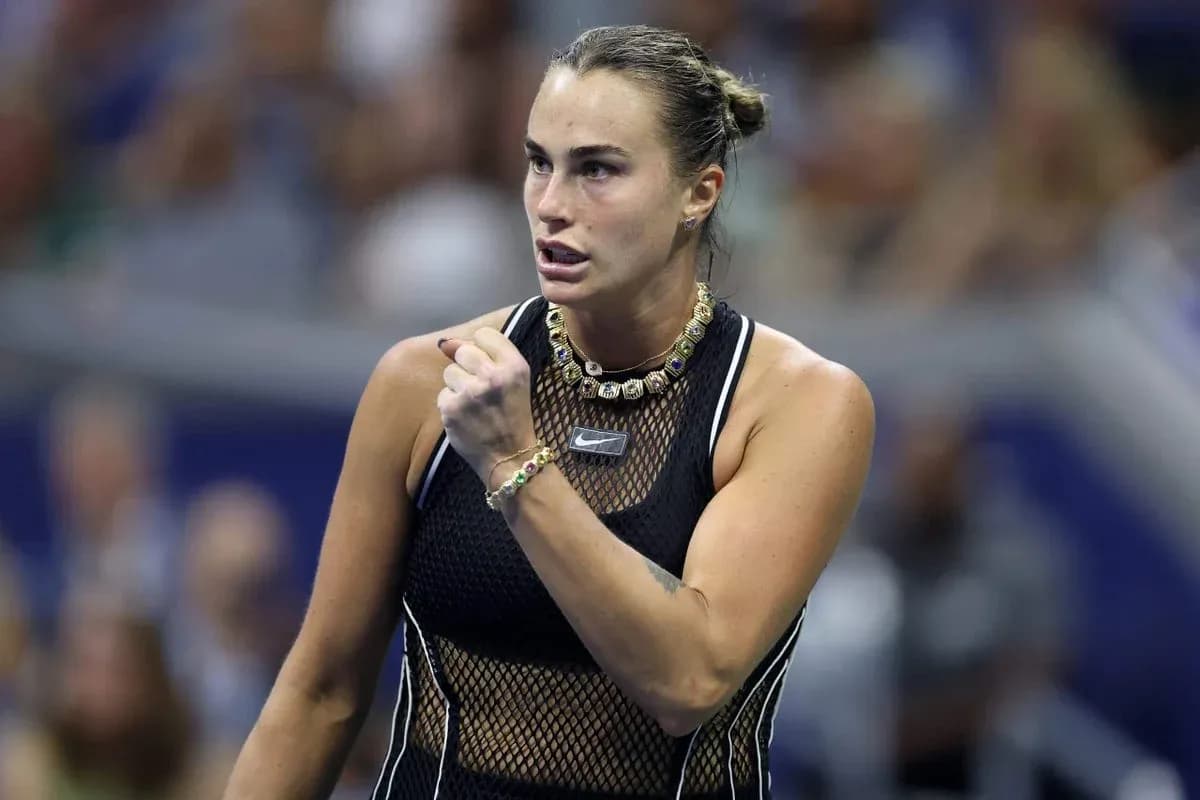
The second set was cleaner, sharper, more ruthless. Sabalenka didn’t need theatrics. A calm pump of the fist after big points, a quiet walk back to the baseline, and another barrage of heavy shots. Pegula kept swinging, but the court seemed to shrink around her.
She later admitted it felt like there was nowhere to go.
Sabalenka’s serving numbers weren’t spectacular on paper — 55 percent of first serves in — but the damage came on the second ball. Those “nasty, twisting” second serves dug into the court, kicked up into Pegula’s strike zone, and still won Sabalenka two-thirds of the points behind them. That’s usually where a returner gets a foothold. Pegula never found one.
For a player who has gone 22-5 since a first-round exit at Roland Garros, and who had recently handled Sabalenka on grass, the experience was jarring enough that she joked with Sabalenka’s team afterward.
“We’re like, ‘Do you like us?’ Like, we’re good people, we’re pretty nice to you guys. Do you think that maybe one day she could be maybe off a little bit, so I could just, like, get a chance?”
There was a more sober assessment, too. Pegula knows her own game. She knows she can’t suddenly morph into Rybakina, blasting aces to escape danger, or Coco Gauff, sprinting her way out of trouble with outrageous defense.
“I’m not quite a Rybakina where I can serve myself out of trouble, and I’m not quite a Coco that can rely on insane athleticism,” she said, measuring herself against Sabalenka’s possible final opponents at the time.
Then came the line that told the story of the night: “I do think the way she played tonight, I think she would have beaten anybody.”
One more night, one massive hurdle
This is Sabalenka’s court, and not just in a sentimental sense. She has owned the hard-court majors.
Four straight U.S. Open finals. Two titles already. Four straight Australian Open finals as well, with two trophies there. On hard courts, at the biggest events, she keeps putting herself on the last Sunday.
The third crown has stayed just out of reach in Melbourne, where she has lost back-to-back finals. New York, she believes, can rewrite that pattern.
She will have to take it from Rybakina, the new No. 1, a server powerful enough to blast through any resistance and a player steady enough to punish any lapse.
Sabalenka walked off Ashe with a quiet, satisfied fist pump, not a wild celebration. She knows what’s left. One more night in the city she loves, on the court named for her dog, with a chance to defend the hardest Slam of all.
The ranking is gone. The era might not be.