Rashid Khan on Afghanistan's Journey in Cricket and the Powerplay
Rashid Khan has lived every beat of the India–Afghanistan story. He has seen it move from hopeful resistance to something far more serious: expectation. Afghanistan no longer turns up simply to “compete”. They arrive believing they can win. And yet, as he sits down before the third and final ODI against India, Rashid is clear – belief alone won’t close the gap.
The work, he says, starts where games are often decided now: the powerplay.
Powerplay truth serum
For Rashid, the series against India has been a harsh but valuable classroom.
“The learning is about how we are going to use the powerplay as a batting unit,” he says. Afghanistan’s young top order has watched India pile on runs in those first six overs, then had to confront the question: can we do that, under any condition, against any bowler?
Delhi’s flat tracks have only sharpened the lesson. High-scoring games are the norm there. To survive, you need a mindset that doesn’t flinch at the idea of 350 or 400. “To have that mentality of scoring big is so important,” Rashid stresses. Afghanistan, he admits, still has “a lot of hard work” to do in its batting department to consistently reach those numbers.
The ball tells a similar story.
If Afghanistan’s bowlers are leaking 70 or 80 in the powerplay, Rashid argues, the target almost stops mattering. Defending 200 or 230 becomes academic. “As a team, collectively we have to find the solution for this,” he says. How to attack. How to defend. How to survive that early storm. Those are the questions this India tour has thrown at them.
A “dangerous” India, led by youth
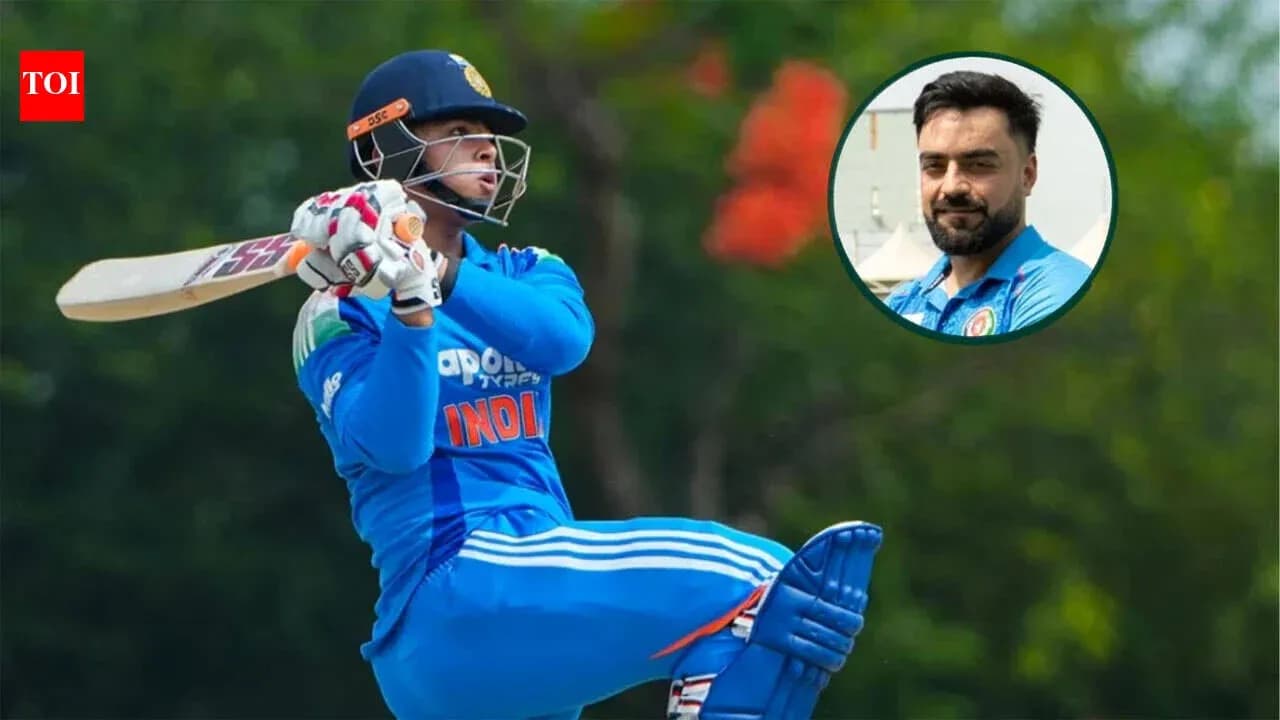
Rashid has faced multiple iterations of India’s T20 side. This Shreyas Iyer-led version, stacked with young hitters, strikes him as something different.
“It is a very dangerous side, a destructive side,” he says. The threat doesn’t come from one star at the top. It comes in waves. “One after the other, someone is coming who is going to be super destructive,” and the numbers back that up – many of them already have T20 hundreds.
What unsettles opponents is not just the volume of runs, but how they get them. Indian batters are taking games deep and finishing with big scores, not just chipping in with 20s and 30s. They play with a freedom Rashid admires. In his eyes, that is how T20 should be played: fearless, but built on immense skill.
That, he says, is what separates this India from most others.
Abhishek Sharma: India’s next “big package”
Among the new faces, one name brings a smile: Abhishek Sharma.
Rashid knows him well from their days together at Sunrisers Hyderabad. The admiration is not casual. He has seen the left-hander’s work up close, in nets and in pressure games. “He always had that kind of ability and skill,” Rashid says.
Right now, the world sees Abhishek as a destructive top-order batter. Rashid sees more. He calls him “a very good bowler as well,” someone who can quietly slip in overs in the middle and change a game with the ball too. In his eyes, Abhishek is not just a promising youngster; he is “a very big package for Team India in the future.”
Vaibhav Sooryavanshi: god-gifted, 15 and fearless
Then there is the phenomenon everyone is talking about: Vaibhav Sooryavanshi.
Rashid has already bowled to him. He has watched him take guard for India at just 15. Talent at that age is not unusual. What strikes Rashid is the completeness of his game.
He keeps coming back to one word: fearless. Sooryavanshi doesn’t slog blindly; he backs his skills and understands his options. “His shot selection is more important,” Rashid points out. The teenager seems to know his game plan against any side, any bowler, any situation. That kind of clarity, that early, is rare.
Then there are the raw tools: power, hand–eye coordination, timing. “He is a god-gifted talent,” Rashid says, and he doesn’t throw that phrase around lightly.
Asked whether Sooryavanshi reminds him of a young Rashid Khan, he laughs at the comparison. He insists he wasn’t that talented at 15, certainly not capable of the kind of six-hitting the youngster is already producing. But he doesn’t step back from the assessment: this is “a unique talent” who has already shown it in the IPL and now for India.
At 15, Sooryavanshi is not just surviving international cricket. He is shaping it.
From underdogs to contenders
If Sooryavanshi represents India’s future, Afghanistan’s present is a story of acceleration.
Rashid traces the turning point back to a string of landmark wins. The bilateral T20 series victory over Pakistan. The 2023 World Cup in India, where Afghanistan beat England. Then Sri Lanka. Then Pakistan again on the biggest stage. The run to the semi-finals of the 2024 T20 World Cup in Australia and New Zealand.
Those results did more than fill highlight reels. They shifted belief.
“That belief started that we are in that category where we can beat big teams,” Rashid says. Afghanistan now sees itself in that bracket. The question has changed from “Can we?” to “How often?”
The danger, he knows, lies in thinking the job is done. “It’s about us now, how we are going to manage and how we keep this continuing,” he adds. Sustaining success is a different kind of challenge.
Ibrahim Zadran’s time
Into that new reality steps Ibrahim Zadran, the T20I captain.
Rashid likes what he sees. Hard work is the first thing he mentions. Ibrahim, he says, “always wants to lead from the front.” Consistency, honesty, straightforward communication – Rashid lists them not as clichés but as requirements for a young leader in a dressing room full of rising stars.
He sees Ibrahim trying to set standards for the next generation, showing them “this is the way to go.” Rashid, now the senior statesman, offers his support and experience, but he is clear: Ibrahim has the ability to lead and to help others grow with him.
From someone who has captained Afghanistan through high-pressure tournaments, that endorsement carries weight.
Lessons in leadership and the body
Captaincy, Rashid admits, taught him some hard truths.
He remembers phases where he put too much pressure on himself, trying to carry everything. It didn’t work. “As a captain, you try to put everything on yourself,” he says, and that can crush your own game. His advice to Ibrahim is simple: stay calm, trust your skills, stick to the process. Don’t obsess over the result; control the preparation and the plan.
His body has delivered its own lessons.
For years, Rashid was the globe-trotter of franchise cricket, hopping from one league to another. It gave him invaluable knowledge of conditions and batters around the world, but the bill eventually arrived. Surgery changed everything. Recovery was a struggle.
He has since cut down his workload, choosing his cricket more carefully. A recent stint at the Red Bull Athletic Performance Centre in Austria provided a turning point. Extensive testing gave him, in his words, “a very clear image” of his body – what to strengthen, what to protect, where to push, where to pull back. With physios and doctors, he mapped out what to avoid, where to play, and how much cricket his body can realistically absorb.
The teenage prodigy who once said yes to every game has become the seasoned pro who knows when to say no.
The next Afghan wave
Rashid’s own rise opened the doors. Now he looks around and sees a new wave building behind him.
Noor Ahmad, the left-arm wrist-spinner, has already made his mark. Rashid believes Noor “can get to the next level” and produce “great performances in the future.” For a country that has built its identity on spin, that matters.
Fast bowling, he admits, remains an area for improvement. But even there, a name excites him: Abdollah Ahmadzai. The young quick is in the squad now, and Rashid likes his pace. If Afghanistan manages him properly, he says, Ahmadzai can become “a very quick bowler and a good future for Afghanistan cricket.”
It is a glimpse of an Afghanistan side that could soon hurt teams with both spin and speed.
One unfinished line in the story
Strip away the accolades, the leagues, the global recognition, and one ambition still burns brightest for Rashid Khan.
A World Cup.
He doesn’t hide from it. He calls it “one unfinished thing” in his career – to win a World Cup for Afghanistan. The 2024 T20 World Cup, where Afghanistan reached the semi-finals but fell short of the final, only sharpened that hunger.
He wants an ICC trophy in his book. T20 or 50-over, it doesn’t matter. What matters is that Afghanistan, the team that started as a feel-good story, stands one day with the game’s biggest prize in its hands.
For now, the work continues in the powerplays, in the nets with Ibrahim Zadran, in the quiet guidance to Noor Ahmad and Abdollah Ahmadzai, and in the respectful admiration of young talents like Abhishek Sharma and Vaibhav Sooryavanshi.
The rivalry with India has changed. So has Afghanistan. The question that lingers is not whether they belong at this level anymore.
It’s how long it will take before Rashid Khan gets to lift that World Cup in Afghan colours.