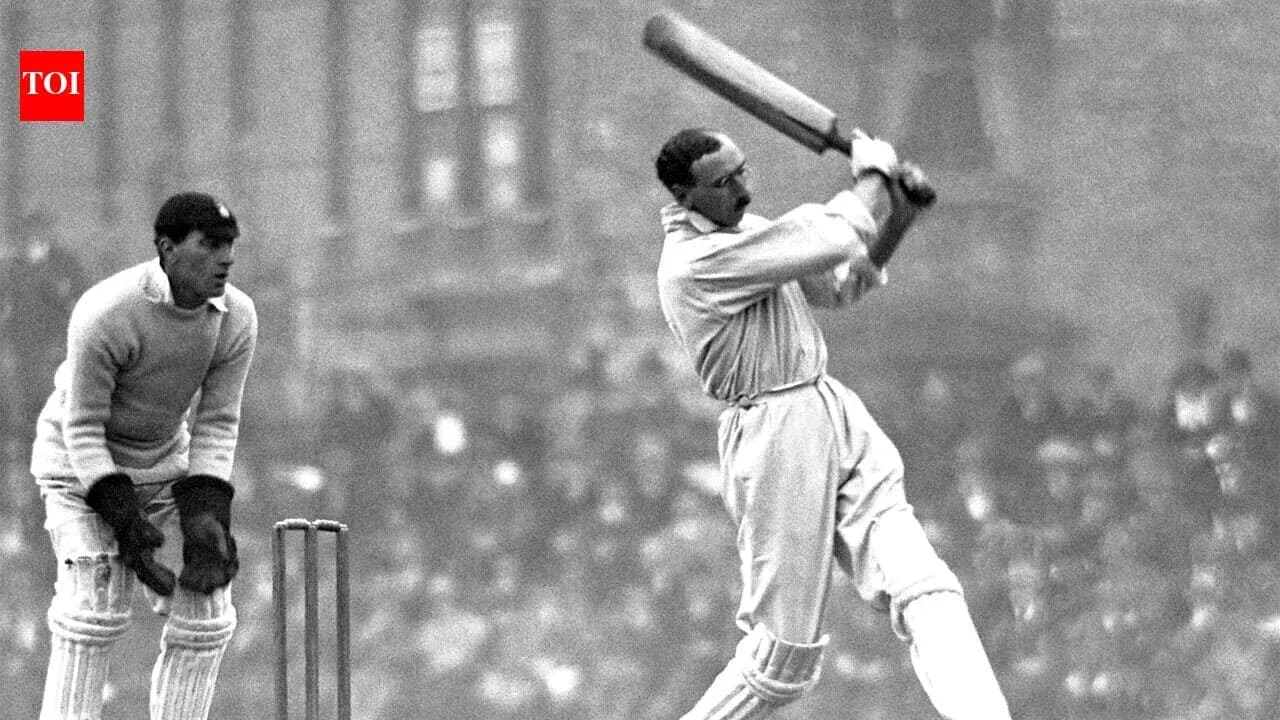
Percy Fender’s 35-Minute Century: The Fastest Hundred in Cricket
Percy Fender’s 35-minute fury: the fastest “real” hundred cricket has ever seen
The clock started ticking at Northampton on August 26, 1920, and it has never really stopped. More than a century on, Percy Fender’s hundred for Surrey against Northamptonshire still stands as the fastest authentic century in first-class cricket by time at the crease. Others have come flying past in fewer minutes on paper, some in even more outrageous bursts of hitting, but the record books — and the game’s conscience — keep circling back to that afternoon.
Because this was no contrivance. No charity bowling. No stitched‑up finish. Just a batter in a hurry and an attack that could not hold him.
A routine county match that exploded
The day began like so many others in the County Championship of that era. Northamptonshire put up 306 in their first innings, anchored by 128 from Fanny Walden. Fender played his part with the ball, chipping in with three wickets, but there was little hint of what was to come.
Surrey’s reply wobbled. At 160 for four, with Andy Sandham gone for 92, they were in trouble. The innings needed rebuilding, not fireworks.
Andy Ducat and Alan Peach had other ideas. They turned the game on its head, piling on 288 in just 135 minutes. Ducat’s 149 gave Surrey a platform. Once he fell, that platform became a launchpad.
Out walked Fender, four days after his 28th birthday. What followed was mayhem.
He went at Northamptonshire from the start: booming drives, savage cuts, pulls dragged in front of square, those slashes that made him such a dangerous lower-order presence. The bowlers searched for a way to drag the tempo back. They found nothing.
Fender’s fifty arrived in 19 minutes. Nineteen. In an era of uncovered pitches, long spells and orthodox fields, he was batting at a tempo that would startle even modern T20 audiences.
Gilbert Jessop had set the old mark: a 40-minute hundred for Gloucestershire against Yorkshire at Harrogate in 1897, long held up as the benchmark for sustained assault. Fender went past him by five full minutes. When he reached three figures, the stopwatch read 35.
Boundaries, and almost nothing else
He did not treat the hundred as a finish line. He treated it as a checkpoint.
Fender stayed unbeaten on 113, completed in 42 minutes. The numbers inside that score are almost as startling as the headline figure. Sixteen fours. Five sixes. Ninety-four of his 113 runs came in boundaries — more than 83 per cent of his total.
This was not a man nudging, rotating, picking off singles. It was a batter hitting, and hitting again.
At the other end, Peach was carving out a more traditional monument: a double-century that anchored Surrey’s surge. He finished 203 not out. When he reached that landmark, Surrey declared, the sixth-wicket stand frozen at 171 runs in only 42 minutes. It was a partnership played at a tempo that would not look out of place in franchise cricket.
Yet the record that survives from that day is not about strike-rate in the modern sense. The statistic that matters is time: the minutes Fender spent at the crease, not the number of balls he faced. That was how speed was measured then, and for this particular debate, it still is.
When 35 minutes didn’t really mean 35 minutes
For 63 years, Fender’s 35-minute dash stood alone. Then, on a damp, awkward 1983 day, Steve O’Shaughnessy of Lancashire apparently joined him.
On paper, O’Shaughnessy’s hundred against Leicestershire also took 35 minutes. In reality, it belonged to a different category of innings entirely.
Bad weather had mangled the match. Time was running out. Both sides needed to manufacture a result, or at least a contest that resembled one. After Leicestershire declared, O’Shaughnessy and Graeme Fowler walked out to face an attack that featured David Gower and James Whitaker with the ball in hand.
What came next was described as farcical. Gower and Whitaker served up full tosses and long hops, over after over. A short boundary turned mishits into sixes and decent contact into carnage. Fowler thrashed his way to 100, peppering the stands with 10 sixes. O’Shaughnessy matched the tempo and reached his own century in 35 minutes.
The scorebook recorded the runs. The stopwatch recorded the time. But the spirit of the record was missing. This was cricket played under manufactured conditions, with both sides complicit in turning the innings into a slogging exercise to force the game forward.
It equalled Fender’s time. It did not match his feat.
The “faster” hundreds that don’t quite belong
O’Shaughnessy was only the start. As declarations became more tactical and captains more inventive, the game produced even more extreme bursts of scoring.
Glen Chapple hammered a century in 21 minutes for Lancashire against Glamorgan in 1993. Mark Pettini rattled up one in 24 minutes for Essex against Leicestershire in 2006. Michael Goodwin and Tom Moody joined the list with hundreds timed at 25 and 26 minutes.
The pattern was familiar. Matches squeezed by weather. Captains desperate to open up a result on the final day. Part-time bowlers sent down a stream of hittable deliveries, fields pushed back or in, depending on what the game required. The runs counted. The records, in the purest sense, did not.
County cricket, especially in its three-day era, often demanded this kind of contrivance. Captains had to gamble. They had to create time where none existed, and that meant staging passages of play that bore little resemblance to a genuine contest between bat and ball.
Those innings live in the scorebooks. They do not sit comfortably alongside Fender’s 1920 masterpiece as “fastest authentic” hundreds.
Which is why, despite the eye-catching figures, his 35-minute century remains the benchmark.
What “fastest” really means
The debate over the fastest century now splits along a crucial fault line: how you define “fastest”.
Measure it by balls faced, and the landscape changes. In first-class cricket, David Hookes holds the record: 102 from just 34 balls for South Australia against Victoria in 1982. In Test cricket, Brendon McCullum’s 54-ball hundred against Australia in Christchurch in 2016 set the standard.
Those records belong to the modern language of batting: strike-rates, ball-by-ball aggression, the relentless push of limited-overs thinking into every format.
Measure it by time spent at the crease in a genuine contest, and the picture sharpens. No declarations engineered around charity overs. No part-time trundlers feeding a hitting drill. Just a batter facing a proper attack, with the match still shaped by orthodox intent.
On that scale, Percy Fender still stands alone.
More than 100 years after he tore into Northamptonshire, no legitimate first-class innings has beaten his 35-minute hundred. Others have been quicker on paper, louder on the scoreboard, more tailored to the modern eye. None have combined speed, context and authenticity in the way Fender did on that August afternoon.
Until someone does it again, against real bowling, under real pressure, the stopwatch that started in 1920 keeps pointing to the same name.