Pakistan's Cricket Collapse: A Lesson from Iceland
It takes a special kind of collapse to inspire hope in Icelandic cricket. Pakistan found it.
On a grey Edgbaston morning, England completed a 3-0 whitewash that will sit proudly in their Test history. For Pakistan, it will be remembered as the tour that spiralled so badly even a parody account from a non-Test nation could land the sharpest blow.
A rearguard that briefly rattled England
Pakistan should have been buried by then.
Razaullah Khan had already delayed the inevitable with a brisk, defiant 81, dragging his side away from the humiliation of an innings defeat and at least forcing England to bat again. The target was only 130. On this surface, in this mood, England were expected to stroll.
Then the first over happened.
Mohammad Abbas, with that familiar metronomic line, removed Ben Duckett with the very first ball of the chase. A few deliveries later, Emilio Gay followed. Two wickets, no runs, and suddenly a routine procession had the faint outline of a contest. England, ten wickets in hand and 130 away, were briefly under genuine pressure from a team that had spent most of the series on the canvas.
The noise lifted. Pakistan’s fielders snapped into life. For the first time in the match, England had to think.
That was as far as the miracle went.
Root and Cox shut the door
Joe Root and Jordan Cox did what Pakistan’s batters had failed to do all tour: they settled, absorbed, and then suffocated the opposition.
Root had moments of fortune. On 23, Mohammad Ali bowled him, only to see the dismissal scrubbed off for a no-ball – Ali’s 17th overstep of the series, a staggering number at this level. Later, on 38, Root edged Abbas between first and second slip. Neither fielder committed. Neither moved decisively. The chance – and with it Pakistan’s last real opening – died in the turf.
From there, England walked it.
Root eased to an unbeaten 62, his 110th Test score of fifty or more, a tally that already includes 41 centuries and speaks to the scale of his career. Cox, compact and composed, finished 59 not out. The chase ended in the 25th over, eight wickets still in the bank, the series sealed with a ruthless calm that has become England’s signature at home.
Root, reflecting afterwards, gave Pakistan their due without indulging in drama.
“Fair play to Pakistan, they threw some punches last night,” he said. “They made it very difficult for us and in some ways it's a good thing to go through that.”
England framed it as a useful examination. For Pakistan, it was one of the few passages of play that resembled a fight.
Iceland’s punchline that cut deep
If the cricket itself stung, the reaction from Iceland Cricket twisted the knife.
On X, they posted: “We believe we won't be hopeless at cricket forever, and Pakistan's fight in the Third Test gave us exactly that hope. We aim for world cricketing domination by the year 2082. If we can do it sooner than then, we will, because our Board will all be dead in 2082.”
It was a joke. It was also a verdict.
The barb landed because it reflected an uncomfortable reality: Pakistan’s standards have dipped so far that a spirited second-innings resistance in a heavy defeat could be held up as inspiration by a minnow with no realistic pathway to Test status any time soon.
When Iceland Cricket can use your performance as a motivational poster, something has gone badly wrong.
Chaos off the field, collapse on it
The numbers are brutal. This was Pakistan’s 16th defeat in their last 21 Tests. The whitewash in England came at the end of a tour that looked less like a campaign and more like a case study in dysfunction.
Seven players were removed from the squad after the second Test. Head coach Sarfaraz Ahmed and assistant Umar Gul were both sacked mid-tour. A disciplinary inquiry swept through the camp, phones were confiscated, and the captain, Babar Azam, discovered squad changes via a press release rather than a direct conversation.
That is not a rough patch. That is a system eating itself.
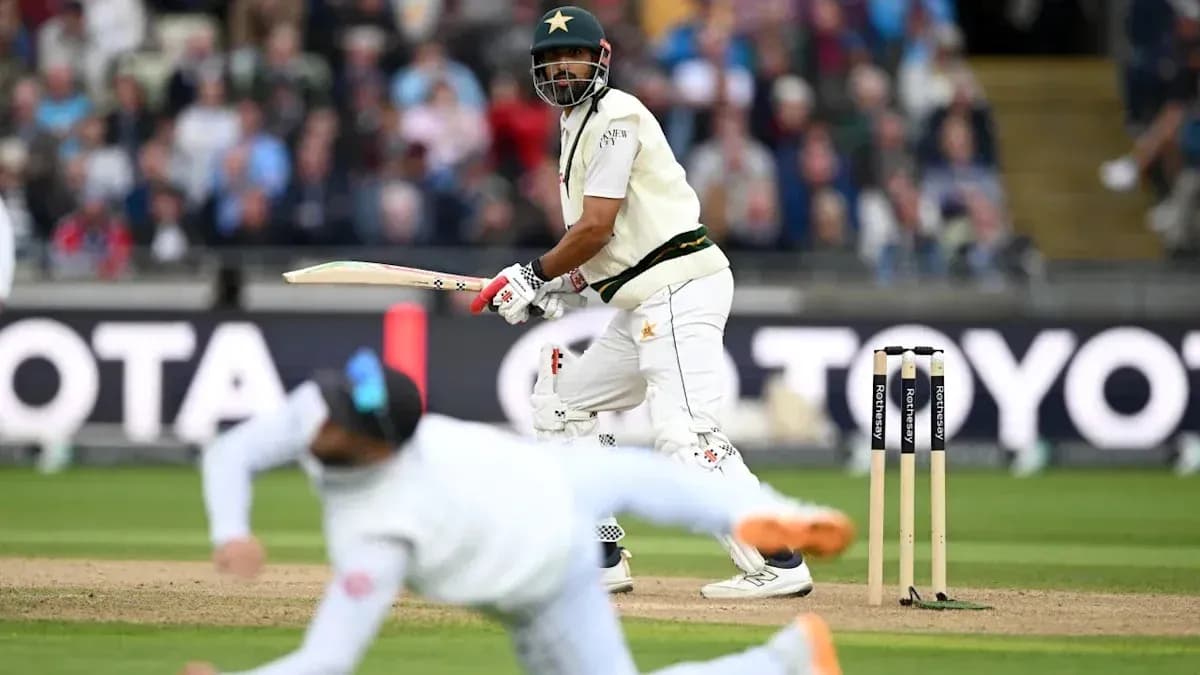
On the field, the rot started early. Pakistan were bowled out for 133 in the first innings at Edgbaston, on what Babar himself described as the best batting surface of the series. His assessment after the defeat was blunt enough.
“We had a couple of good moments. I think we have bowled well, but I think the first innings cost us. Too many soft dismissals,” he said.
He was right. The bowlers, led by Abbas, manufactured a sliver of hope on the final day. The batters had already thrown away the match.
A cautionary tale with no quick fix
Strip away the memes and the mockery and the Iceland joke reveals the core problem: Pakistan have slipped from being a volatile giant to something more troubling – a side whose flashes of resistance are now framed as exceptions rather than expectations.
The most memorable image of their summer is not a match-winning spell or a statement century. It is Razaullah Khan, a lower-order batter, swinging his way to 81 in a game Pakistan still lost by eight wickets, and being hailed for “restoring some pride” to a cricketing powerhouse.
That is not how a leading Test nation should be living.
This is bigger than one tour, one coach, or one captain. It is about planning that doesn’t exist, communication that breaks down at the worst possible moments, and a culture that allows panic selections, mid-series sackings, and public disciplinary sagas to overshadow the cricket itself.
England’s 3-0 scoreline is not just a result. It is a diagnosis.
Pakistan now face a stark choice: keep patching over cracks with cosmetic changes, or finally build the kind of long-term structure that stops an Icelandic punchline from sounding so uncomfortably close to the truth.