Pakistan's Historic Collapse Against India's Spinners in T20I
What should have been a statement day for Pakistan turned into a brutal reminder of how quickly T20 cricket can strip a side bare.
On the occasion of their 200th women’s T20I, Pakistan walked out in Dubai, chose to bat, and were bundled out for just 55 by an India attack that never loosened its grip. It was their lowest total in the format, worse even than the 56 they mustered against New Zealand at the same venue in 2024, and the fifth-lowest total India have ever conceded in women’s T20Is.
For a brief, flickering spell, it looked very different.
Bright start, brutal ending
Muneeba Ali and Shawaal Zulfiqar began with the kind of calm that suggested Pakistan had read the surface well. The ball came on, the gaps opened, and 27 without loss hinted at a platform. Muneeba survived a couple of early alarms but kept going; Shawaal matched her stroke for stroke. India, already assured of a semi-final place after wins over Thailand and Hong Kong, didn’t panic.
Then the game turned in a heartbeat.
Shafali Verma finally cut through the early resistance, cleaning up Muneeba for 13 off 15. One breakthrough. One crack in the wall. India drove a truck through it.
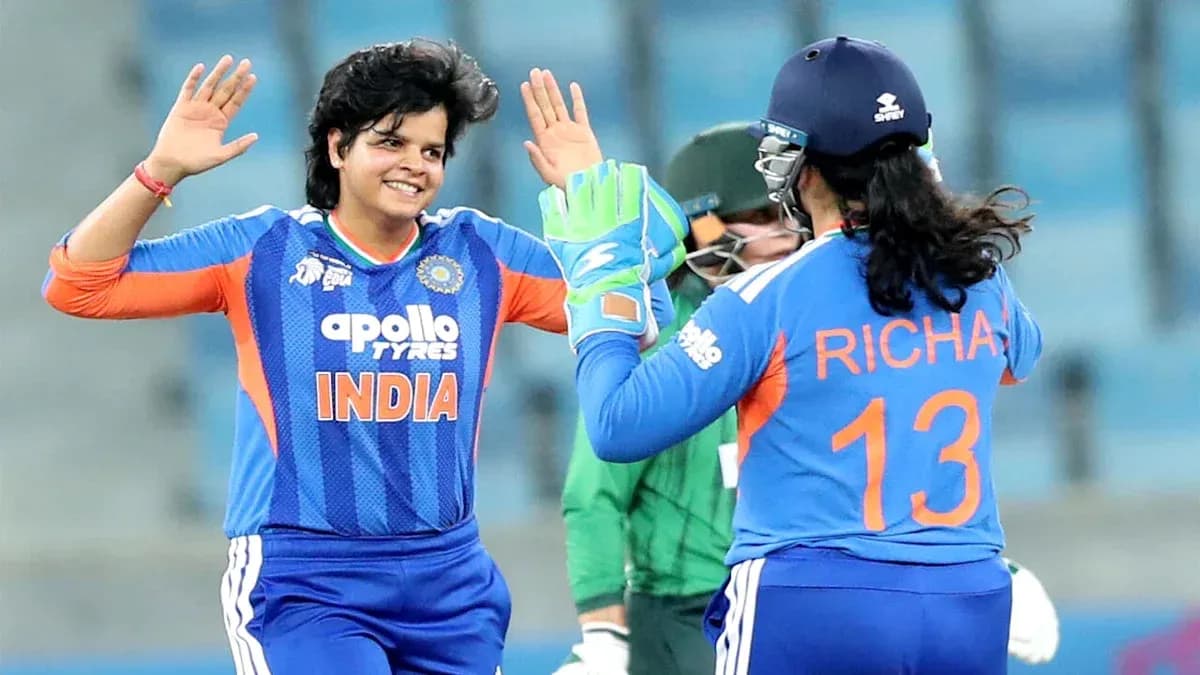
Sree Charani took the ball for the final over of the powerplay and ripped the contest away. Two wickets in that over, two more body blows to a line-up suddenly unsure of its footwork and its options. From 27/0, Pakistan lurched to 35/6, their innings collapsing in on itself as India’s spinners hunted in tandem.
The pressure told, and kept telling.
Charani and Rawat choke Pakistan
Charani’s spell summed up India’s approach: no frills, no gifts, no let-up. She finished with astonishing figures of 3 for 7, her lengths nagging, her pace through the air just enough to keep batters pinned on the crease.
Her own explanation at the break was as simple as her method. She spoke of bowling to her strengths, of coaches urging the spinners to give more revs on the ball, of working on consistency with the arm ball and accuracy with yorkers. There was nothing complicated about it. Pakistan simply had no answer.
On the other end, Prema Rawat matched that relentlessness. She picked up 3 for 9, slicing through a middle order that never settled long enough to build anything resembling a partnership. Deepti Sharma added 2 for 5, and Shafali’s early strike completed a bowling card that read like a collective strangling of an innings.
Only the two openers reached double figures: Muneeba’s 13 and Shawaal’s 14 from 14. After them, the scorecard turned stark. No rebuild. No counterpunch. Just a steady procession back to the dugout as India’s spinners repeatedly breached defences and Pakistan’s batters froze under the scoreboard squeeze.
The innings ended in the 19th over, 55 all out in 18.1 overs, the collapse as swift as it was ruthless.
A landmark Pakistan will want to forget
This was supposed to be a milestone worth celebrating. Two hundred T20Is is a significant journey in the women’s game, a testament to years of toil and growth. Instead, Pakistan walked off with an unwanted piece of history.
Their previous lowest all-out total, 56 against New Zealand in Dubai in 2024, is now second on a list they would rather not see extended. The roll call of past struggles – 60 against England in Taunton in 2009, 63 against India in Guangzhou in 2012, 65 against West Indies in St Andrew’s in 2011 – gained a new and painful entry.
For India, the numbers tell a very different story. This performance added another emphatic line to their dominance in this rivalry: they had already won nine of the previous ten T20Is against Pakistan, the only blemish in that stretch coming in the 2022 Asia Cup. Here, the gulf looked wide again, and it started with the ball.
Harmanpreet’s historic day, India’s familiar script
Amid the wreckage of Pakistan’s innings, there was a landmark worth savouring on the other side. Harmanpreet Kaur stepped out as a T20I captain for the 150th time, the first cricketer – male or female – to reach that mark. On a day that demanded composure and clarity, her bowlers delivered both.
India came into the contest already through to the semi-finals, brimming with confidence in an attack that had barely been stretched by Thailand and Hong Kong. Against Pakistan, that belief hardened into something more imposing: a clear sense that they could dictate terms, especially with the ball.
The scoreboard, and the history books, now agree. Pakistan’s 200th T20I will be remembered not for longevity, but for a collapse that India’s spinners turned into a statement. The question for the rest of the tournament is simple: if this is the level of control India can summon on command, who is ready to withstand it when the knockout pressure arrives?