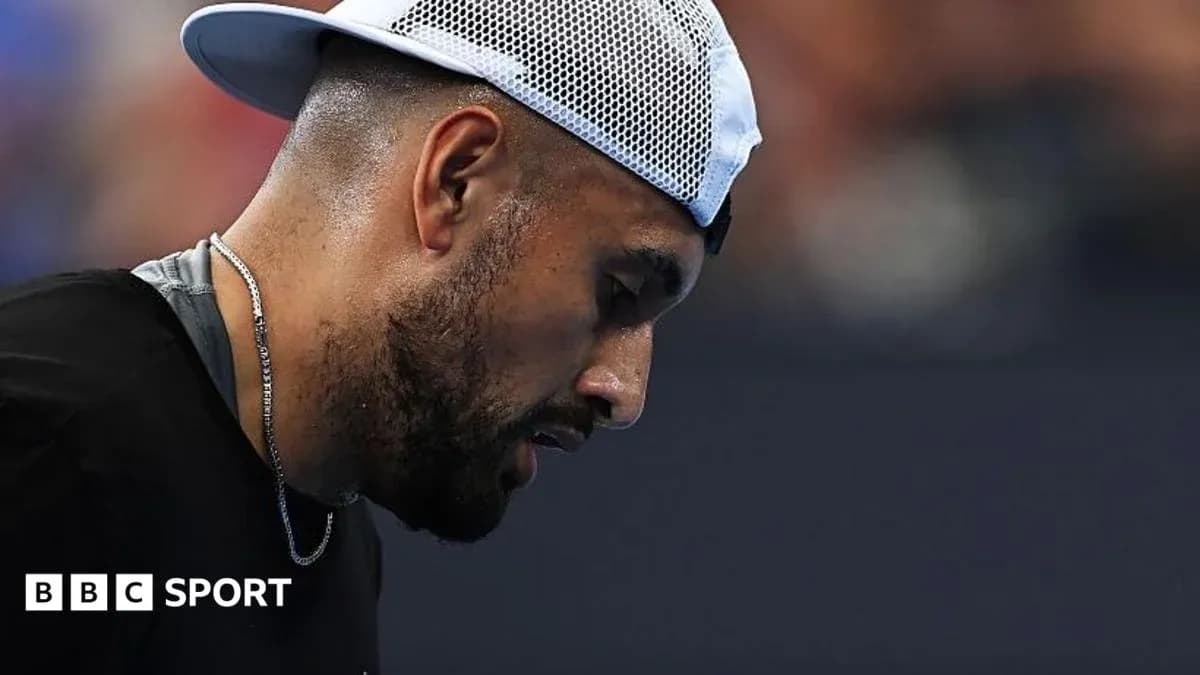
Nick Kyrgios Returns to Tennis After One-Month Ban
Nick Kyrgios is free to return to tennis after serving a one‑month ban for testing positive for cocaine – another turbulent chapter in one of the sport’s most combustible careers.
The 31-year-old Australian was provisionally suspended on 4 August when a sample taken during the Mallorca Open in June was found to contain benzoylecgonine, a metabolite of cocaine. He later told investigators from the International Tennis Integrity Agency (ITIA) that he had used the drug at a nightclub in Magaluf in the early hours of 20 June.
Two days after that night out, Kyrgios stepped on court in Mallorca for his first-round match. He lost in straight sets to fellow Australian Adam Walton, a flat performance now cast in a very different light.
After consulting an independent expert, the ITIA accepted that Kyrgios’ cocaine use took place out of competition. Under the rules, he faced a maximum three‑month suspension, but the ban was cut to one month once he entered a treatment programme. That suspension ended on Thursday, 3 September, clearing him to compete again.
Financial Price: Kyrgios must forfeit the €6,570 (£5,650) he earned in prize money at the tournament.
When news of the positive test first broke, Kyrgios announced he would step away from social media and public life for 28 days, saying he wanted to “focus on getting myself right”. It was a rare moment of public retreat from a player who has spent much of the past decade living in full glare.
The on-court story has been bleak for some time. Once ranked as high as world number 13, Kyrgios has slipped all the way to 918 after a season wrecked by physical problems. He has managed only four singles matches this year, his body repeatedly breaking down after years of knee and wrist issues.
His most recent appearance came not in singles but in men’s doubles at Wimbledon, where he and Alexander Bublik went out in the first round. The grass that once staged his greatest run – the 2022 Wimbledon final against Novak Djokovic – has since offered only reminders of how far his career has drifted.
In a lengthy Instagram statement after his provisional suspension, Kyrgios wrote that injuries in recent years had taken “a huge toll on me, both mentally and physically”.
“My body hasn't been able to do what my mind expects it to do,” he said. “Coming to terms with being near the end of my career has been harder than I ever imagined. None of that excuses what I did.”
Cocaine is listed by the World Anti-Doping Agency as a stimulant and a substance of abuse, and the case drops Kyrgios back into a familiar place: the eye of a storm.
Controversy has followed him almost from his breakthrough. His talent has always been matched by volatility – smashed racquets, arguments with umpires, audible obscenities and a string of heavy fines that made him one of the most polarising figures on tour.
The turbulence has not been confined to the court. In 2023 he admitted assaulting an ex-girlfriend two years earlier, avoiding a criminal conviction but adding to the shadows around his name. He has also faced criticism for a series of comments widely viewed as misogynistic.
This year he drew more fire after sharing a post from influencer Andrew Tate, whose views have been condemned across sport and beyond. Kyrgios later insisted he had gone “to all lengths” to distance himself from the self-proclaimed misogynist, yet the association lingered.
He has not been shy about attacking the system either. Kyrgios publicly lambasted the handling of two high-profile anti-doping cases involving Jannik Sinner and Iga Swiatek, calling them “disgusting” for tennis. Now he finds himself on the other side of the process, his own case dissected in the same public arena.
Strip away the noise and the record still stands: seven ATP Tour singles titles, a Wimbledon final in 2022, and an Australian Open men’s doubles crown that same year alongside close friend Thanasi Kokkinakis. At his best, Kyrgios electrified crowds and unsettled the game’s giants with raw power and audacious shot-making.
The question now is stark. With his ban served, ranking in freefall and body battered, does he have the desire – and the time – to turn the story back toward tennis?