Mourinho's New Defensive Strategy at Real Madrid
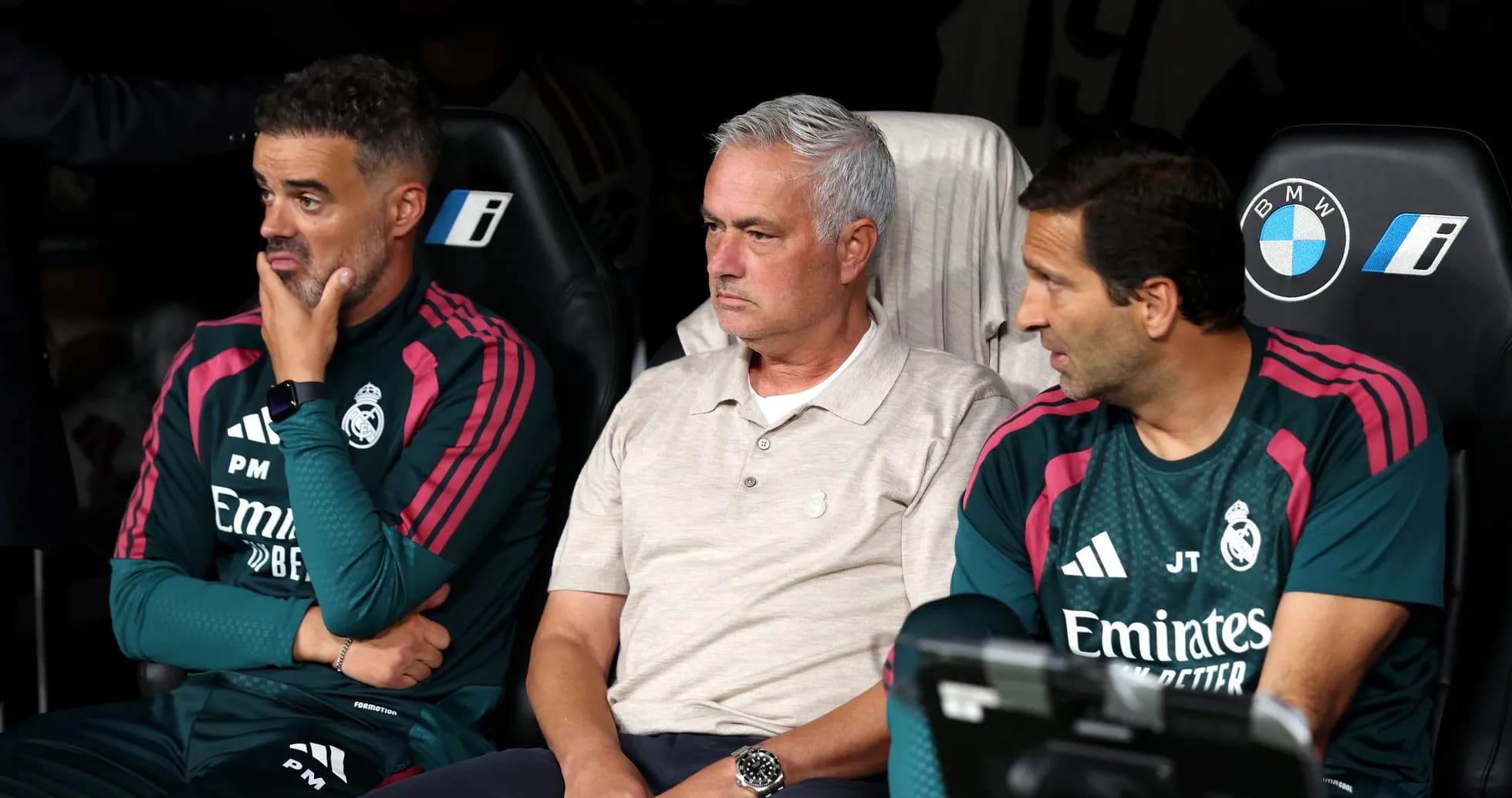
José Mourinho has never hidden where he starts building a team. At the back. And on a tense night against Real Sociedad at the Santiago Bernabéu, you could see the scaffolding of his new Real Madrid defence going up in real time.
Mourinho’s 35th-minute alarm
For 35 minutes, Thibaut Courtois lived a quiet life. One early stop from Mikel Oyarzabal in the 10th minute, then calm. Then Sergio Gomez let fly.
His powerful strike skimmed too close to Courtois’s goal for Mourinho’s liking. The serenity snapped. The coach reacted instantly.
According to “AS”, he barked for more focus from his back line and sent five players to warm up with fitness coach Antonio Pintus: Cucurella, Camavinga, Brahim Diaz, Trent Alexander-Arnold and Asensio. It looked like a threat, but for Mourinho it was routine.
“I always do that in the 35th minute. I like everyone to be inside during the break, because there are instructions for everyone,” he explained. It was classic Mourinho: control the moment, control the message.
The first half closed with the game level at 1–1, but the real story was still to come.
A new back four takes shape
The restart brought the first clear sign of the defensive hierarchy Mourinho is drawing up. Cucurella replaced Álvaro Carreras, stepping out for his first appearance as a Real Madrid player at the Bernabéu.
That single change redrew the whole back line.
Suddenly, three of the four defenders were summer signings. Dumfries took the right, Cucurella the left, with Konaté as the right-sided centre-back and Huijsen, brought in last season, on the left of the pairing. A new wall, built almost overnight.
Mourinho’s reasoning for the switch was blunt and practical: “The change of Carreras was because of the yellow card,” he said, referring to the booking the full-back picked up in the 10th minute for a challenge on Kubo. One card, one risk too many.
Behind that simple explanation sits a clear plan. Inside the club, the technical staff have effectively settled on this quartet. Only Antonio Rüdiger looks likely to rotate in, either for Konaté or Huijsen, while they wait for Éder Militão’s return. Until then, this is the line entrusted with the season’s biggest nights.
Dumfries over Trent, Cucurella’s edge
The most striking call is on the right. Dumfries, more used to operating as a wing-back in a five-man defence, has moved ahead of Trent Alexander-Arnold and established himself as Mourinho’s first-choice right-back.
It is a stylistic decision as much as anything else. With Dumfries on one flank and Cucurella on the other, Madrid’s full-backs push the defensive line higher. They squeeze the pitch, defend on the front foot and give the team the platform to attack and press in advanced zones. That, in turn, frees the midfielders and forwards to hunt the ball the way Mourinho wants: high, aggressive, relentless.
The data backs up what the eye test suggests.
Opta numbers show Dumfries ranking fifth in passes played in the final third, with 15. Only Güler (25) and Mbappé (22) finished ahead of him, while he matched Valverde and sat just behind Bernardo on 17. For a right-back in a Mourinho side, that is a loud statistic.
On the opposite flank, Cucurella wasted no time making his mark, both as an outlet and as a defender stepping up to contest duels early. His numbers would end up mirroring the steel at the heart of this new structure.
Numbers that tell a story
Look across the back four and the pattern is clear.
Konaté led the tackling charts with two successful challenges, level with Cucurella. Huijsen quietly ran the game in possession, completing 69 of his 72 passes. A 95.8% success rate, the best on the pitch.
Carreras, despite his early withdrawal, also posted strong defensive work: four ball recoveries, matching Huijsen’s tally. Collectively, Madrid’s defence recovered 15 balls, seven of those in Real Sociedad’s half. Nearly half of their defensive wins came in advanced areas. That is not a team retreating into its box; that is a line stepping up and biting.
On Courtois’s goal, Madrid allowed only three shots, the same number they had conceded against Espanyol. For most clubs, that is a miserly figure. For Mourinho, it still feels like too much.
Chasing the ghost of 2010–11
The standard he measures himself against is brutal. During the 2010–11 season, one of the defining years of his career, his side kept 30 clean sheets in 59 matches. Sixteen shutouts in 38 La Liga games. Eight in 12 in the UEFA Champions League. Six in nine in the Copa del Rey. More than half their fixtures ended with the opposition blanked.
That is the benchmark haunting every defensive tweak he makes now. Three shots conceded may look acceptable on paper, but in Mourinho’s world it is a reminder there is still tightening to do.
The encouraging part for Madrid is that this back four is only at the beginning of its life cycle. Konaté and Huijsen are still learning each other’s movements. Dumfries is adapting his game from a back five to a flat four. Cucurella is finding his bearings in a new stadium, a new dressing room, a new set of demands.
And yet, the outline already looks sharp.
A defensive unit on the clock
Time, for once, might be on Mourinho’s side. The next few weeks offer a clear runway to harden this line before the calendar explodes.
Malaga and Betis await in La Liga. The Champions League opener sits in the middle as an early continental exam. Then Rayo and Elche, matches where Madrid will see plenty of the ball but cannot afford lapses. After that, the derby at the Metropolitano, where every aerial duel, every second ball, every line step will be tested by Atlético.
By then, this back four will either look like a finished product or a work still in progress.
Mourinho has nailed his colours to this defensive mast. Dumfries over Trent. Cucurella trusted on the left. Konaté and Huijsen with Rüdiger in reserve, waiting for Militão’s return.
The foundations are down. The question now is simple and unforgiving: can this new wall carry Real Madrid through the season’s storm, or will it be remembered as just another experiment on the way to something tougher?