Maia Bouchier leads England to record ODI chase against Ireland
England did not just reel in Ireland’s 281 for 5. They dismantled it.
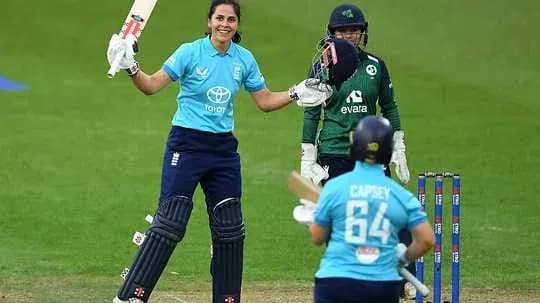
On a sunlit afternoon at Grace Road in Leicester, Maia Bouchier tore into the chase with a century that set a new high-water mark for England’s women in ODI run-chases. Her 104 from 95 balls, laced with 11 fours, turned what looked a competitive target into little more than a platform for batting practice.
By the time the winning runs came in the 39th over, England had strolled to their highest successful ODI chase, and Ireland’s earlier optimism had long since drained away.
Ireland set a target with real substance
For a while, this looked like Ireland’s day to make a statement.
After the early loss of a wicket, Amy Hunter and Gaby Lewis rebuilt with the kind of composure that has become a hallmark of Ireland’s emerging core. Their second-wicket stand of 136 from 152 balls gave the innings its spine and its shape. Both passed fifty, both finished in the 60s, and between them they threaded 13 fours around the ground, punishing anything loose.
At 30 overs, Ireland were well placed. Then came the wobble.
Three wickets fell in just over seven overs from the 30th, and the innings teetered. The platform Hunter and Lewis had built suddenly looked fragile, and a total under 250 loomed into view.
Leah Paul and Rebecca Stokell refused to let it slip. Their partnership – 84 off 71 balls – changed the mood again. They ran hard, picked gaps, and crucially, kept England from settling into any kind of control with the ball. The final 10 overs brought 77 runs, Ireland surging to 281 for 5 and walking off with something tangible to defend and something to believe in.
It felt like a “par-plus” total. It did not survive contact with Bouchier.
Bouchier and Dunkley rip up the script
From the outset, Bouchier batted like a player who had already decided the result.
The tone shifted in the sixth over. Jane Maguire, just 23 and tasked with testing England’s top order, ran in with purpose. She left the over with scars. Bouchier lined her up and hit four boundaries in succession, each one more emphatic than the last. Any early tension in the chase vanished with that single assault.
Sophia Dunkley matched the tempo. The pair raced to 72 without loss inside the first 10 overs, the run rate already galloping beyond seven an over. Ireland’s seamers searched for movement, for a mistake, for anything. The ball kept finding the middle of English bats.
Dunkley’s fifty came from 40 balls in the 15th over, a blur of drives and clips, while Bouchier reached her own half-century in the 17th, from 53 deliveries. The scoreboard did not just tick; it surged. Every over seemed to bring another release shot, another boundary that pushed Ireland further into the shadows of the game.
By the time the partnership reached 143 off 118 balls, England were not just ahead of the rate. They were out of sight.
Murray strikes, but the chase never stalls
Cara Murray finally broke the opening stand in the 20th over, removing Dunkley for 73 off 61 balls. It was a crucial strike, a rare moment when Ireland’s fielders could gather in a huddle with something to celebrate.
Murray then cut through again almost immediately, dismissing Jodi Grewcock in the following over. Two wickets in quick time, the ball turning, a hint of pressure. If there was a window for Ireland, this was it.
England slammed it shut.
Alice Capsey walked in and settled quickly, feeding off Bouchier’s rhythm. The pair added 50 brisk runs, and with every clean strike the chase returned to cruise control. Bouchier moved into the 90s, the innings now a showcase of tempo and timing rather than any desperate scramble.
Her century arrived in the 31st over, from 91 balls. A landmark knock, crafted with authority and aggression. She fell soon after, dismissed in the 32nd over for 104, but by then the chase had been stripped of its tension. England still had wickets, runs in hand, and batters eager to join the fun.
Kemp’s late surge seals it in style
Freya Kemp made sure the finish matched the ferocity of the start.
She came out swinging, targeting the seamers with ruthless clarity. Louise Little disappeared for two boundaries in an over; Arlene Kelly fared worse as Kemp crashed four fours off her, dragging England beyond 250 in just the 34th over.
Murray, Ireland’s standout with the ball, struck for a third time to remove Kemp for a 22-ball 36. It was a reward for persistence on a day when most of her colleagues could not stem the flow.
But the chase was already done in all but name.
Capsey, calm and unflustered, steered England home, finishing unbeaten on 41 from 40 balls. She sealed the match with a boundary, a fitting full stop to a pursuit that had never really looked in doubt.
Ireland had batted with heart, built partnerships, and finished with a flourish. On many days, 281 for 5 would have been enough to ask serious questions.
On this one, Bouchier and England answered before the questions had even fully formed.