John Martin Defends FAI's Decision on Israel Fixtures
The Republic of Ireland’s autumn dates with Israel remain on the calendar, but nobody at Abbottstown is pretending they sit comfortably there.
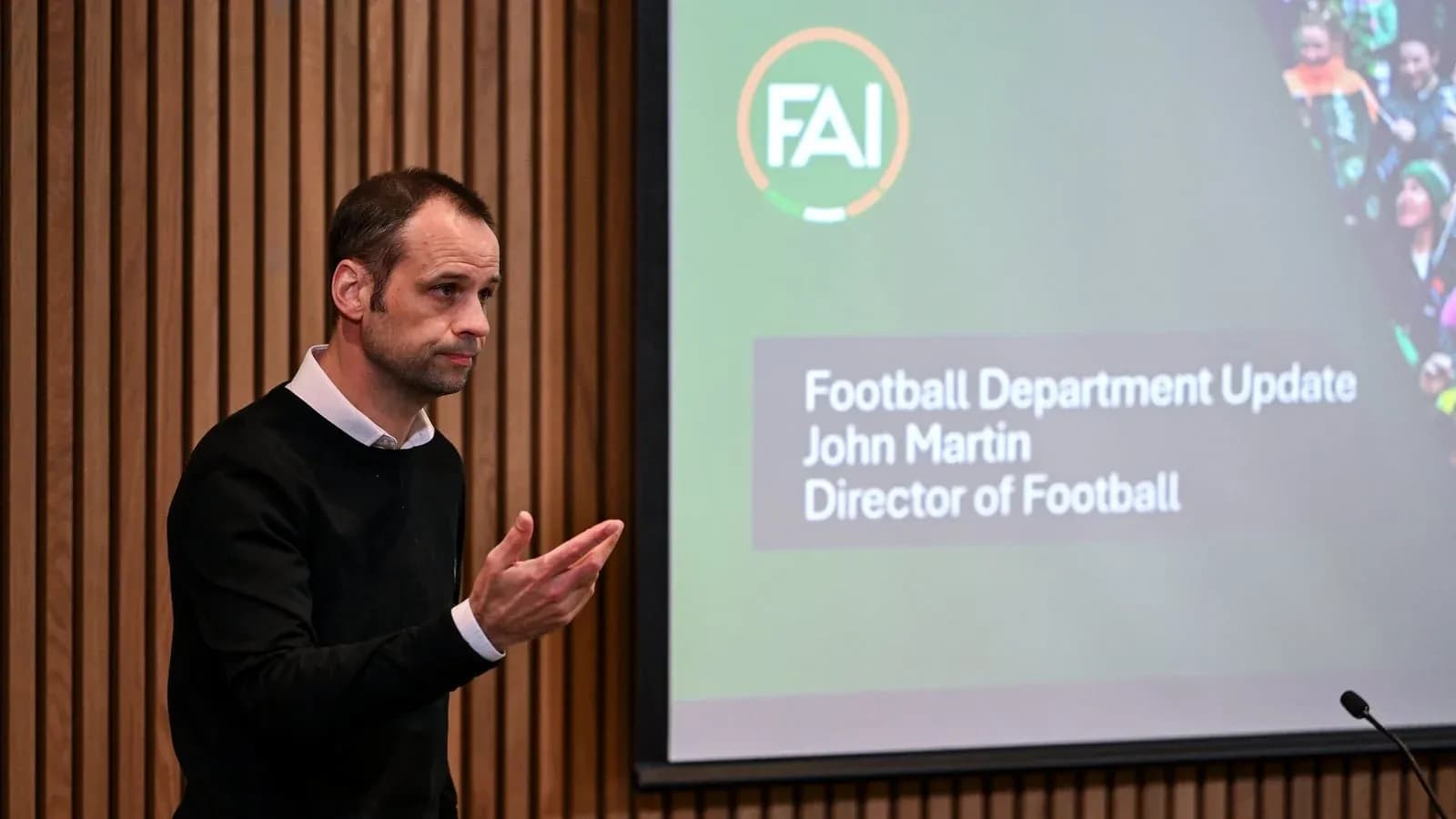
FAI Director of Football John Martin has again underlined that he would rather the UEFA Nations League double header did not go ahead, yet insists Irish football cannot afford the consequences of refusing to play.
Ireland are due to face Israel in Debrecen, Hungary, on 27 September, with the ‘home’ game following on 4 October in Backa Topola, Serbia. Both are technically Ireland fixtures. Neither will feel like it.
The association has already confirmed there will be no tickets for Ireland supporters. The September game will have only Israeli fans present, while the October tie will be played behind closed doors.
The backdrop is unrelenting pressure on the FAI and on the squad to boycott the matches. Martin is adamant the burden should not land on the dressing room.
“It’s really hard on the players because I think someone said, ‘oh, it’s falling on the players’,” he told RTÉ Sport. “It always falls on the players in a performance environment.
“In this situation, the decision shouldn’t fall on the players because it’s not at the player’s decision. It was a decision made by the association, by the board and by the executive.
“People like me and David Courell made this decision, not the players.
“We need to protect the players and look after the players because we shouldn’t find a situation where they’re being criticised.
“People can criticise me and David, that’s fine, and people are getting heavily criticised over it. It’s a deeply uncomfortable situation for us to be.”
The discomfort has been building for months.
In July, an extraordinary general meeting saw delegates asked whether to endorse the FAI board’s call to fulfil the Nations League fixtures. Sixty-eight percent backed the decision, 32% opposed it. The games survived, but the argument did not end there.
Martin, now the public face of that stance, is clear: the association does not want these games. It just fears the price of not turning up.
“We all agree, and the association has been on the record to say that we don’t want to be playing these games. That is the reality. I don’t want to play the games, but for that to impact Irish football, that’s where I would maybe disagree with some of the voices, [who] say we shouldn’t play the game.
“I agree with a vast majority of what people are saying about the situation. The aspect of not playing the game is where we have a difference of opinion.
“I think it’s for Irish football we will play the game.”
The calculation is stark. Any refusal to fulfil fixtures would invite UEFA sanctions that could hit the senior side, the underage structures, and the FAI’s already fragile finances. Martin believes that is a risk the game here cannot absorb.
Inside the camp, another delicate balance is being struck. Players will not be forced to travel.
“It’s a personal choice for the player,” Martin said. “We have a fantastic manager in person in Heimir who will manage that. But at all stages, we need to mind the player, but you always need to mind the player.
“You should never forget the player. We’re always mindful of the environment the player is in and we need to protect them as best as possible.
“It [is] going to be really difficult because it does fall on them naturally because they’re on the pitch.
“But I would hope people can see that they’re following the lead of the association and following the decision that the association took, as opposed to putting them at the centre.”
So Ireland will fly into neutral venues, play ‘home’ and ‘away’ games that feel like neither, and do so under a spotlight that has nothing to do with tactics or team selection. The footballers, Martin insists, are simply following orders.
Separate storm over Shamrock Rovers agreements
While he fronts up on Israel, Martin is also caught in the swirl of another sensitive issue.
The Sunday Times reported that the FAI is investigating alleged third‑party ownership breaches involving Shamrock Rovers players Michael Noonan and Alex Noonan. The agreements at the heart of the probe date back to Martin’s time as Rovers CEO.
He now works for the FAI, the very body examining the case. On the face of it, a potential conflict of interest. Martin says there has been no move to sideline him.
He has not been asked to step aside and is not part of the FAI team conducting the investigation. Their task is to establish whether any FIFA rules were broken.
A complaint from Michael Noonan’s mother to the English FA about agent agreements triggered the process earlier this year. Shamrock Rovers later announced they were working with FIFA to review two agreements and stressed the club itself was not the focus.
The case has since been referred back to the FAI, which is now gathering documents and trying to pin down the facts. Martin has previously said he is content with his record at Tallaght Stadium and wants the review completed.
“I’m very comfortable about my time from Shamrock Rovers, exceptionally comfortable,” he said.
“I can’t comment. I’ll leave that to other people to figure that out. It’s not something I’m worried about.”
Asked directly if there had been any request for him to step down temporarily, he replied: “Absolutely not. It is frustrating because there’s things that I’d like to be able to go into more detail on.
“I’ve been incredibly dignified, professional and respectful of the club. I intend to continue being dignified, professional and respectful towards the law because I think someone in my role needs that.
“I don’t think Irish football needs people to be talking public negatively about each other because that damages the perception of the game. I’m a naturally positive person. I’ve only good things to say about the club. It’s a situation I can’t talk about. But I’m in no way worried about it.”
Two controversies, one common thread: Martin placing himself squarely in the firing line, asking that the players and, in the Rovers case, the club, are spared as much collateral damage as possible.
Whether Irish football emerges from both sagas with its image intact is another matter entirely.