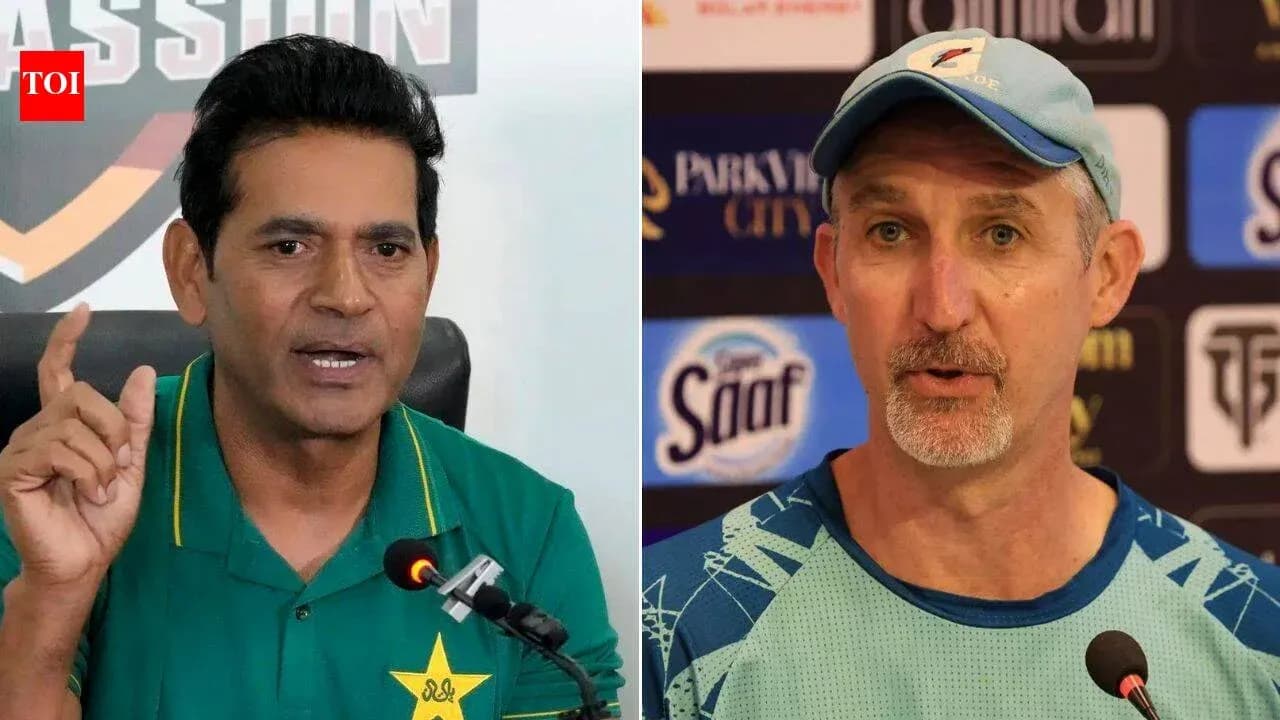
Jason Gillespie criticizes Aaqib Javed over Pakistan’s Test selection chaos
Jason Gillespie has launched a stinging attack on Pakistan chief selector Aaqib Javed, accusing him of presiding over a selection shambles and treating players with “disrespect” after Pakistan’s mid-series cull against England.
The former Pakistan head coach, who oversaw a 2-1 Test series win over England earlier in 2024, watched from afar as the Pakistan Cricket Board (PCB) ripped up its plans after heavy defeats at Headingley and Lord’s. The response from Lahore was brutal: seven players sent home, the head coach and bowling coach removed, and an entirely new backroom team flown in for the third Test in Birmingham.
For Gillespie, it was painful.
“I feel for the players, this is these guys livelihoods,” he told The Australian, laying bare his frustration at a setup he believes is now ruled by fear rather than trust. “From the outside it looks like they are playing with fear.”
The fear, he suggests, starts at the selection table.
“They change their mind like they change their pants”
Gillespie’s sharpest words were reserved for Aaqib Javed, who has been chairman of selectors for the last two years and, in Gillespie’s view, the architect of the instability.
“It’s pretty clear they don’t have a selection strategy at all, particularly under Aaqib Javed,” he said. “They change their mind like they change their pants — daily.”
The clearest example, in his eyes, is Salman Ali Agha. One week, he is leading Pakistan as captain in the first Test against England. The next, he is out of the XI for the second Test. Before the third, he is on a plane home.
“Salman Ali Agha goes from captaining the team in the first Test against England to out of the team for the second Test and on the plane home before the third Test. How does that work?” Gillespie asked, his rhetorical question cutting straight to the heart of the chaos.
The results on the field have been just as brutal. Pakistan were hammered by an innings and 103 runs at Headingley, then outplayed again at Lord’s, losing by 194 runs as England wrapped up the three-match series 2-0 with a Test to spare. The scoreboard told one story; the PCB’s reaction told another.
Blame game turns ugly
As the inquest deepened, Aaqib Javed publicly pointed the finger at Gillespie and former white-ball coach Gary Kirsten, suggesting the pair had left behind deeper problems.
Gillespie’s response was scathing.
“Aaqib Javed came out recently and blamed (former Pakistan white-ball coach) Gary Kirsten and myself for everything that is going on,” he said. “Aaqib has been chairman of selectors for the past two years. We haven’t even been there. Somehow he claims it is our fault. Make sense out of that. I think Javed needs to look at himself in the mirror.”
It was a rare, direct rebuke from a coach who usually keeps his public comments measured. This time, he did not bother to pull his punches.
Players finding out via social media
What truly angered Gillespie, though, was not just who was picked or dropped, but how those decisions were delivered.
“There is definitely no communication between Aaqib Javed, who is meant to be chairman of selectors, and the players,” he said.
Reports this week revealed that several players only discovered they had been axed when friends and family forwarded them the PCB’s official statement on social media. No call from the coach. No message from the captain. No explanation from the selectors.
“The players who were sacked heard it through family and friends and the media they had been sacked. How disrespectful is that?” Gillespie said.
For professionals fighting for their careers, the method stung as much as the decision.
Mass clear-out before Birmingham
The PCB’s reaction after Lord’s was sweeping. Wicketkeeper Mohammad Rizwan, opener Imam-ul-Haq, Salman Ali Agha, spinner Ali Usman, pacer Khurram Shahzad, all-rounder Aamir Jamal and batter Awais Zafar were all recalled as Pakistan scrambled for a response before the third Test at Birmingham, starting September 9.
At the same time, head coach Sarfaraz Ahmed and bowling coach Umar Gul were removed from their roles. Mike Hesson and Ashley Noffke were drafted in to take charge for the final Test, a dramatic mid-series reset rarely seen at this level.
For a team already reeling from two heavy defeats, it means walking into Birmingham with a new coaching team, a reshuffled squad and a dressing room still processing how brutally the axe fell.
Gillespie, watching it all unfold from a distance, sees a familiar set of problems in Pakistan cricket: short-term fixes, long-term damage, and a group of players left to carry the weight of decisions they did not make.
The scoreboard in England already reads 2-0. The bigger question now is what kind of scars this series will leave on Pakistan’s dressing room — and whether anyone in power is willing to own them.