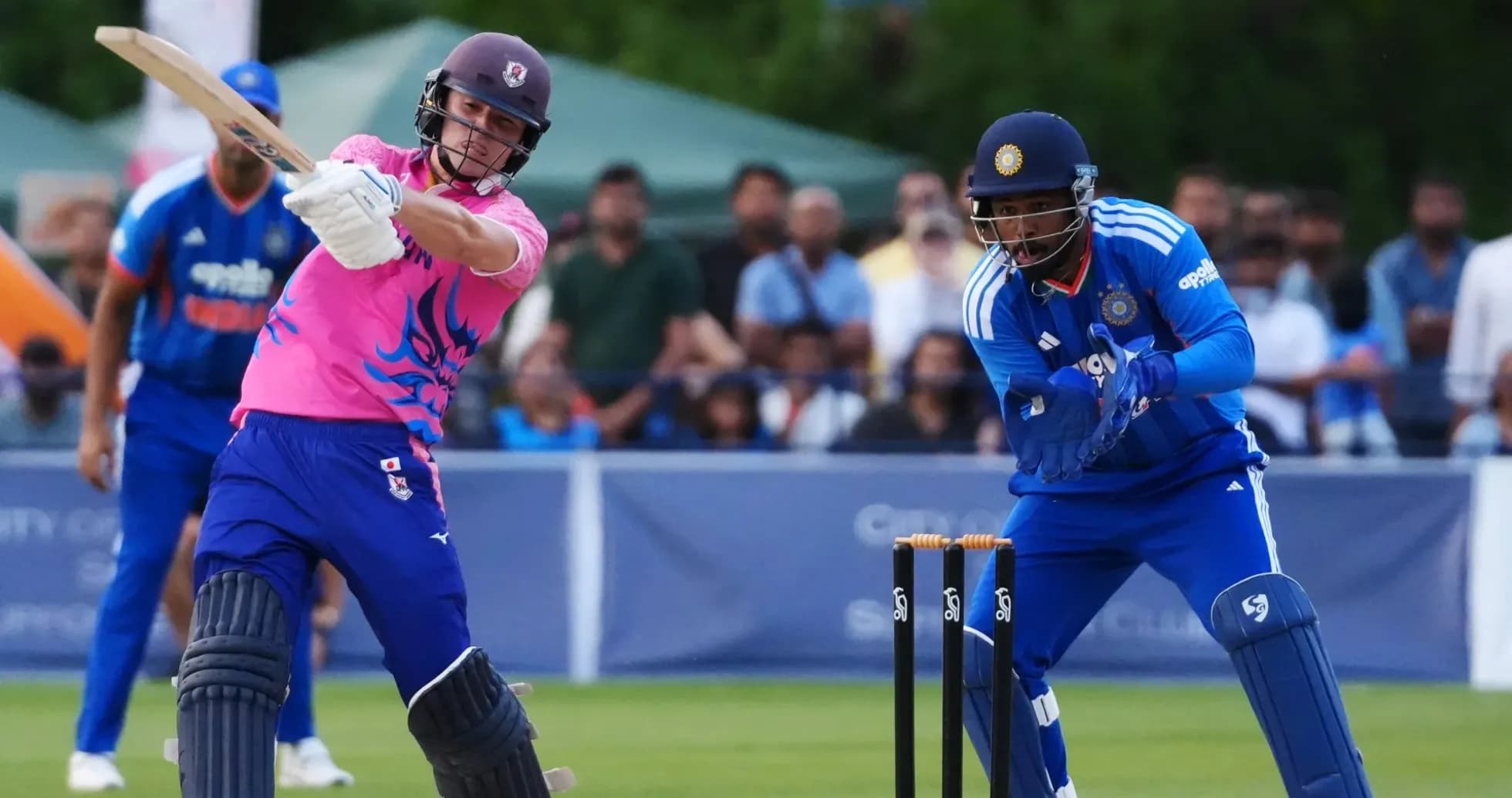
Japan's Near-Miracle Against India Ends in Controversy
Japan’s near-miracle in Sano ended in a storm of anger, not rain.
A five-over shootout against the world champions should have been a showcase, a celebration of how far Japanese cricket has come. Instead, India’s two-run win on Tuesday has been dragged into a debate about power, pressure and the thin line between authority and intimidation.
The scoreboard says India won. The mood around the cricket world says Japan were wronged.
A five-over scrap with giants
Rain stripped this contest at Sano International Cricket Ground down to its bare bones: five overs a side, 33 to win for Japan against the three-time T20 world champions.
Shreyas Iyer won the toss, India batted, and for a moment it looked like the script would hold. Then Charlie Hara-Hinze tore it up.
The Japanese seamer removed Abhishek Sharma in the first over, then came back to dismiss Ishan Kishan with the second ball of his next. Two India stars gone, the minnows suddenly dictating terms. On a slow, low wicket, every run felt heavy.
Iyer steadied India with a busy 16 off 12, dragging his side to 32-4. Not a total, a tease. Enough to keep the champions interested, not enough to kill the contest.
Japan walked out needing 33 from 30 balls, chasing the biggest scalp in their history.
Japan dare to dream
Axar Patel took the new ball and immediately stamped India’s intent on the chase, removing Lachlan Yamamoto-Lake with his fourth delivery. One down, 31 still needed from four overs.
Washington Sundar tightened the noose in the second over. Japan added only six and lost another wicket to the off-spinner. The chase was alive, but fragile.
India doubled down on spin. Japan refused to fold.
Seventeen runs came from the next two overs. The hosts nudged, hustled, picked gaps. Captain Kendel Kadowaki-Fleming, leading an associate side against the game’s richest power, made 12 before falling. His dismissal hurt, but it didn’t break them.
As Patel took the ball for the final over, Japan needed eight from six with seven wickets still in hand. For a team ranked 41st in the ICC T20 men’s rankings, against the world champions, this was uncharted territory.
One dot ball. One single.
Seven needed off four.
Then came the ball that has lit up timelines and talk shows.
The wide that vanished
Patel fired one down the leg side. Umpire Chris Thurgate, standing at the bowler’s end, stretched his arms: wide.
Alexander Shirai-Patmore had tried a reverse sweep, but the ball stayed out of his reach. The call looked straightforward. One run to Japan, one extra ball. Six needed from four.
Then the temperature changed.
Iyer and Patel reacted instantly, anger clear, body language loud. They marched towards the umpire, protesting the decision. Voices rose, arms gestured, the champions making their case.
There was no signal for a TV review. No big screen replay. No audible third umpire intervention. Just a brief consultation between Thurgate and his colleague Chris Brown.
And then, astonishingly, the wide was revoked.
The signal disappeared. So did Japan’s extra run and extra delivery.
The equation snapped back: six needed off four, not five off four.
From there, Japan could only scratch three singles from the last three balls. They finished on 30-3, two runs short of India’s 32-4. Agony, not ecstasy, at the end of their most high-profile match.
On paper, a narrow defeat. In the eyes of many, something harsher.
Laws, power and a growing backlash
The anger didn’t take long to surface.
In cricket, when an on-field decision is changed, there is usually a process. A DRS call. An umpire review. A replay on the big screen. A third umpire’s voice guiding the outcome.
None of that happened in Sano.
The Marylebone Cricket Club’s Laws of Cricket are clear on when a wide can be revoked under Law 22.3. An umpire may cancel a wide if the ball touches the bat or the striker’s body before a fielder does, or if the delivery is called a no ball.
Neither applied here. The ball did not hit bat or body. It was not a no ball.
Yet the decision changed, seemingly on the strength of India’s protest alone.
That was enough for many to call it out. Ben Gardner of Wisden labelled it “a disgraceful decision”, writing that India had “bullied the umpires into overturning a wide call against Japan” with five needed off four for what he described as “the biggest upset in cricket history”.
Others were blunter. “Japan were robbed here,” posted Abu Zaid Sarooji on social media.
Even some Indian supporters sided with Japan, pointing out that Shirai-Patmore had not changed his stance before the ball was bowled and had not tried to manipulate the wide law with his movement.
The sight of India’s captain and bowler confronting the umpires, followed by a reversal without visible evidence, cut against one of cricket’s old unwritten codes: you don’t hound the officials in public.
On this night, that line looked badly blurred.
Silence from the middle, pride from Japan
Neither captain dwelt on the incident afterwards.
Iyer instead focused on conditions and Japan’s performance.
“Honestly speaking, it was a very difficult wicket to bat on,” he said. “A five-over game, it can go anywhere. It doesn’t matter how good a team you are.”
He reserved praise for the hosts.
“The attitude and approach the Japanese team showed today was impeccable, and kudos to them. Their approach was outstanding. I’m sure that they are on the right track.”
Kadowaki-Fleming, visibly emotional, framed the night in historic terms for his side.
“Emotions are running pretty high in our group. But the fact that we’re able to run the best team in the world, in my opinion, to the last ball of a game is pretty special,” he said. “I think today was a really momentous occasion in that it was the first time we were able to face a full member.”
The Japanese players walked off looking shattered, not just beaten. They had taken India to the final ball. They had outplayed expectations. They had not, in their eyes or many others’, been allowed a fair crack at the finish.
A tiny cricket nation, a giant stage
Strip away the controversy and the context is remarkable.
Japan, an associate ICC member with just 7,300 registered players and 16 cricket grounds, went toe-to-toe with the world champions in their first ever match against a full member.
The game itself was the product of years of lobbying by the Japan Cricket Association. The JCA worked for more than a year to convince the BCCI to send India to Sano. Government support, corporate sponsorship and quiet diplomacy finally brought the giants east.
JCA chief executive Naoki Alex Miyaji had framed the fixture as a beginning, not a miracle cure.
“One match or competition itself won’t change anything, and we are certainly not going to think that suddenly it’s going to be as popular as baseball or football in Japan,” he told Reuters. “But the match against India is the first page of a new era.”
On the field, Japan wrote a story that deserved a cleaner ending.
They pushed India to the brink. They showed skill, nerve and organisation. They made a powerhouse sweat in a format designed to expose nerves.
The record books will show a two-run defeat in a five-over lottery. The footage, and the fury around a single revoked wide, will tell a more complicated tale.
For Japan, the question now is simple: was this cruel night in Sano the peak of an unlikely surge, or the spark that drives them towards the next giant they can drag into deep water?