Japan Builds Homegrown Core Ahead of Asian Games
Japan have drawn a clear line in the sand ahead of the Asian Games, choosing principle and long-term planning over short-term firepower.
In assembling their squad, selectors have deliberately left out players who qualify for T20Is under ICC regulations but do not meet the stricter Asian Games eligibility rules. The message is blunt: this campaign will be built on those fully aligned with the multi-sport event’s criteria, not on technicalities.
That stance opens the door for a new wave of talent.
Emerging spin-bowling all-rounder Jake Kusuda-Nairn is among the biggest winners, rewarded with a call-up after catching the eye in domestic cricket. His rise has been steady rather than spectacular, but his ability to influence games with both bat and ball gives Japan a valuable balance in conditions that often reward smart spin and sharp game awareness.
There is also a distinctly nostalgic thread running through the squad list. Tsuyoshi Takada returns to the fold, a name that will stir memories for those who followed Japan’s early steps on the regional stage. He first pulled on national colours at the ICC East Asia-Pacific Twenty20 Championship back in 2013. Now, more than a decade later, he steps back into a side that has grown in ambition and expectation, carrying with him the experience of that first era.
The squad’s spine tells another important story: the quiet rise of cricket in Japanese schools.
Both Wataru Miyauchi and Makoto Taniyama come through school Bukatsu programs, proof that the sport is no longer just an imported curiosity but something being built from the ground up. Taniyama in particular embodies that journey. A leg-spinner who shaped his action by studying Shane Warne on YouTube, he wears shirt number 23 in tribute to the Australian icon and has already carved his own piece of history as Japan’s leading wicket-taker across all pathway and international competitions.
His presence gives Japan not just wickets, but identity.
Youth also has its say. Charlie Hara-Hinze, part of the U19 Cricket World Cup side that famously defeated Tanzania, keeps his upward trajectory going with a place in this squad. That win at youth level was a landmark moment; his inclusion now underlines Japan’s intent to carry that belief into senior cricket rather than let it sit as a one-off highlight.
There is a reunion of sorts in the spin department as well. Benjamin Ito-Davis returns after a frustrating spell on the sidelines, his previous East-Asia Pacific T20 World Cup 2028 Sub-Regional Qualifier cut short by a hand injury. Before that setback he had begun to look like a key piece in Japan’s plans. Now he has the chance to pick up where he left off, in a side that increasingly leans on its slow bowlers to control tempo and choke opposition line-ups.
All of this unfolds against the backdrop of a team still very much alive in the race for the 2028 T20 World Cup.
Japan finished second in that Sub-Regional Qualifier, level on points with Papua New Guinea. Net run rate, not nerve, denied them top spot, despite Japan beating the Barramundis on the final day of the tournament. That closing win did more than tweak a table; it proved they could stand up to a regional heavyweight when it mattered.
Now comes the next examination.
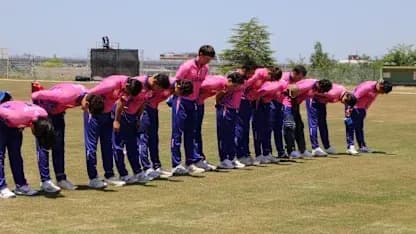
With a squad shaped by eligibility discipline, school pathways, and a blend of returning stalwarts and ambitious youngsters, Japan head into their Asian Games preparation knowing exactly who they are. The question is no longer whether they belong on this stage, but how far this carefully built core can push the boundaries of Japanese cricket in the years leading to 2028.