Japan's Rising Cricket Ambitions: From Novice to Competitive
Japan has never pretended to be a cricket powerhouse. It does not have the weight of history, the teeming club structures, or the street games that feed the sport in South Asia. What it does have, though, is something the International Cricket Council (ICC) values just as highly: world-class hosting muscle and a growing appetite for the game.
This is a country that has staged the Olympics, the World Aquatics Championships, the World Athletics Championships and now the Asian Games. When Japan builds a stage, the world shows up. The ICC has noticed.
ICC’s quiet Japan project
Behind the scenes, Japan has become a strategic project for cricket’s global rulers. William Glenwright, the ICC’s GM – Development, lays out the long game clearly.
Part of the ICC’s planning, he explains, is to work with Japan to “build up their capabilities to host larger ICC events”, with the idea that “one day, you know, years down the track, there might be an opportunity to host or co-host a Youth World Cup or something as part of a bigger plan.”
This is not idle talk. The governing body is already treating Japan less like a novelty outpost and more like a future events partner. That is why India’s decision to tour Japan and play a T20I against the world’s 41st-ranked side has been seized upon in Dubai as a landmark moment.
“India's tour of Japan is so important,” Glenwright says, “because not only does it build, obviously, the capability of the cricket team, but it builds the broader capabilities of the organisation around meeting the demands that come with hosting world champions.”
For the ICC, this is about more than one fixture. It is about exposing the Japan Cricket Association (JCA) to the full circus that follows a world champion team and seeing if the local administrators can handle the scale. If Japan is to host major ICC events one day, this is the kind of dress rehearsal it needs.
From minnows to meaningful opponents
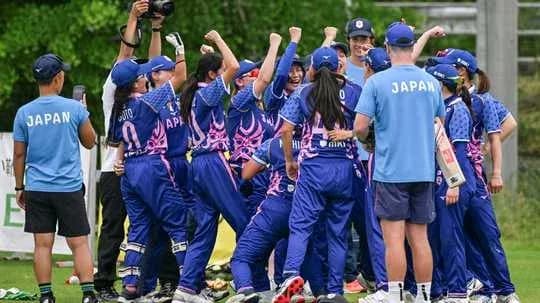
On the field, Japan’s men’s and women’s teams have been quietly stacking up experience and results.
The men have built a busy calendar: seven games in 2022 (five wins, two defeats), eight in 2023 (four wins, four losses), a bumper 25 in 2024 (18 wins, six defeats, one abandoned), 11 in 2025 (six wins, five losses) and, already in 2026, 10 matches with eight victories and just two defeats. Along the way, they have taken down Kuwait (ranked 23rd), Bahrain (27th) and Papua New Guinea (22nd). Those are not seismic shocks, but they are clear markers of progress.
The women’s trajectory has been even more striking. Four straight defeats in 2022, then a 2023 haul of four wins from 16. The curve bends sharply upwards after that: 10 wins from 14 in 2024, seven from 11 in 2025, and three victories from five outings so far in 2026. The raw numbers tell a simple story: Japan’s women are learning fast.
Their captain, Mai Yanagida, can feel it on the ground. “Japan is not a cricket nation like India,” she says, “but I think over the last few years, or 10 years, I think the awareness of cricketers and the popularity of cricketers has increased. So hopefully there'll be a lot of crowd and people will watch us play. And hopefully, yeah, we'll compete with one of the top nations.”
That hope becomes reality on Friday morning (IST), when Japan’s women open their Asian Games campaign against India.
‘Facing India is just unreal’
For Yanagida and her team, this is not just another fixture on a developing nation’s calendar. It is a leap into the deep end against the newly crowned Asia Cup champions, a side they have only watched from afar.
“Facing India is just unreal. And it's very exciting,” she says. “Of course, we've never played against them before. They are one of the top nations. We were watching the Asia Cup, we were following them. They just won the tournament. I know that all the players are top-class players. It can be intimidating. But it's more like an excitement to watch them and see them play and share the field with them.”
They have followed the Asia Cup, they have watched the WPL, they know the names and the styles. Now they will share the same turf. For a young cricketing country, that kind of exposure is priceless.
For the ICC, this is exactly the ripple effect it wants. “Having a full member and the world champions playing any associate member is hugely important to us from a cricket perspective,” Glenwright says. But the significance, he adds, stretches beyond the boundary rope.
“What does it mean for the country of Japan and cricket's significance in Japan? And that's the ripple effect of a fixture like this, because it reflects a growing confidence in the game and in the full members' belief in the abilities of our associate members to host full members in major international cricket.”
Screens, streams and a growing audience
The signs of that growing confidence are not confined to the pitch. They are on screens, too.
For the first time, the ICC live-streamed select matches on YouTube and Facebook in key emerging markets, and Japan responded. Across platforms in the country, those games drew more than 1.1 million views.
The non-English YouTube feeds across Japan and Indonesia combined for 201,000 views. Of that, Japanese-language feeds delivered 58 percent (118,000 views), leaving the remaining 42 percent split between Hindi and Urdu. On Facebook, the tilt was even clearer: of 252,000 non-English views across the two territories, Japanese feeds accounted for 70 percent.
Those numbers are modest by Indian standards, but they matter. They show that when cricket is offered in Japan’s own language, an audience appears – and stays.
Asian Games: gateway to something bigger
The Asian Games sit at the heart of this push. For the ICC, they are not just another event on the calendar; they are a gateway.
“Firstly,” Glenwright says, “because the Olympic Games is limited in size, as it is for all sports, the Asian Games or the regional games allow more of our members to participate in a multi-sport event. And secondly, that unlocks all sorts of funding from governments, from Olympic committees and from sponsors, in addition to the increased competitive opportunities that it provides.”
The impact in Japan is already visible in concrete and grass. On the back of the Asian Games, the country now has a second international-standard cricket ground. Sano was the first. Nagoya is the new one.
“So that means we have two international-standard facilities in Japan,” Glenwright notes, “which means all of a sudden, the capability and potential for Japan to host major ICC events, where by and large you need at least two international facilities, changes now, and it brings Japan into the equation.”
There have been murmurs and negative reports around aspects of the Asian Games ground, which falls under the Asian Cricket Council’s purview. Questions have been raised about athletes’ enclosures, changing rooms, media areas and the general off-field infrastructure.
On the cricketing core, though, the ICC is relaxed. “The ground itself, we have no concerns with. We held a World Cup qualifier there earlier this year. The reports are that the pitch and the outfield are excellent. We wouldn't have held a World Cup qualifier there if we weren't confident in it,” Glenwright says.
As for the off-field concerns, he believes they are being dealt with. “I believe they are being addressed. And the last update that we had is that they were being addressed. But in terms of the pitch itself and the outfield, the cricket facility, we're very confident that it's going to be a great facility that reflects the importance of this event and the members participating in it.”
A new kind of cricket nation
So Japan arrives at these Asian Games in an unusual position. Not as a traditional force. Not as a novelty act. As a test case.
On one side, a women’s team that has climbed from heavy defeats to credible records and now stares at India with a mixture of nerves and excitement. On the other, an ICC that sees in Japan a rare combination: a wealthy, organised host nation with room to grow on the field and off it.
If Yanagida’s side can compete, if the stands fill, if the streams spike again in Japanese, the sport’s global map shifts a little. And then the question will not be whether Japan belongs in cricket, but how soon it can bring a World Cup of its own to town.