India Wins Fourth Women’s T20 Asia Cup Title with Dominant Performance
On a humid Sunday that felt made for champions, India did not just win another Women’s T20 Asia Cup. They stamped their name all over it.
A 72-run hammering of Sri Lanka delivered a fourth title, built first on the silken brutality of Smriti Mandhana and Shafali Verma, then finished off by a spin attack that toyed with a chase that never truly breathed.
Openers turn final into a procession
Finals are supposed to be tight. Nervy. This one was over inside an hour.
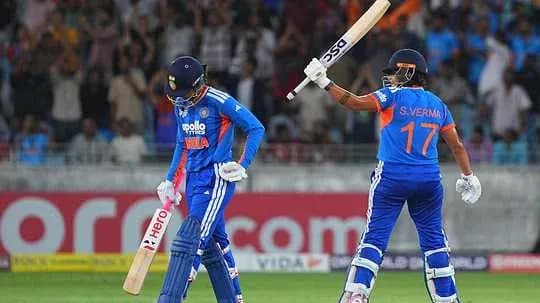
Mandhana and Verma walked out with the air of players who knew they were the best side in the tournament and were ready to prove it one last time. The first few strokes were almost deceptive in their gentleness.
Verma’s assault began not with a slog, but with touch. Two soft glides off Mithali Ayodhya – one guided past gully, the next nudged to midwicket – both sped away for four. No violence, just timing. Then the tempo changed.
Chamari Athapaththu offered width and Verma pounced, launching two sixes in four balls. The tone of the day shifted in that brief passage. India were no longer just building; they were bullying.
Having eased herself in, Verma detonated. She raced to the fastest fifty in Women’s T20 Asia Cup history, getting there in 24 balls – one delivery quicker than Mandhana’s own benchmark set in 2022. Records were being hunted down even as the final slipped away from Sri Lanka.
Mandhana, usually the one dictating terms, played the perfect foil. She opened with a boundary first ball, then tucked the ball into gaps, content to let Verma tear the game apart. Singles, twos, the occasional four – she batted like someone who understood that control can be as ruthless as power.
Chamudi Praboda bore the brunt of Verma’s confidence. Another pair of back-to-back fours punished anything remotely loose, and by the eighth over, Verma had her third fifty of the tournament. India were flying; Sri Lanka were hanging on.
The numbers told their own story. The pair moved to yet another century stand, drawing level with the world record for the most 100-plus partnerships for any wicket in women’s T20Is – six of them now. By the time the 12th over ended, India were 120 for 0. The final was drifting out of Sri Lanka’s reach with every over.
A stumble, but not a collapse
Sri Lanka finally found a crack in the wall.
Verma fell in the 13th over, and with that dismissal came a flicker of hope for Athapaththu’s side. It grew brighter a few minutes later when chaos struck in the middle. Harmanpreet Kaur and Mandhana, two of India’s most experienced heads, got themselves into a dreadful mix-up. Mandhana was run out, and for the first time, India’s innings lost its rhythm.
The middle order tried to keep the run-rate high and paid for it. Wickets fell, the scoring stalled, and what had looked like a march towards 200 began to feel more like a scramble for a competitive total.
Yet the openers had given India such a cushion that even the stutter could not derail them. Late in the innings, G Kamalini – drafted in for Pratika Rawal – added a final twist, launching the last ball for six to push India beyond 180. It was the kind of blow that lingers in the mind of a chasing side as they walk off to regroup.
A chase smothered by spin and nerves
History sat heavily on Sri Lanka’s shoulders. Only once before had a team chased more than 150 in a Women’s T20 Asia Cup – Sri Lanka themselves, against India, in the 2024 final. That memory might have offered belief. The new-ball passage quickly stripped it away.
Four balls into the reply, Kranti Gaud struck. Imesha Dulani, who had started with a lap shot, tried the same option again. This time, her stumps were flattened. Gaud roared, offering a fired-up send-off that captured India’s mood. They were not just defending a total; they were hunting a title.
Sri Lanka crawled through the first three overs, the required rate already beginning to glare at them from the scoreboard. Athapaththu, as so often, tried to fight back. She slog-swept Verma for six and took 12 off the part-time bowler’s first over, a brief injection of defiance.
With Vishmi Gunaratne settling alongside her, Sri Lanka finally found a partnership. They crossed 50 without further damage, and for a short stretch, the chase looked alive. Athapaththu then took on Prema Rawat, taking 11 from the over, including a six and a four off consecutive balls. The Indian camp, so dominant all evening, had a few moments to think.
That was as far as Sri Lanka’s resistance went.
Deepti Sharma’s second over changed everything. Athapaththu danced down the track, missed, and was smartly stumped. The dismissal snapped Sri Lanka’s backbone and swung the contest decisively back India’s way. Three balls later, Gunaratne was bowled, and with her went the last realistic thread of hope.
From there, India’s spinners tightened the noose.
Shree Charani, in the middle of a standout 2026, ripped through the heart of the Sri Lankan middle order. Flight, dip, and relentless accuracy left batters groping. One by one, they fell away. Beyond the top three, only Nilakshika Silva managed to reach double figures. There was no counter-attack, no late surge, just a slow, inevitable slide.
Sri Lanka were bowled out for 111. India had their title, and they had it in style.
A statement win, a growing legacy
The 72-run margin now sits as the second-largest victory in the final of a five-plus team Women’s T20I tournament, behind only Australia’s 85-run win over India in the 2020 T20 World Cup final at the MCG.
On this night, though, India were the ones dishing out the bruising. A record-equalling opening stand, a record-breaking fifty, a spin unit that choked the life out of a chase – it was the performance of a side that knows its own strength.
Four Asia Cup titles already in the bag. The question now is not whether this team can dominate the region. It is how far this core can push the standard of the women’s game, and who, if anyone, is ready to stop them.