Guy Sasson's Grand Slam Dream Ends in US Open Final
Guy Sasson’s Grand Slam dream in wheelchair doubles ended on the very last step, under the lights of New York.
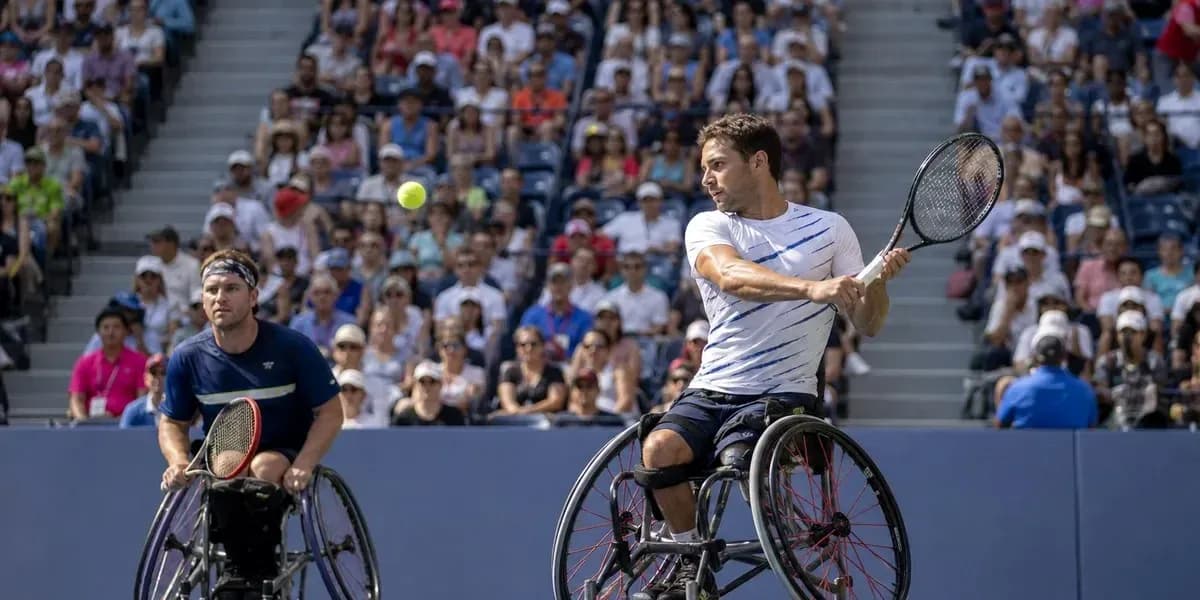
The Israeli, playing alongside Dutch star Niels Vink, fell 2–6, 6–3, 7–10 in a tense match tiebreak to Sam Schroder and Australian Jin Woodman in the US Open quad doubles final, a result that stopped one of the sport’s great calendar-year runs just short of perfection.
They had done everything right up to this point. Australian Open. Roland Garros. Wimbledon. Three majors, three titles, an imperious march that made Sasson and Vink the clear No. 1 seeds in New York. Schroder and Woodman, seeded second, were the obvious threat, the only pair with the weapons and belief to stand in their way.
For a set, the script held. Sasson and Vink dominated the opener 6–2, imposing themselves with the kind of authority that had defined their season. But the final never settled into a procession. Schroder and Woodman hit back, tightening their returns, changing the pace, and dragging the match into a deciding match tiebreak.
There, the margins shrank to almost nothing. One misjudged ball, one bold swing, one nervy service point. Schroder and Woodman held their nerve just that fraction longer, edging it 10–7 and snatching the US Open title from the pair who had seemed destined for a clean sweep of the majors.
For Sasson, it capped a demanding week on both fronts.
Partner in doubles, rival in singles
In singles, the world No. 3 reached the semifinals of the quad division, only to run into the man who has shared his greatest successes this season. Vink, the third seed’s partner in doubles, stood across the net as his opponent.
Sasson refused to fold. Down 2–5 in the opening set, he clawed his way back to 5–5, showing the same resilience that has pushed him into the sport’s elite. But Vink found the answers when it mattered, closing out the set 7–5 and then backing it up 6–3 in the second. He went on to lift the singles title, underlining why this partnership has been so devastating in doubles and so unforgiving when they collide.
Back home, the performances did not go unnoticed. Israel ParaSport Center CEO Boaz Kramer hailed the efforts of Sasson and fellow Israeli Sergei Lysov, stressing that a Grand Slam title is never an accident but the result of a long, punishing journey shared by athletes, coaches, and support staff. He underlined the center’s commitment to continue backing Sasson and Lysov, along with their head coaches Ofri Lankri and Damien Martinique, as they build toward the LA28 Paralympic Games.
The message was clear: this is not the end of a story, but the middle of one.
Lysov battles, Brand emerges
Lysov, returning to the US Open for a second appearance in the men’s wheelchair division, had a tougher time with the draw. He bowed out in the opening round of singles after a three-set battle, and his doubles campaign ended just as sharply, another match tiebreak going against him in the first round.
Those fine lines that decide a season’s highlight or heartbreak cut his way last year. This time, they didn’t.
If Sasson represents the established force and Lysov the hardened campaigner, 17-year-old Dan Brand is the emerging face of Israel’s next wave.
Making his junior US Open debut, Brand announced himself with a composed first-round singles win. In the second round, he stood toe-to-toe again, only for his body to betray him. Severe cramps struck in the middle of the deciding set, and despite his efforts, he slipped to a three-set defeat.
In doubles, Brand teamed up with Austrian Tilo Berman. Seeded fifth, they pushed through to the second round before falling to Yannick Alvarez of Puerto Rico and American Ryan Cozad. It was a solid first taste of the big stage, but also a sharp reminder of how unforgiving junior Grand Slams can be.
There will be no long pause to reflect. After a brief stop in Israel to visit his family, Brand will head straight back into the grind, scheduled to compete at the J500 Osaka Mayor’s Cup World Super Junior Tennis Championships from September 21–27 in Japan.
Sasson chasing LA28, Lysov searching for another breakthrough, Brand taking his first real steps on the global stage: the US Open did not deliver a perfect script for Israeli wheelchair tennis. It did something else. It showed how close they already are to the very top—and how much more dangerous they could become by the time Los Angeles comes into view.