England's Dominance Over Sri Lanka: Brook and Buttler Shine
England didn’t just chase 146. They toyed with it.
On a day when Sri Lanka’s early promise evaporated in a blur of wickets and misjudgment, Harry Brook and Jos Buttler turned a routine target into a statement, sealing the series with a swagger that underlined just how far apart these sides are in T20 cricket right now.
Dawson’s spell flips the script
For a while, Sri Lanka looked alive. 55 without loss, both openers set, the ball skidding nicely onto the bat. England’s attack probed but didn’t penetrate, and the tourists had a platform that should have launched them to something far more imposing than 145.
Then Liam Dawson walked in.
Introduced in the fifth over, the left-armer changed the entire mood. His control of pace and length dragged Sri Lanka into a tangle they never escaped. The first breakthrough loosened their grip. The second broke it. From there, wickets began to fall in clumps, the innings losing shape and nerve.
Dawson’s second spell was just as telling. Shanaka tried to muscle him away, heaved high, and offered a swirling chance that tested Tom Banton’s nerve and angles. Donald, having already put one down in the over, sprinted in from the deep and just about clung on, ball trapped between thumbs, relief written all over his movement. It felt like a sliding-doors moment. For Sri Lanka, the door slammed shut.
Around Dawson, England’s attack hunted in a pack.
Craig Overton chipped away, clever with his cutters. His dismissal of Mendis – cramped by a slower-ball cutter that snuck into the off stump as the batter tried to run it down – summed up Sri Lanka’s muddled thinking. They wanted to attack, but every time they pressed, England found another way to drag them back.
Adil Rashid, even on a small ground, remained the bowler you least want to see at the death. Asalanka, finally forced to take him on, aimed high and straight but couldn’t clear long-off, Overton judging the catch as if he’d been waiting for it all evening.
And then there was Jofra Archer. Late in the innings, with Sri Lanka desperate for a surge, he shut the door with brutal simplicity. Full, fast, straight: Chameera lost his middle stump to a classic yorker. Ratnayake, forced to swing, picked out Brook at mid-on, a reward for the captain’s aggressive field and sharp reading of the moment. From 55-0 to 145-9, the collapse was as stark as it sounds.
Baker, too, left a mark. Pace-off, back of a length, he strangled the middle overs and finished with a wicket-maiden, 1-15 from four, a quietly emphatic note in the fight for places. Sri Lanka never really solved him.
By the time the 20 overs were done, 146 felt light. On this pitch, against this batting order, it was.
Buttler rewrites the record book, then the field
If Sri Lanka needed early wickets to make a game of it, Jos Buttler had other ideas.
He began quietly enough, dabbing, nudging, finding his range. But once he settled, the assault was clinical and cold-blooded. Against Madushanka, he leaned into one and stroked it past mid-on. When the bowler tried to out-think him, pulling the pace back to counter a scoop, Buttler simply reversed the plan – literally – reverse-scooping for four, the speed of eye and hand almost indecent.
The next phase was carnage. A shimmy down the pitch, a cover drive lasered to the fence, then a cross-batted blow over deep backward that only the soft outfield prevented from reaching the rope. Sri Lanka’s fielders chased shadows; their captain chased angles.
By the time Malinga came on, the comparison with Sri Lanka’s own powerplay was brutal. At the same stage, they had 38 without loss. England were already into the 50s, Buttler in complete control.
One moment cut through the noise. A single to point took him to 15,000 T20 international runs, nudging him past Kieron Pollard at the top of the all-time list. No fuss, no celebration, just a quiet nod to history from the most softly spoken assassin in the game.
Hasaranga’s introduction changed nothing. Buttler went back to a short one and launched it into the river, a strike that captured the mood of the chase: ruthless, dismissive, almost amused by the size of the task. Eight more from the over, England cruising, Sri Lanka bereft of answers.
When Buttler finally miscued, top-edging a pull off Chameera to short third, he had already done enough. 30 runs, tempo set, pressure transferred.
Donald’s homecoming and Brook’s brutality
At the other end, on his home ground, Donald played with the kind of freedom that makes selectors sit up. From the moment he stepped away to off and flipped Chameera over his own head for six, he looked intent on writing his own script.
He cuffed the same bowler over his head again, this time for four, then muscled another boundary through midwicket. The timing wasn’t always pure, but the intent never wavered. Shanaka shuffled his field like a man chasing smoke.
Hasaranga and Malinga offered a sliver of hope. Malinga, mixing his pace, lured Donald into a wide slower ball, the opener chasing and skying to mid-on, where Hasaranga accepted the chance. One brings two, they say, and soon after, Buttler was gone as well.
But any thought of a wobble evaporated the moment Harry Brook took guard.
Brook arrived with England needing 91 from 88. That equation might trouble lesser sides. It barely registered with him. His first scoring shot, a languid glide off Malinga through third man for four, was outrageous for a man just in. Soft hands, hard intent.
Then came the over that broke Sri Lanka’s spirit.
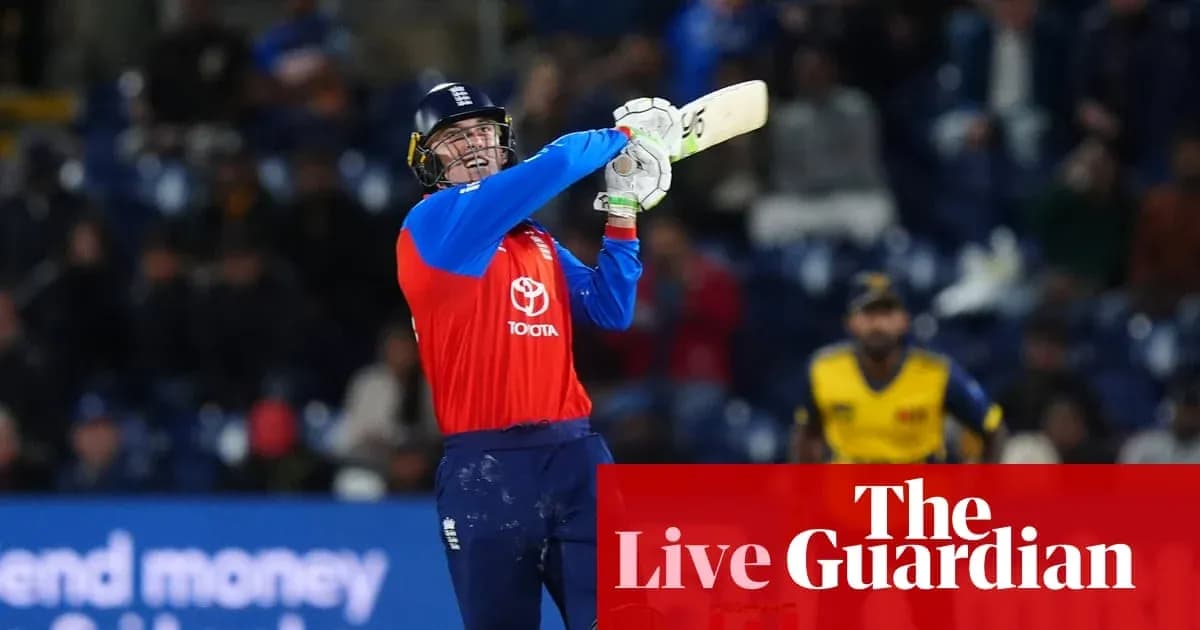
Facing Hasaranga, Brook waited, watched, and then simply dismantled him. First, he hauled over square leg for six, England’s third of the innings, surpassing Sri Lanka’s entire tally in a handful of overs. After a dot, he moved his feet, cleared his front pad and launched another six over wide long-on. The crowd sensed something shifting. So did Sri Lanka.
Brook wasn’t finished. This time he held his stance, feet still, and whipped a third six over midwicket, the ball disappearing into the stands as if it had been misfiled into another sport. In the space of a few deliveries, what had been a chase became a violation.
He didn’t last to the end – Malinga, at deep square, flung himself forward to pluck a screamer, finally halting the onslaught at 23 – but the damage was irreparable. The shot selection, the audacity, the complete lack of deference to a seasoned international attack: this is what England have built their white-ball revolution on. Brook is simply the latest, perhaps most freakish, expression of it.
A serious side, with time to wait
By the time the winning runs came, the contest had long since drained of tension. England’s batting depth never needed to reveal itself fully; the chase was handled with such authority that the lower order might as well have stayed in their tracksuits.
What lingered instead was a sense of frustration at the calendar. This is a serious T20 side, brimming with power, variety, and tactical clarity under Brook’s leadership in this series. The way he set fields, tweaked plans – such as instructing Overton not to go full, baiting the batter into a mis-hit down the ground – spoke of a captain already comfortable in the role.
They’ve secured the series, out-thought and out-hit Sri Lanka, and showcased a depth that would trouble anyone in the world.
There is only one problem: there is no World Cup until 2028.
On this evidence, England will spend the intervening years doing what they did here – refining, rotating, and, more often than not, overpowering whoever stands in front of them. The question is simple now: when the next global tournament finally arrives, will anyone be ready for this?