England's Scrappy ODI Win: Brook and Jacks Shine
Harry Brook had asked for more of the “high-octane” chaos that lit up England’s T20 clean sweep. What he got at Chester-le-Street was something very different: a scruffy, slow-burning one-day win that owed everything to a man who, not long ago, was turning out in the East Anglian Premier League – and another who has quietly become indispensable.
On a tired, end-of-season surface, England’s 265 all out in 48.1 overs looked light. No sixes. A collapse in the middle. A new mystery spinner running riot. Yet Sri Lanka never truly felt close, dragged down by the conditions, the toss, and a vice-captain who suddenly bowled like a frontline operator.
England won by 89 runs. The margin flattered them. The performance from Will Jacks did not.
Brook steady, but England stall
Brook, under a warm September sun, played the anchor. His 67 was controlled, almost subdued by his standards, but it was the innings England needed as the pitch gripped and the ball softened. He walked off with his team 182 for three and well placed to surge beyond 300.
They never got there.
Tom Banton had gone early, bowled by a lovely seaming delivery from Asitha Fernando after an energetic powerplay that brought 61 for one in the first 10 overs. From there, batting became sticky. Stroke-making lost its fluency. England’s scoring rate sagged.
Joe Root, in that familiar one-day rhythm of nudges, dabs and late cuts, looked set to bat Sri Lanka into the ground. He moved to 44, stretching an extraordinary run of ODI form that had seen him go 416 balls without dismissal. Then Sachindu Colombage arrived properly in the game.
Colombage’s leap from club cricket to centre stage
Colombage is 28, a wrist-spinner with a jerky, deceptive action and a modest domestic record. Last summer he was playing for Downham Stow in the East Anglian Premier League. On this afternoon he was dismantling some of England’s most decorated white-ball batters.
Gary Kirsten, Sri Lanka’s head coach, had looked past the numbers and trusted his eye. He liked the drift. He liked the dip. He liked the way Colombage’s leg-breaks hovered just long enough to tempt a misjudgement.
Root was the first to pay, beaten on the back foot as his off stump was rattled. Jos Buttler followed for 31, trapped lbw by one that straightened sharply. Jamie Overton, later, was bowled by a leg-break that climbed above his eyeline and ripped back.
Colombage finished with three for 44, figures that shaped the entire contest. WinViz had Sri Lanka as slight favourites at the halfway mark. Watching from the stands, it felt plausible. England’s 265 looked like a score from another era, especially given the lack of sixes – their first ODI innings in more than seven years without clearing the rope.
The turning point came with Brook.
Having looked set for something far bigger than 67, he chose to charge Dushmantha Chameera, looking for that familiar inside-out carve over the off side. Instead he skewed to deep point. One stroke, one misjudgement, and the innings buckled.
From 182 for three, England slumped to 211 for seven. Four wickets fell for 29 runs in 46 balls. Buttler went. The less experienced middle order followed.
Rehan Ahmed’s dismissal summed up the chaos. Kevin Pietersen, England’s new mentor, had hammered home the need for sharper strike rotation. Ahmed pushed to the ring, set off, realised there was never a run, and then effectively stopped. Charith Asalanka’s direct hit did the rest. It was the kind of run-out that drains dressing rooms.
England needed someone to hold the innings together. Jacks, batting out of his preferred top-three role and into the lower middle order, did just that.
Jacks the finisher, then the destroyer
Jacks’s unbeaten 46 might be remembered as the quieter half of his day. It shouldn’t be. With England wobbling, he found calm. With Gus Atkinson for company, he dragged them to something defendable. His late surge – 18 runs off the 48th over – changed the feel of the target.
Since being recast as a lower middle-order player last year, Jacks has had to adjust. He likes the new ball, the open field, the chance to dictate. Now he walks in later, often under pressure, asked to finish instead of set. He has responded with an average of 43 and a strike rate north of 100 in this role. On this pitch, against this attack, 46 not out was gold.
His real statement, though, came with the ball.
Brook turned to his vice-captain and got something far beyond “part-time” support. Jacks’s off-breaks, once a handy extra, are hardening into a genuine weapon. Here he took five for 22 from seven overs, mixing his pace, changing his angles, and never letting Sri Lanka settle.
Only Vic Marks – five for 20 against New Zealand in Wellington in 1984 – has better ODI figures for an England spinner. It is not a list Jacks would have expected to be on so soon.
Brook certainly no longer sees him as a fill-in. He called him “a very good off-spinner” and a “vital player” across the last 18 months, praising the way Jacks has embraced the all-rounder brief instead of grumbling about being shunted down the order. The dressing room clearly sees a leader. The numbers now back that up.
Sri Lanka never in the chase
Chasing 266, Sri Lanka needed a clean start and one batter to own the chase. They got neither.
Familiarity with conditions told. England’s attack, even without Adil Rashid – ruled out of the series with a hand injury – knew exactly how to use the surface. Jofra Archer, at the end of his all-format summer, took some punishment late on, but the rest of the seamers were disciplined. Overton, bowling cross-seam, picked up two wickets and squeezed the middle overs.
Every time Sri Lanka hinted at a partnership, Jacks intervened. He removed set batters, prised open the lower order and kept the asking rate climbing. His biggest scalp was Dunith Wellalage, the tourists’ top-scorer with 45, undone as Jacks varied his flight and pace.
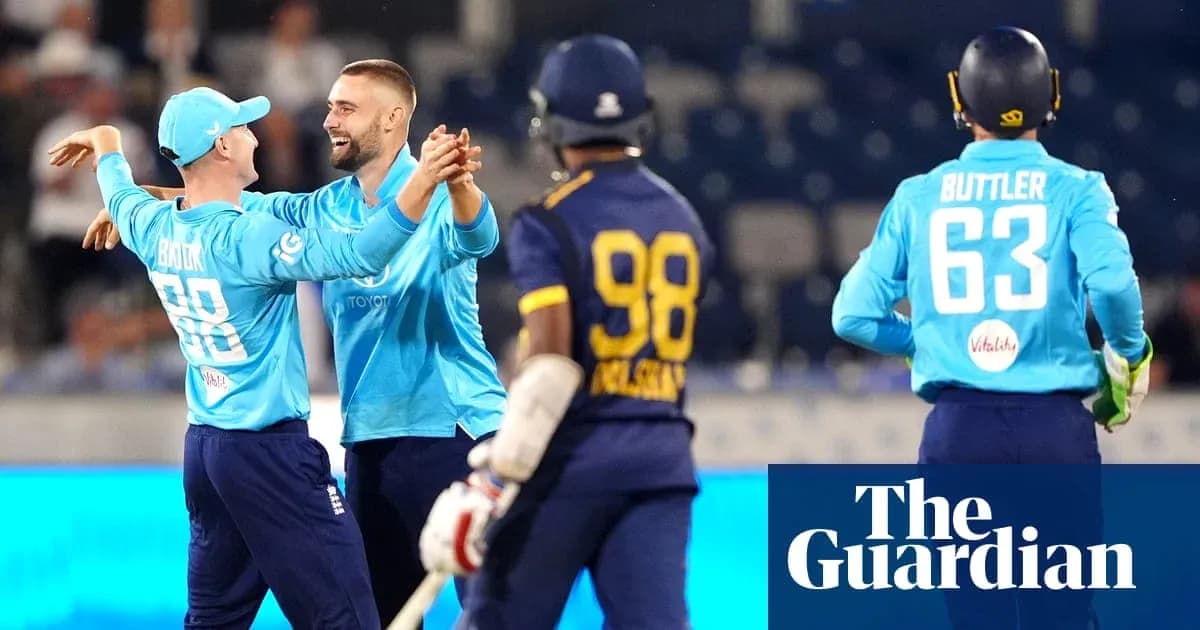
The pressure finally broke Sri Lanka’s resistance. Once the lower order walked in, the result felt inevitable. Jacks completed his five-for with a beauty to Dilshan Madushanka, ripping one past the tailender’s defence to bowl him and seal a comfortable win.
England had defended a sub-300 total for the first time since 2022. Brook had his 11th win as ODI captain, nudging his record into the black after 10 defeats and adding another quiet step to England’s one-day rebuild.
This was not the spectacle Brook had been selling after the T20s. It was scrappier, slower, more nuanced. It was also the kind of match England will have to win more often over the next 12 months as they build towards another World Cup: on tired pitches, without fireworks, leaning on versatility and nous.
On this evidence, they have found a vice-captain made for that kind of cricket.