England's Resilience Amid Imran Khan Controversy at Lord’s
On a murky, fractious day at Lord’s, England’s batters were not the only ones under pressure. By the time bad light dragged the players from the field with the hosts 248-9 in the second Test against Pakistan, the cricket had been forced to share the stage with a full‑blown diplomatic row.
Jamie Smith and Jordan Cox, each with composed half-centuries, dragged England out of a hole that had yawned wide at 36-3. Yet the numbers on the scoreboard felt almost secondary to the controversy raging off it.
PCB fury over Imran Khan segment
During the lunch interval, Sky Sports aired an 18-minute interview that detonated the calm of a Lord’s Test. Sitting with former England captain Michael Atherton were Kasim and Sulaiman Khan, sons of Imran Khan — Pakistan’s World Cup-winning captain and former Prime Minister, held in solitary confinement for three years and, according to his lawyers, in rapidly deteriorating health.
Kasim Khan did not temper his words. “It is not very clear what they are doing, just blatantly trying to kill him in there. Keep him in as long as possible, and silence him,” he said.
Atherton framed the segment starkly on air: “This is a humanitarian appeal, because there are increasing concerns about the health and wellbeing of Imran Khan.”
The interview followed a renewed letter, co-signed this week by a group of former international captains and driven by ex-Australia skipper Greg Chappell, urging Pakistan to ensure Imran receives proper medical care. “The former players who signed the letter, many of them played against Imran. He’s held in the highest regard as a former player, one of the greatest players that Pakistan have produced,” Atherton told viewers. “And as his son said there, there’s an increasing sense of urgency around his health and we want to make sure he gets the proper and requisite medical care.”
Pakistan’s reaction was swift and severe. According to Cricinfo, the Pakistan Cricket Board contacted Sky ahead of the interval to protest the segment and warned that their players would not return after lunch if it was broadcast. Sky initially delayed the interview, then ran it in full. By the time the clip ended, Pakistan’s players were already preparing to resume the second session at 2.40pm.
The match went on. The tension did not entirely lift.
Abbas bites again at his favourite ground
Out in the middle, Mohammad Abbas reminded Lord’s exactly why he calls it his favourite ground.
Pakistan, humiliated by an innings and 103 runs at Headingley in the first Test and anchored to the bottom of the World Test Championship table, at least got the conditions they craved this time. Under leaden skies, on a green-tinged pitch after a rain delay, captain Babar Azam won the toss and chose to field. It was his only change to the XI, returning from a finger injury and replacing stand-in skipper Salman Ali Agha.
Abbas, 36 and schooled by several county stints, settled instantly into that nagging, metronomic length that English batters know all too well. This is the ground where he took eight wickets in 2018 and walked away with the player-of-the-match award. He wants more than memories now.
“My first man-of-the match was at Lord’s, that’s why it’s my favourite ground — hopefully I will put my name on the honours board this time,” he said, eyeing a five-for.
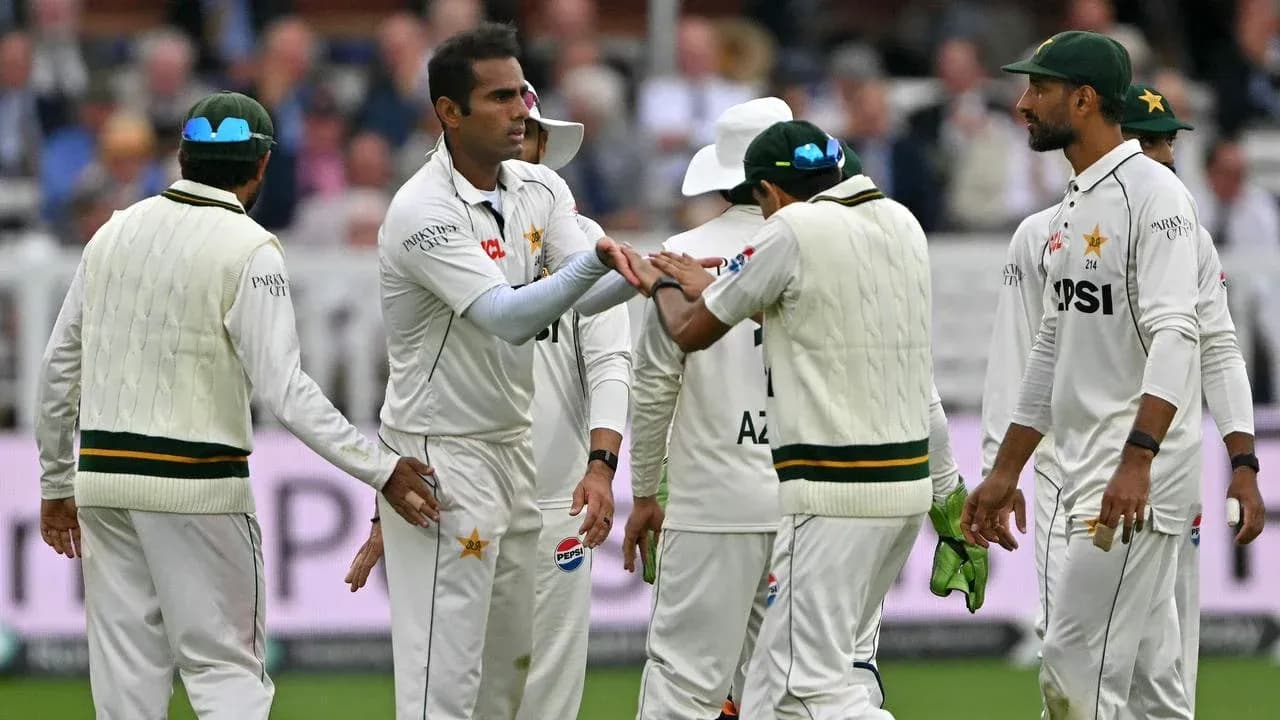
He struck early. Emilio Gay glanced a leg-side delivery that should have been routine, but Mohammad Rizwan flung himself to his left and clung on one-handed, a superb catch that set the tone.
Ben Duckett, who had begun to look settled, was trapped lbw by an Abbas nip-backer for 17. Medium pace with the keeper standing up has become something of a recurring nightmare for England, and Rizwan again came to the stumps when Joe Root walked out.
The plan worked. Abbas pinned the England captain on the back leg for just four, a huge moment in a spell where he took three wickets for four runs in 16 balls and reduced England to 36-3.
“Joe is a big batter, so I was pleased to get him with Rizwan coming up,” Abbas said. “When the ‘keeper is up, I am asking (questions), so we are making a plan.”
When Harry Brook was bowled by a superb Mohammad Ali delivery that jagged back through the gate for 15, England limped to lunch at 80-4, the ball darting, the clouds heavy, Pakistan’s seamers prowling.
Smith and Cox change the mood
England needed resistance. They found it in Jamie Smith and Jordan Cox, a pair who refused to be bullied by the conditions or the scoreboard.
Dan Lawrence might have gone cheaply when he flicked to midwicket, only for Shan Masood to spill a straightforward catch — a reminder of the shoddy fielding that plagued Pakistan in Leeds. The reprieve did not last. Lawrence, on 10, turned spinner Ali Usman to the leg side and set off for a single that never existed. Cox sent him back, Masood swooped and threw cleanly to Rizwan. Run out, and England deeper in trouble.
The pressure could have suffocated England’s middle order. Instead, Cox and Smith began to punch back. Cox, at number three and fresh from a fifty in his previous Test innings, mixed crisp drives with firm clips off his pads, using the leg side to break Pakistan’s lines. He reached his half-century from 88 balls, with seven fours, bringing it up by whipping consecutive boundaries off Usman.
Smith scored faster, his own fifty arriving from just 63 deliveries. He picked length early, drove anything overpitched and punished width. Their stand of 67 steadied England and, for the first time all day, forced Babar to search for answers.
The partnership ended in sharp, almost symbolic fashion. Cox edged Khurram Shahzad and substitute fielder Salman Ali Agha, back in the action after ceding the captaincy, flung himself low at second slip to take a superb catch.
Smith kept going, but Mohammad Ali returned to tear out the heart of the innings. He bowled Smith for 61, a vital, counter-attacking knock ended by another ball that nipped back. Two deliveries later, Ali produced a near-replica to remove Ollie Robinson, the tailender offering no answer to the late movement.
By the time the umpires finally decided the light was too poor to continue, despite the floodlights blazing, Abbas had 4-56 from 15 overs and Ali 3-67 from 17. Pakistan’s quicks had their rewards; England, just about, had a total.
“I think it is a decent enough day for us,” Smith told Sky Sports. “The ball was doing enough, nipping around — overhead conditions obviously assisted.”
England cling on, Pakistan sense a chance
England’s selection drama — Brydon Carse dropped from the squad after another late-night drinking incident, without having played in the first Test — felt like a footnote by stumps. The story belonged to the contest between bat and ball and the storm swirling beyond the boundary.
Pakistan, so poor in all departments at Headingley, were far sharper with the ball at Lord’s. Their fielding still flickered between the inspired and the infuriating, but the attack, led by Abbas and Ali, exploited every ounce of assistance on offer.
England, powered by Smith’s 61 and Cox’s 55, had clawed their way from the brink of collapse to something competitive, if not commanding. At 248-9, the innings hangs in the balance, just as the series does.
The question now is whether Pakistan can separate the emotion of the Imran Khan row from the ruthlessness required with bat in hand. On a pitch that has already given their seamers so much, can their batters finally cash in and turn a charged day at Lord’s into a turning point in this series?