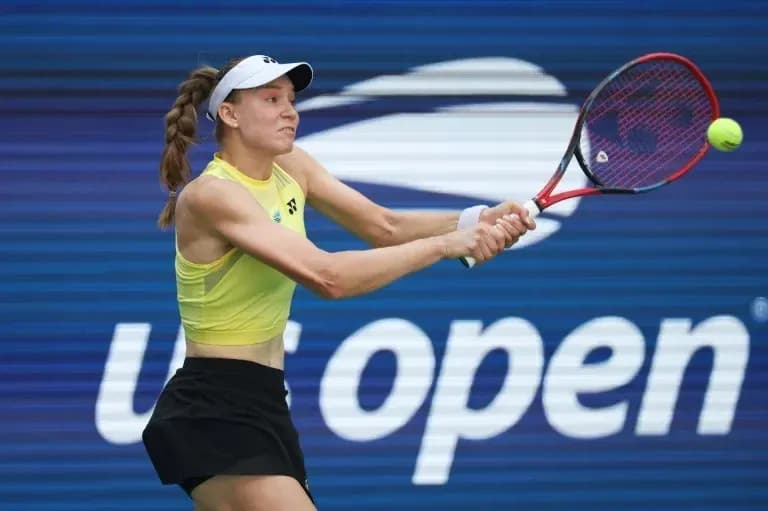
Elena Rybakina Becomes World Number One After US Open Victory
Elena Rybakina walked into Arthur Ashe Stadium chasing a semi-final spot. She walked out as the next world number one.
The 27-year-old Kazakh fought back from a set down to beat Olympic champion Zheng Qinwen 3-6, 6-1, 6-4 in a bruising US Open quarter-final that lasted two hours and 14 minutes, and with it guaranteed she will replace Aryna Sabalenka at the top of the rankings next week.
“It’s just a number right now,” she said on court, almost brushing aside the milestone. She had other priorities in the moment. “Of course I’m in the semis. It’s an amazing achievement (but) during the match I feel like I just need to focus on my game.”
On paper, it’s historic. Rybakina becomes the first player from Kazakhstan to reach world number one and the 30th woman ever to hold the top spot. In her mind, it’s something to savour later.
“It’s something for which you’re going to be very proud when you finish at the end of the year,” she said. “No matter how long you’re going to stay it’s an achievement and I feel very proud.”
For now, the job is not done. The second seed moves into Thursday’s semi-final to face the winner of the clash between Coco Gauff and Mirra Andreeva, a blockbuster duel between the fourth-ranked American and the 19-year-old French Open champion from Russia.
A slow start, a sharp reset
Rybakina came into the day with a worrying statistic hanging over her: 0-6 at the US Open when losing the first set. That ghost hovered again when Zheng, ranked 121 after a long layoff with elbow surgery, stormed through the opener.
The Chinese star, still riding the momentum of her Olympic gold and a remarkable run from qualifying in New York, struck first. She grabbed the initial break chances of the match in the eighth game, broke for 5-3 when Rybakina netted a forehand, and then dug in.
What followed was a 14-minute ninth game that showcased Zheng’s grit. She saved five break points, uncorking an ace, a backhand winner down the line and a service winner, while watching Rybakina misfire on backhand returns. On her fourth set point, Zheng drew another forehand error on the return and pocketed the set.
“It was very tough. I didn’t start my best,” Rybakina admitted. “I was struggling a little bit. We got into long rallies and I made mistakes. I was trying to be more aggressive because I feel like I wasn’t pushing enough.”
There was another battle going on, too. This was Rybakina’s first early-day match of the tournament after a string of night sessions, and she didn’t hide the mental adjustment.
“It has been an early match. In my head I was complaining about the shadow,” she said. “I was too much negative. I’m glad I pushed all the negative thoughts away. I just kept telling myself: ‘Keep fighting’.”
Once she did, the match flipped.
The serve ignites, the world number one emerges
Rybakina opened the second set with back-to-back aces. It felt like a statement. She held, broke Zheng immediately with a forehand winner for 2-0, then saved a break point with another forehand strike on the way to 4-1.
The pressure finally told. Rybakina broke again with a forehand winner for 5-1 and served out the set with authority. The second seed had found her range, her tempo, and the kind of controlled aggression that has already brought her two majors — Wimbledon 2022 and this year’s Australian Open.
Any lingering questions about the foot injury that had disrupted her US Open preparation faded as she moved freely and hit without restraint. She improved her head-to-head record against Zheng to 5-1, with a third win over her this season alone.
The decider became a test of nerve.
Zheng, who had stitched together seven wins in New York from qualifying to the last eight, refused to fold. She saved a break point in the fifth game. Rybakina answered by fending off a break point of her own in the eighth. At 4-4, the margins shrank to a handful of swings.
Then came the crack. Serving in the ninth game, Zheng double-faulted to hand over the decisive break. Rybakina, now smelling the finish line and the number one ranking, stepped up to serve it out and did not blink.
One last hold. One last forehand. A place in the semi-finals, and a new name at the top of the women’s game.
Zheng’s run ends, but her statement stands
For Zheng, the loss stung, but the bigger picture was hard to ignore. After almost eight months out following elbow surgery, she arrived in New York ranked 121, went through qualifying, and won seven matches to lock up a return to the top 60 next week.
“I got a lot of chances in the third set, but I didn’t take them,” she said. “That was a bit pity for me to lose this match, but obviously I can take positive things from the US Open this year.”
She knew where the match slipped.
“Maybe when she serve second serve, I could be more aggressive sometimes and make a bit less mistake in the return,” she reflected. “Today is just few points makes the difference.”
Those few points separated a first US Open semi-final from a long, satisfied walk back to the locker room after a breakthrough fortnight.
A new order at the top
Rybakina came into the tournament as one of four women with a shot at leaving Flushing Meadows as world number one. Her win slammed that door shut on the others. Sabalenka, Gauff and Jessica Pegula all saw their hopes of claiming the top spot evaporate with the Kazakh’s comeback.
Sabalenka and Pegula will meet in Thursday’s other semi-final, still hunting the title if not the ranking. Rybakina, meanwhile, chases a third Grand Slam crown with the confidence of a player who knows she now sets the standard.
She has already made history for Kazakhstan. The ranking is secure. The question now is simple: can the new number one finish this New York run with the trophy in her hands?