Elena Rybakina Withdraws from WTA Finals After Historic Season
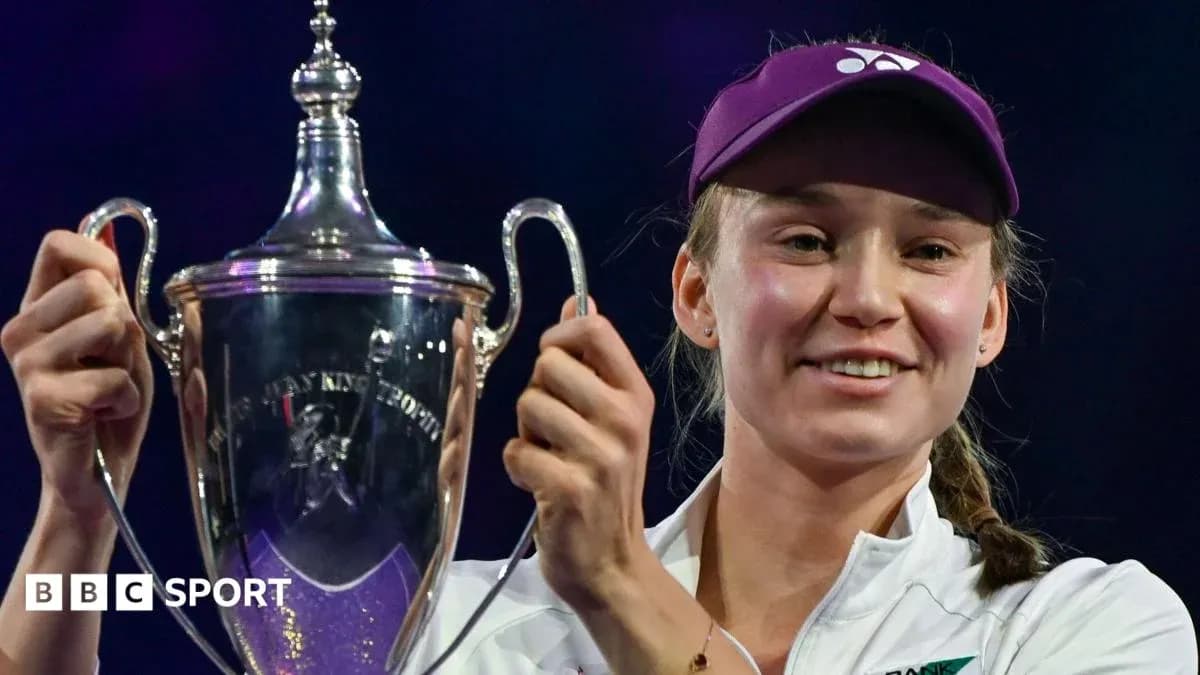
Elena Rybakina’s season of supremacy has ended not with a final statement in the desert, but with a quiet, reluctant withdrawal.
The world number one pulled out of the WTA Finals on the eve of the tournament in Indian Wells, forced to abandon her title defence by a viral illness that her body simply could not shake in time.
“I am really sad to inform all my fans and supporters that I unfortunately have to withdraw from the WTA Finals this year,” Rybakina said. “I've had an incredible season but my body is just not physically ready to compete. I'm going to spend some time resting and recovering at home and getting myself ready for the 2027 season.”
For the tour, it is a jolt. For Rybakina, it is a pause at the end of a year that has redefined her place in the sport.
A historic season, cut one week short
Rybakina arrived in 2026 with a major title already on her résumé from Wimbledon 2022 and a nagging question attached to her name: could she back it up? She answered with a season that left little room for doubt.
She claimed the Australian Open, then the US Open, seizing two majors in one year and establishing herself as the game’s standard-bearer. She added trophies in Stuttgart and Ningbo, and pushed deep on hard courts again with runner-up finishes at Indian Wells and Toronto.
The numbers are blunt and unforgiving for her rivals. She finished the year with a 54–14 record, winning 17 of 19 matches at Grand Slam level. Six of her 15 career titles have come since last October, a blistering run that transformed her from a dangerous champion into the dominant force on tour.
The ranking soon reflected the reality on court. In New York, she ended Aryna Sabalenka’s 99-week grip on the number one spot by beating the Belarusian in the US Open final. In Tokyo in October, she locked in the year-end world number one ranking, the ultimate confirmation of a season spent at the sharp end of every big draw.
Power, precision, and a tour on the back foot
Rybakina’s rise has been built on the most reliable weapon in the women’s game. Her serve has not just been good; it has been the defining shot of the season.
She led the tour with 438 aces, a staggering 140 more than second-placed Sabalenka. Matches often felt decided before they began, opponents scrambling to hold serve just to stay attached to a scoreboard that her delivery controlled.
But this was no serve-only campaign. Rybakina hammered 1,775 winners across the year, more than any other player, and repeatedly imposed herself in the biggest matches. She collected 10 wins against top-10 opponents, again unmatched on tour, and turned marquee encounters into statements of hierarchy.
The pattern became familiar: a heavy first serve, a flat, unflinching forehand, and a demeanour that barely flickered regardless of the occasion. Big stadiums, big names, big pressure – she met all of it with the same stripped-back, ruthless tennis.
A missing champion in the desert
Indian Wells, where she finished runner-up earlier this season, was supposed to be the final stage of her 2026 story. She arrived as defending WTA Finals champion, chasing a slice of history.
No woman has retained the season-ending crown since Serena Williams in 2014. Rybakina, 27 and at the peak of her powers, stood on the brink of that company. One more week, one more title, and the comparison would have been impossible to ignore.
Instead, the Finals lose their top seed and reigning champion a day before the first ball is struck. The draw opens up. The field breathes a little easier. The event itself loses the player who has defined the year.
For Rybakina, though, the decision underlines the toll of a relentless schedule and a season played at full throttle. Illness has intervened where opponents so often could not.
The standard for 2027
Rybakina leaves 2026 as the undisputed number one, the owner of two new majors, four titles in all, and the most imposing statistical profile on tour. She has answered the question that lingered after Wimbledon 2022 and replaced it with another.
If this is what she can do in a year when her body finally says “enough” in November, what happens when she returns in 2027 fully rested, fully fit, and already knowing exactly what it takes to rule the sport for 12 months straight?