Elena Rybakina Claims US Open Title and World Number One Ranking
Elena Rybakina walked into Arthur Ashe Stadium on Saturday night already knowing the rankings story. Win or lose, she would wake up as the new world number one.
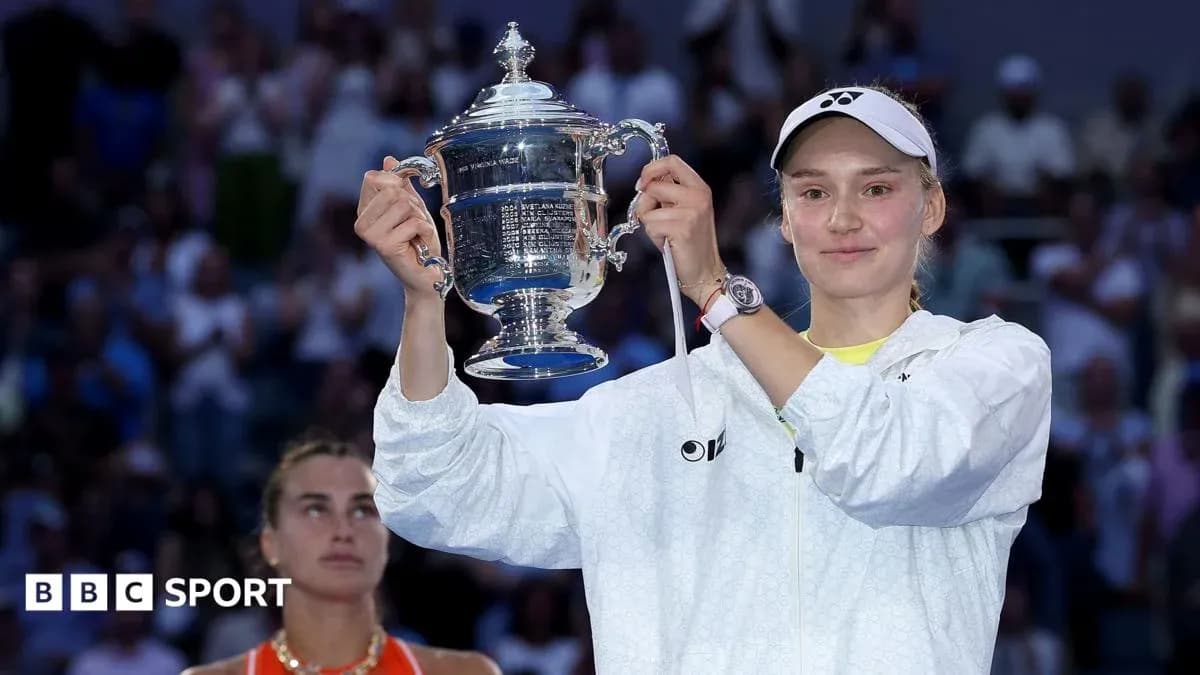
She left with something far more powerful: the US Open trophy and a statement performance that underlined why, right now, she is the standard in women’s tennis.
The 27-year-old from Kazakhstan dethroned two-time defending champion Aryna Sabalenka 6-4 5-7 6-2, claiming her first title in New York and the third Grand Slam crown of a surging career that already includes Wimbledon 2022 and this year’s Australian Open.
Ice versus fire
This rivalry has always been about contrast as much as quality. Sabalenka, all noise and raw emotion, stalking the baseline and barking at her box. Rybakina, almost eerily calm, barely a flicker as she unloads from the back of the court.
On this stage, that contrast decided the match.
Rybakina’s serve — usually her sledgehammer — misfired early. First serves drifted long, second serves sat up. On another night, that might have been enough to let Sabalenka run away with the opener.
Instead, Rybakina tightened everything else. She read Sabalenka’s delivery, stepped in, and turned return games into ambushes. The defending champion’s frustration grew with each heavy, deep reply that pinned her behind the baseline. The set went to Rybakina, 6-4, not because she was at her best, but because she was composed when her best briefly deserted her.
Sabalenka, chasing a third straight US Open crown and desperate to soften the blow of losing the top ranking to the woman across the net, finally found her range in the second set. The groundstrokes bit harder, the errors dropped, and Rybakina’s level dipped just enough to invite trouble.
At 5-6, with Rybakina serving to force a tiebreak, Sabalenka swarmed her second serve. Three chances came and went before the Belarusian seized the third, cracking open the match and dragging it into a decider with a clenched fist and a roar. The champion was still swinging.
Then the old demons came back.
The decider that defined it
The third set began with a familiar pattern: Rybakina absorbing, redirecting, refusing to blink. Sabalenka’s loose shots — the rushed forehands, the flattened backhands that flew long by inches rather than feet — crept back into the contest. So did the negativity.
Rybakina sensed it. Her returns grew bolder, landing deeper, driving Sabalenka off the baseline and into defensive positions she hates. The break for 2-1 felt inevitable, not opportunistic. From there, the incoming world number one expanded into the match, shoulders looser, feet lighter, striking through the ball with the authority of a player who knows the moment belongs to her.
Sabalenka’s resistance sagged. Rybakina’s control hardened.
Serving for the championship, the Kazakh finally showed a crack. On her first match point, she tossed the ball, swung — and double-faulted. A lesser player might have let the doubt seep in.
Rybakina reset in an instant. Next point, she went to her signature weapon and drilled an ace, sealing the title and underlining her status as the game’s most complete force.
For once, the mask slipped. A brief, unmistakable smile crossed her face as she walked to the net. No wild celebration, no collapse to the court. Just a small window into the satisfaction of a season that now boasts two majors and a new world number one ranking.
A decade of struggle, a fortnight of dominance
This was not the title most had circled for her. Not because of her game — which screams hard-court success — but because of her history in New York.
For 10 years, the city and its brash energy had given her nothing. Early exits, flat performances, a player whose personality never quite synced with the chaos of Flushing Meadows.
“I was coming here for the last 10 years and it was never successful. I'm falling in love with New York more and more,” she said afterwards, the line carrying the weight of a long, stubborn journey.
Her tennis has always seemed tailor-made for these courts. The penetrating serve. The thunderous, first-strike groundstrokes that can take the racquet out of anyone’s hands. The ability to dictate from the first ball, to play on her terms.
That’s why this breakthrough felt overdue. Yet the path to it almost never started.
From injury doubt to career peak
Just weeks ago in Cincinnati, Rybakina left the court with an injured ankle and a genuine fear she might not make it to New York at all. She couldn’t walk for several days. Her team went “day by day,” as she put it, unsure if the joint would hold up to the pounding of a two-week major.
It did more than hold.
Once she stepped onto the US Open courts, her serve became a shield and a sword. She cruised through her opening four matches, barely allowing opponents to find a foothold in rallies. Games flashed by as she racked up cheap points, conserving energy for the inevitable storm that lurks in the second week of a Slam.
That storm arrived in the form of Zheng Qinwen and Coco Gauff. Both took the first set from her. Both forced her into a different kind of battle — longer exchanges, higher stakes, more pressure. Rybakina answered those questions too, grinding through, proving not just her firepower but her durability and patience.
Against Sabalenka, she stitched those two versions of herself together. The bully from the baseline. The fighter who can absorb punishment and still find a way. The result leaves her one French Open title short of the career Grand Slam, a milestone that suddenly feels less like a dream and more like an appointment.
“Some magic is happening. I was unlucky with injury and just going day by day,” she told Sky Sports. “We didn't know how it was going to be so I'm super happy and still can't believe it.”
Magic, maybe. But also cold, ruthless clarity at the biggest moments.
New York finally belongs to Elena Rybakina. The question now is how long the rest of the tour will be chasing her.