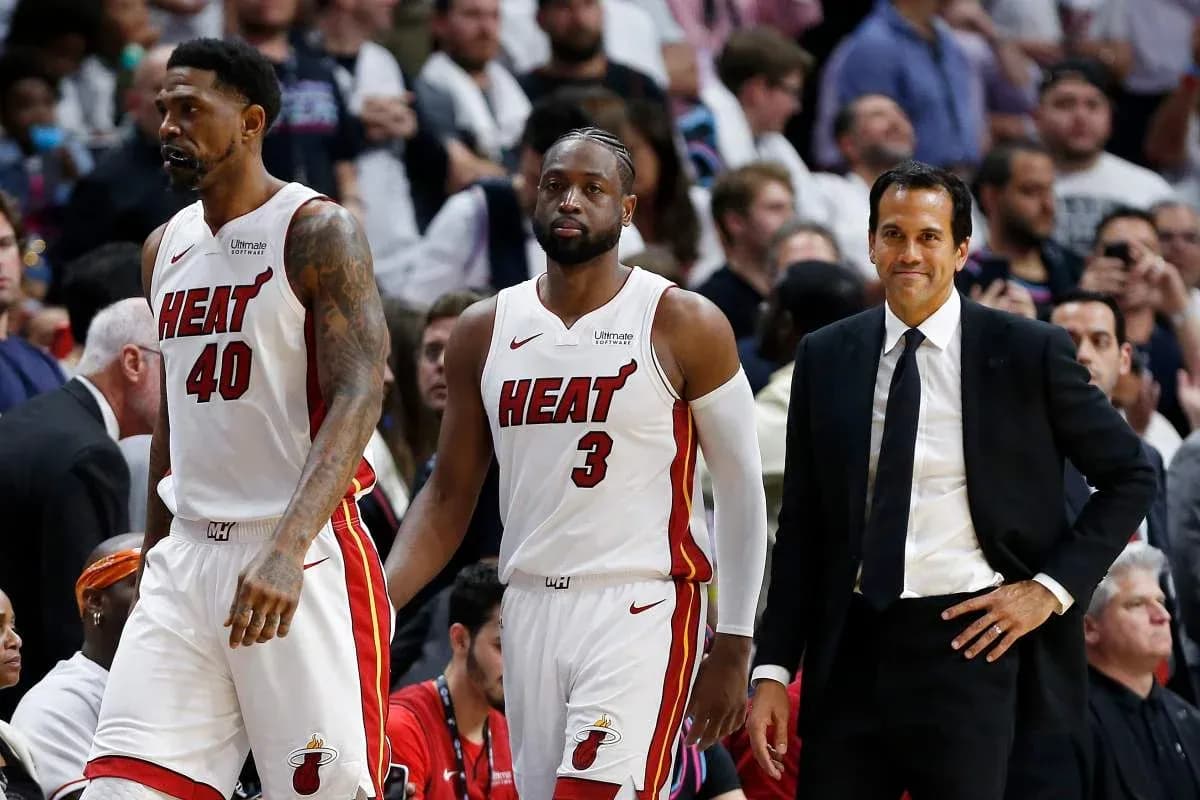
Dwyane Wade's Journey to Redefine Heat Culture
Dwyane Wade has heard every kind of locker-room joke an NBA career can throw at a player. Three titles, thirteen All-Star nods, a Hall of Fame résumé in waiting — and all of it built inside one of the league’s most famously hard-edged environments.
But the tone of those rooms hit him differently once his daughter Zaya came out as a trans woman.
The Heat legend recently opened up about how the casual jabs and LGBTQ jokes that long passed as “normal” in NBA circles began to grate on him, and how that tension forced a reckoning — not just with teammates, but with himself.
“I started listening a little bit differently,” Wade said, explaining that before he and his family publicly spoke about Zaya, something in him had already shifted. The same locker rooms he once treated as background noise suddenly sounded a lot louder.
He called it what it was: a “masculine, toxic environment” that he and so many others grew up in. The jokes were the same. Wade wasn’t.
As he put his daughter’s feelings and safety at the center of his world, those offhand comments from teammates stopped being harmless banter and started to feel like a direct threat to the kind of space he wanted to create — both at home and at work. He began to pull away. No longer laughing. No longer lingering.
He walked out of the room when certain things were said.
In a league where no active player has ever publicly come out, that silence has long been part of the culture. Jason Collins waited until after retirement to share his truth, not wanting the storm that would have followed during his playing days. Wade, watching his daughter navigate her identity in public, could no longer shrug off the same old lines.
The pressure finally told in Miami.
Udonis Haslem Steps In
If there is a heartbeat to “Heat culture,” it has long been shared by two men: Dwyane Wade and Udonis Haslem. Teammates for over a decade. Co-leaders in the locker room. Trusted lieutenants of Pat Riley and Erik Spoelstra.
So when Wade started to change, Haslem noticed.
“I remember having a conversation with UD because he seen that I wasn’t in on the jokes no more,” Wade recalled. He wasn’t laughing. He was leaving. He was distancing himself from his own brother.
That bothered him as much as the jokes did.
Wade decided he couldn’t let the gap grow in silence. He sat down with Haslem and laid it out: the language, the jokes, the way certain communities were talked about. The fact that the words now cut differently because of Zaya — and because of the man Wade was trying to become.
This wasn’t a lecture. It was a hard, honest talk between two veterans who had gone to battle together for years.
Haslem, Wade said, simply didn’t know. Not really. Not in the way Wade was now experiencing it through his daughter’s eyes.
From that conversation, the tone changed.
Haslem adjusted his thinking. Then his tone. Then his verbiage. Then, crucially, his actions. One of the most respected enforcers in the league, the man who embodied Miami’s edge, chose to shift with his friend rather than push back.
For Wade, it was proof of what can happen when trust meets vulnerability in a space not known for either.
He called it “the power of someone that he trusts to have a safe conversation with him in a safe environment.” In a league that often prizes toughness over tenderness, that kind of exchange is still rare.
Yet in Miami, it helped reshape the room.
Redefining Heat Culture
The Heat are routinely held up as one of the NBA’s model franchises, built on discipline, conditioning, and an almost militaristic standard of accountability. Spoelstra and Riley set the tone, but Wade and Haslem carried it into the locker room.
Now, that culture has another layer.
Wade has become one of the most visible LGBTQ allies in American sports, praised for the way he stands publicly with and for Zaya. His advocacy isn’t abstract. It’s rooted in the very real discomfort of sitting in a room full of men he loves and realizing the jokes they make could wound his child.
He didn’t set out to be the face of a movement. He set out to protect his daughter. Once the environment he’d lived in for years collided with that mission, something had to give.
So he pushed for a different kind of standard in the NBA’s most macho space: a standard where language matters, where respect isn’t conditional, and where even the toughest voices in the room can learn and pivot.
The banners in Miami tell one story about Dwyane Wade and Udonis Haslem — the championships, the grit, the sacrifice. The quieter story, unfolding long after the confetti fell, is about two veterans deciding that “Heat culture” could mean more than just hard fouls and early-morning workouts.
It could mean growth. It could mean protection. It could mean making sure the next generation walks into a locker room that sounds a little different from the one they inherited.