Dinusha’s Epic Defiance Stalls India in Colombo Test Draw
By the time Sonal Dinusha pushed into three figures for the third time this series, the mood in Colombo had shifted. What began as India’s march towards a clean sweep slowly turned into a long, stubborn, Sri Lankan sit‑in. By the final session on Day 5, the contest had stopped being about who would win. It became about how long one young all-rounder could hold off an entire attack.
Sri Lanka, following on and once staring at a heavy defeat, ground their way to 395/8 in 140.3 overs, with Dinusha the axis around which the entire resistance turned. The lead – 170 – was never really about setting a target. It was about survival. And with every over he soaked up, the prospect of a result slipped further from India’s grasp.
Dinusha, Again
This has been Sonal Dinusha’s series. That much is no longer up for debate.
He began Day 5 on 83*, having already dragged Sri Lanka from the brink once in the first innings with a superb century. He finished it with yet another hundred, this one stitched together under even greater pressure and, crucially, under visible physical strain. His back troubled him. His movements stiffened. The sweeps, though, never left him.
All morning, Dinusha and Keshara Nuwantha blocked out India’s plans and their impatience. Sri Lanka resumed on 242/6 following on, still 58 behind, but the pitch had gone docile and the ball, as Sairaj Bahutule had warned before play, kept softening after the 30th over. India were forced to work with a surface that had lost its menace and a ball that refused to bite.
Nuwantha played within himself, rarely flirting outside off stump. Dinusha was more expansive, sweeping the spinners relentlessly, picking off singles, and occasionally threading boundaries. The pair raised a 50‑run stand and pushed Sri Lanka past parity, then beyond a 100‑run lead. By lunch, Sri Lanka were 330/6, the partnership unbroken, India wicketless through the entire session.
The numbers told one story. The body language told another. India’s bowlers had already sent down close to 90 overs in the first innings, enforced the follow-on, and now were grinding again on a surface that refused to deteriorate as expected.
India’s Frustration, Sri Lanka’s Resolve
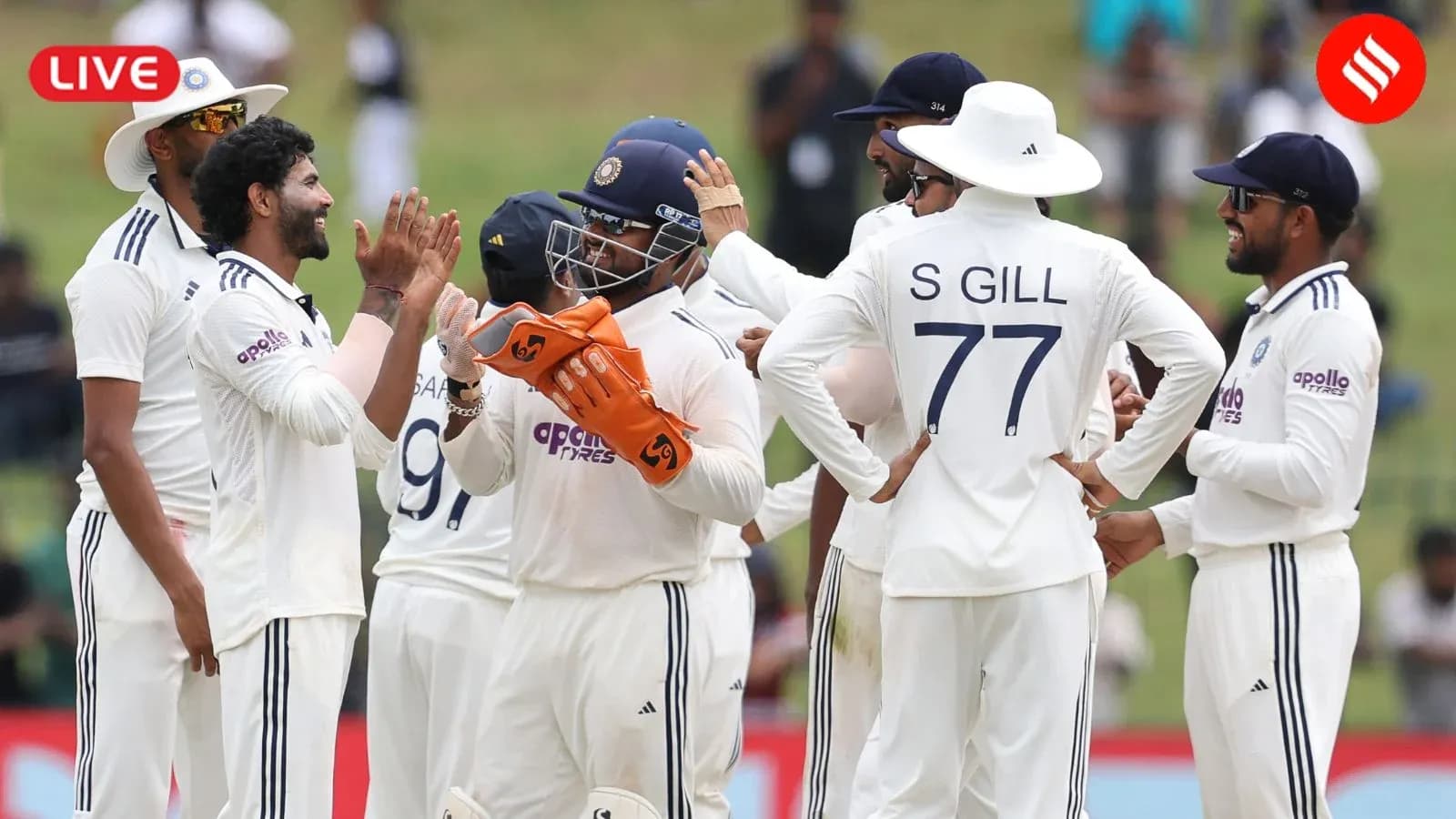
Shubman Gill rotated his bowlers constantly. Mohammed Siraj, Prasidh Krishna, Ravindra Jadeja, Manav Suthar, Saransh Jain – all were used in short, probing bursts. The new ball, available at 80 overs, was delayed, then finally taken with Sri Lanka 257/6. Gill went to pace from both ends, Siraj and Prasidh hunting for that one spell to crack the game open.
It never quite came.
Nuwantha eventually fell for a hard‑earned hand, nicking off to Suthar after a long, stubborn stay. Dhruv Jurel took a sharp catch and India finally had a breakthrough at 331/7. The relief was obvious. But Sri Lanka had already dragged the game away from danger and into deadlock.
Prabath Jayasuriya arrived and did exactly what his team needed: nothing flashy, nothing risky, just a straight bat and a narrow scoring zone. He faced over 20 deliveries, played within the stumps, and refused to follow anything wide. On a pitch that never really misbehaved, that discipline was enough.
Jadeja, India’s most threatening bowler across the day, kept beating the bat and hitting the rough outside the left-hander’s off stump. He finally removed Jayasuriya, who drove loosely and was taken by the infield. That brought Lahiru Kumara to the crease – and with him, the last realistic chance for India to force a finish.
Kumara Shuts the Door
Kumara’s role was simple: survive. He did far more than that.
He had already shown in the first innings that he could hang around, facing 52 balls. In the second, he settled in again, playing 24 deliveries early on, then stretching his stay, over by over, into something far more significant. He left well, defended straight, and when Dinusha’s back tightened, he took more of the strike.
India tried everything. Siraj banged it in short. Prasidh searched for lift and late movement. The spinners went around and over the wicket, used the rough, changed pace, altered angles. Gill even turned to part‑timers as Jadeja walked off mid‑over with heel discomfort, another worrying sign for India on a day that kept slipping away.
Nothing dislodged Kumara. Nothing dislodged Dinusha either.
By Tea, Sri Lanka were 383/8, Dinusha marooned on 98*, the lead 170. The game, in truth, was gone as a contest. The only question left was whether Sri Lanka would dare dangle a declaration to spice up the final session. They chose sanity over romance. With Dinusha’s third century of the series sealed soon after the interval and the clock running down, the draw became the only sensible outcome on the table.
A Pitch That Never Turned Ugly
Much of India’s frustration stemmed from the surface itself. The Colombo pitch teased turn from Day 2, but never evolved into the raging fourth- and fifth-day beast they might have hoped for.
The ball gripped occasionally, particularly from the rough, but rarely from a good length on straight lines. Batters could trust their defence. They could leave on length and line. They could sweep – as Dinusha did repeatedly – without the constant fear of that one unplayable ball.
Bahutule, India’s spin coach, had flagged the challenge: once the ball softened and the seam dampened in the wet outfield, it lost bite. That’s exactly how it played out. India’s spinners kept asking questions, but the pitch refused to join the interrogation.
The decision to enforce the follow-on, made with weather looming on Day 4 and Sri Lanka 303 adrift after being bowled out for 290, was tactically sound. It also meant India’s bowlers shouldered an immense workload on a surface offering diminishing returns. As the overs piled up, so did the Sri Lankan partnerships.
The Turning of the Tide
The shift in this Test didn’t begin on Day 5. It started the previous afternoon.
After India had rolled Sri Lanka for 290 – Saransh Jain finally claiming Dinusha for his debut wicket – Gill put them in again, hunting a three‑day finish with rain around. Early in the follow‑on innings, it looked on. Siraj removed Lahiru Udara with a short ball. Jadeja trapped Kamil Mishara sweeping. At 83/2 at lunch on Day 4, Sri Lanka still trailed by 130 and were wobbling.
Then came the resistance.
Pasindu Sooriyabandara and Kamindu Mendis put on a sparkling stand, mixing discipline with adventure. Kamindu reached a half-century with a six over square-leg. Pasindu slog‑swept, drove, and ran hard. India’s young left‑arm spinner Manav Suthar, so impressive earlier in the series, suddenly found himself under sustained attack for the first time in his Test career.
The partnership crossed 100, dragged the deficit under three figures, and forced India to think. Prasidh eventually broke it, Mendis falling to a well‑set short‑ball trap, Gill running back to take a superb catch. But the tone had changed. Sri Lanka, for the first time in the match, were dictating tempo.
Pasindu carried on into the 90s, Dhananjaya de Silva added a calm presence, and by Tea Sri Lanka were 199/3, just 14 behind. The pitch had gone flat, the ball older, the Indian bowlers weary.
The final session of Day 4 swung back India’s way. Suthar removed Dhananjaya with a soft dismissal, then out‑thought Sooriyabandara, who charged and was stumped by Pant. Saransh Jain joined in, trapping Niroshan Dickwella and tightening the screws. From 199/3, Sri Lanka collapsed to 228/6 as the light closed in and rain swept across Colombo.
That collapse opened the door. Dinusha slammed it shut the next day.
Young Bowlers, Harsh Lessons
For India, this Test will be remembered as much for the education of their young bowlers as for the result that got away.
Prasidh Krishna, backed strongly by bowling coach Morne Morkel before the game, again showed why India see him as a long‑term all‑format option. His extra bounce and willingness to do the “donkey job” – long, hard spells into the pitch – gave India control and occasional breakthroughs. Siraj, operating at a more moderate pace in these conditions, still hammered the deck, especially at Dinusha’s ribs, searching for that one mistake.
Jadeja was, as so often, India’s most reliable threat. He hit the stumps, challenged both edges, and kept the scoring tight. His heel discomfort late on Day 5, though, will concern India with a home series against Australia on the horizon.
Suthar and Jain lived the full Test experience in fast‑forward. Periods of control. Periods of attack. Periods of being attacked. Jain, on debut, was praised by Bahutule for his consistency and side‑spin-driven drift. He earned his first Test wicket with Kumara’s dismissal in the first innings, then contributed crucial strikes in the follow-on. Suthar, meanwhile, oscillated between looking the most threatening spinner on show and being targeted by Sri Lanka’s middle order.
These are the days, as Morkel put it, that build character. Days when the pitch doesn’t help, partnerships grow, and you have to find ways – any ways – to be creative enough to prise out a “sneaky wicket”.
Sri Lanka Find a Spine
For Sri Lanka, this match was less about the scoreline and more about rediscovering a bit of backbone.
They were outplayed for long stretches of the series, but in Colombo they finally strung together the sort of stubborn, layered batting that Test cricket demands. Dinusha’s twin centuries, Kamindu and Pasindu’s counter‑attacking stand, Nuwantha’s stoic support, Kumara’s tail‑end defiance – all of it added up to something more substantial than a mere draw.
They denied India a clean sweep. They protected their pride. They unearthed, in Dinusha, a genuine long‑term all‑round prospect who can change games with bat and ball.
India, for all their dominance across the series, walk away from Colombo with questions. About finishing off games on flat tracks. About managing workloads when enforcing the follow-on. About slip field placements for their quicks. About how their next generation of spinners responds when the pitch doesn’t play along.
The scoreboard will record this as a draw. The memory, though, will linger as the Test in which a young Sri Lankan left-hander refused to let a series end quietly – and forced a heavyweight Indian side to think hard about how they close out the next one.