Dane Sweeny Upsets Lorenzo Musetti at US Open
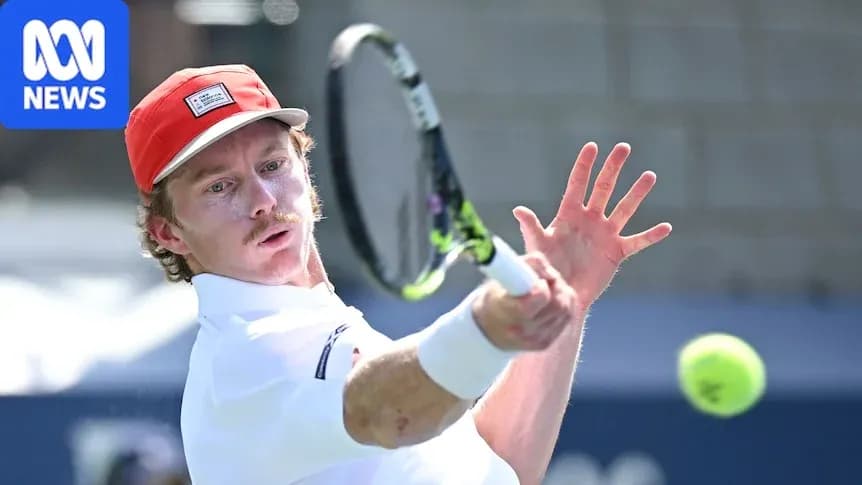
Dane Sweeny walked into Flushing Meadows as a wildcard. He walked off court on Friday as the man who blew the US Open draw wide open.
The 25-year-old Australian, standing just 170cm, produced the match of his life to dismantle 14th seed Lorenzo Musetti 3-6, 6-1, 6-2, 6-2 in a stirring second-round upset that crackled with defiance and nerve.
This was no lucky escape, no five-set scramble. Sweeny bossed a dual grand slam semi-finalist from the back of the court and at the net, running Musetti into the ground and refusing to yield once he’d found his range.
He dropped the opening set, then flipped the script.
The response was brutal. Sweeny tore through the second set 6-1, dragging the Italian wide, rushing him, forcing rushed swings and ragged errors. Once he broke twice early in the third to lead 3-0, the favourite’s composure went with it.
Musetti called for a medical time-out, clearly in distress as the underdog swarmed all over him. Even when he retrieved one of the breaks, the world No.14 kept barking towards his box, searching for answers that never came.
Sweeny kept diving, literally, to keep his grip on the match.
Despite carrying a massive ice pack on his right elbow after his first-round win, he hurled himself around the net like a throwback, channelling Boris Becker with full-length dives for acrobatic, winning volleys. The crowd lapped it up. So did Sweeny.
By the time he closed it out, the Australian had not only reached the third round of a grand slam for the first time, he’d secured at least $US290,000 in prize money and a rankings surge towards a career-high mark of at least No.115.
“I'm just grateful to be even able to compete in grand slams. The tennis journey is such a rollercoaster,” he said on court, soaking in the noise. “And to soak up the atmosphere and get a win, a couple of wins, in front of this crowd, is awesome.”
His reward is another Italian: world No.22 Luciano Darderi awaits in the last 32 on Saturday (AEST). On this evidence, Sweeny will not be overawed.
For a while, it looked like a full-scale Australian charge into the third round.
Tristan Schoolkate, who had fought his way through qualifying, came out swinging against French Open runner-up Flavio Cobolli and pinched the first set 6-3. Under a punishing New York sun, he went toe to toe with the fifth seed for more than two and a half hours.
The Italian’s class eventually told. Cobolli steadied, tightened up his service games and began to find heavier length, turning the match around to win 3-6, 6-3, 6-4, 7-5 after two hours and 41 minutes. Schoolkate’s run ended, but not before he had announced himself on one of the sport’s biggest stages.
On the adjacent storyline, Alexei Popyrin relived a familiar frustration in New York.
Two years after stunning Novak Djokovic in the third round, he again positioned himself for a spot in the last 32 by taking the opening set against Alejandro Tabilo. He looked sharp, aggressive, and fully locked in as he swept through the first set 6-2.
Then came the fine margins.
Tabilo, the 25th seed from Chile, dug in and dragged the match into tiebreak territory. He edged the second-set breaker 7-4, repeated the trick 7-3 in the third, and with the scoreboard weight behind him, raced away 6-2 in the fourth to complete a 2-6, 7-6 (7-4), 7-6 (7-3), 6-2 win. The victory sets up a likely third-round clash with top seed Alexander Zverev.
What began as a day that might deliver a trio of Australian breakthroughs instead became Sweeny’s stage.
One qualifier finally ran out of steam. One former giant-killer fell in two tiebreaks he’ll replay in his mind for days. But the smallest man in the story produced the biggest punch, flattening a top-15 star and elbowing his way into the second week conversation.
Elsewhere, sixth seed Alex de Minaur was scheduled to follow Schoolkate onto The Grandstand against Dutchman Botic van de Zandschulp, another chance for Australia to leave its mark on a draw suddenly feeling a little more open.
Sweeny has already done his part. Now the question is simple: how far can this run, and this new belief, carry him?