Cristiano Ronaldo's Journey: Tears, Triumphs, and Unfulfilled Dreams
On an August night in 2003, a skinny teenager with frosted tips pulled on the Portugal shirt for the first time. He was 18, freshly signed by Manchester United, and still more promise than product. The venue was a low-key friendly against Kazakhstan, the kind of game that usually drifts into obscurity.
Cristiano Ronaldo refused to drift.
Luiz Felipe Scolari threw him into a squad led by Luís Figo and the other grandees of Portugal’s “Golden Generation.” The kid from Madeira did not yet own the stage, but he looked like he intended to. A debut in a 1-0 win was a small entry in the record books, yet it marked the beginning of a story that would bend the history of international football.
Tears at Home
Less than a year later, the stakes exploded. Portugal hosted Euro 2004 and Ronaldo, still a teenager, walked into his first major tournament with a nation’s hopes wrapped around his shoulders.
In the opening game against Greece, he rose in stoppage time, hanging in the air in that familiar way, and buried a header. His first goal for the national team. It should have been a perfect introduction. Instead, it landed in a 1-2 defeat that stunned the hosts and hinted at the turbulence to come.
Portugal recovered and advanced. In the semifinal against the Netherlands, Ronaldo struck again, this time opening the scoring and driving his country into their first major final. The boy was becoming the face of the future in real time.
Then came the final, and with it, a national trauma. Greece, stubborn and unyielding, stole a 1-0 win. As the whistle went, the cameras found Ronaldo. Tears streaming, shoulders shaking, a teenager broken on home soil. That image – a prodigy sobbing beneath confetti meant for someone else – became one of the defining photographs of his early career.
The stage was set. Glory would not come easily.
Dragging Portugal to Brazil
Fast forward a decade. The boy was gone; in his place stood one of the game’s most ruthless finishers. Yet even a prime Ronaldo could not spare Portugal from a shaky World Cup qualifying campaign in 2013. They missed automatic qualification and were shoved into a playoff with Sweden.
Ronaldo versus Zlatan Ibrahimovic. A duel dressed up as a tie.
In Lisbon, Ronaldo struck the only goal in a 1-0 win. The job was half-done. In Solna, it turned into something else entirely.
He opened the scoring in the second half, seemingly killing the contest. Ibrahimovic answered with two thumping replies, flipping the game to 2-1 and threatening to rip the World Cup from Portugal’s grasp.
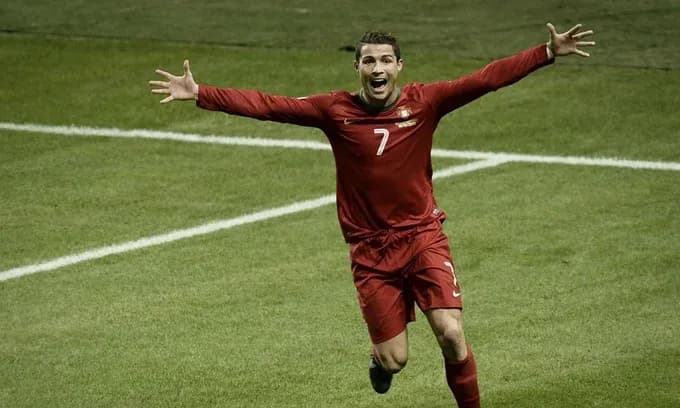
Ronaldo’s response was brutal. First, he burst through and finished with cold precision. Then another run, another lethal strike. Hat-trick complete. Portugal 3, Sweden 2 on the night, 4-2 on aggregate.
Across the two legs, Portugal scored four goals. Every single one belonged to Ronaldo. He didn’t just drag his team to Brazil; he carried them on his back.
From Heartbreak to the Summit of Europe
Euro 2016 did not begin like a coronation. Far from it. Portugal stumbled through the group stage, drawing all three matches and inviting criticism from every angle.
Against Hungary in the final group game, chaos reigned. Portugal fell behind three times. Each time, Ronaldo refused to let the campaign die. He scored twice, including a deft flick and a towering header, to salvage a 3-3 draw and keep the door to the knockouts open.
The team grew harder to kill with every round. In the semifinal against Wales, Ronaldo did what Ronaldo does: another towering header, another opening goal, another step toward history in a 2-0 win.
The final against France in Paris brought back an old emotion: tears.
A crunching challenge in the 25th minute left Ronaldo on the turf. He tried to continue, strapping the knee, limping, pleading with his body. It would not listen. When he finally gave in and left the field, he did so in tears again, the captain’s armband slipping from his arm.
Portugal, this time, did not collapse with him.
They dug in, forced extra time, and then Eder – a squad player few outside Portugal would have named before the tournament – unleashed a stunning long-range strike. France froze. Portugal exploded.
On the touchline, Ronaldo, now in a coach’s zone between the technical area and raw fandom, lived every second. When the final whistle blew, he climbed the steps to lift the trophy that had escaped him in 2004. The tears of Lisbon were washed away in Paris.
It was Portugal’s first major international title. It belonged to the team. It also, unmistakably, belonged to him.
A Hat-Trick for the Ages at 33
By the time the 2018 World Cup rolled around, Portugal arrived in Russia as reigning European champions. Ronaldo was 33, an age when most forwards begin to fade. He chose that moment to write another chapter.
The opening game against Spain in Sochi turned into a classic. In the fourth minute, he won a penalty and dispatched it with familiar authority. Before halftime, he added a second, pouncing on a rare mistake from David de Gea.
Spain, stung but not stunned, roared back. They took a 3-2 lead and seemed ready to close the door on another Ronaldo show.
With two minutes left, he stepped over a free kick on the edge of the box. The run-up was familiar, the stance iconic. The execution was outrageous. He curled the ball over the wall and into the top corner, a strike dripping with defiance and precision.
Hat-trick complete. A 3-3 draw salvaged. At 33, he became the oldest player ever to score a World Cup hat-trick at the time. For a decade and a half, he had been redefining what was possible. That night, he did it again.
Benched and Beaten in Qatar
The 2022 World Cup in Qatar began with another record. Ronaldo scored in the group stage to become the first male player to find the net in five different World Cup tournaments. History kept bending toward him.
Then came a rupture.
Head coach Fernando Santos, unhappy with Ronaldo’s reaction to a substitution in the previous game, made a seismic call before the Round of 16 against Switzerland. He benched his captain for Goncalo Ramos.
The decision could have torn the dressing room apart. Instead, it produced a 6-1 win, with Ramos scoring a stunning hat-trick. Ronaldo came on late, a supporting actor in a show he once owned.
Santos stayed with the same script in the quarter-final against Morocco. Again, Ronaldo started on the bench. Again, he entered in the second half, this time chasing a game slipping away. He could not change it. Morocco held firm, won 1-0, and sent Portugal home.
As in 2004 and 2016, the camera found him at the end. Another World Cup, another exit, more tears. The greatest goalscorer in international football still had no World Cup trophy.
Nations League Glory and a Record for the Ages
The absence of a World Cup did not mean an absence of silverware. Beyond the European crown, Ronaldo found a new stage in the UEFA Nations League.
In 2019, he tore through Switzerland in the semi-final, scoring a hat-trick that reminded everyone of his enduring appetite for the biggest moments. Portugal then edged the Netherlands 1-0 in the final to become the competition’s first champions, with Ronaldo again at the center of the celebrations.
The story did not end there. Six years later, at 40, he was still writing lines few imagined possible. In the 2025 Nations League final against Spain, Portugal trailed 2-1 when Ronaldo struck in the 61st minute to level at 2-2. The game went to penalties. Portugal held their nerve and lifted the trophy once more, another title added to a haul that kept swelling long after most careers had wound down.
Between those triumphs came a personal milestone that may stand for generations. In September 2021, against Ireland, Ronaldo scored twice late on to overturn a deficit and win the match. Those goals took him past Ali Daei’s long-standing mark of 109, making him the all-time leading scorer in men’s international football.
He did not stop there. He kept scoring, kept pushing, kept stretching the limits of what an international career could look like.
The Sixth World Cup and the Final Rift
The 2026 World Cup carried a strange weight. Ronaldo arrived as a veteran of five previous tournaments, chasing a final shot at the only prize missing from his international résumé.
He made more history. By scoring again, he became the first player to find the net in six different World Cups. No one had ever done it. No one had come close to such longevity at the very top of the international game.
Yet the dream remained out of reach. Portugal fell 1-0 to Spain in the Round of 16. Another knockout defeat, another World Cup campaign ending too soon. The tournament that had defined so many careers never quite bent to his will.
The months that followed were anything but serene. A conflict with head coach Jorge Jesus erupted into the open. Ronaldo left a September training camp early and publicly accused the coach of breaking promises. For a player who had carried the flag for 23 years, it was a raw, unvarnished split.
On November 5, he chose to end it on his own terms. In a video message, he announced his retirement from the national team. He spoke of the honor and responsibility of wearing the number 7 shirt for more than two decades and acknowledged that it was time to pass the torch.
No more qualifiers. No more finals. No more last-minute rescues.
An Unmatched Legacy, an Unfinished Quest
When the dust settles, the numbers look almost unreal. Ronaldo leaves Portugal with world records of 234 appearances and 146 goals. Three major international trophies: Euro 2016 and two UEFA Nations League titles. Hat-tricks across three different decades. Goals in six World Cups. Milestones that stretch from teenage promise to a 40-year-old still deciding finals.
He never did lift the World Cup. That void will always hang in the background of any debate about his place in history.
Yet the image that endures might not be of him holding a missing trophy. It might be of a teenager crying in 2004, a captain lifting silver in 2016, a veteran raging against time in 2022 and 2026.
For 23 years, Cristiano Ronaldo turned Portugal from a talented nation into a permanent threat on the biggest stages. The shirt will pass to someone else now. The question is not whether anyone can match his numbers.
It’s whether anyone will ever carry a country quite like he did.