Cara Murray's Stunning Spell Turns Game Against England
England’s charge towards a towering total ran straight into Cara Murray’s spell of a lifetime, as Ireland’s leg-spinner tore through the middle and lower order to leave a once-dominant innings suddenly vulnerable.
For 40 overs, England had looked set to disappear over the horizon. Then Murray took the ball, went a little fuller, a little straighter, and the game changed.
Murray’s four-wicket burst halts England
Her impact came in waves. First came Freya Kemp. Set, balanced, and seemingly in control on 23, she stepped out and launched Murray straight down the ground. It looked clean. It looked safe. It wasn’t.
Gaby Lewis, patrolling long-off, timed her run perfectly, stretching to her left to cling on while tiptoeing inches inside the rope. Kemp stood in disbelief; Lewis, as Ffion Wynne put it on BBC Radio, had done “really, really well” to make a tricky catch look almost routine. England 260-5, the brakes applied.
The pressure told again almost immediately.
Charlie Dean, England’s captain, tried to impose herself from the off. First ball from Murray: a firm whip through mid-wicket for four. Statement made. Second ball: the riposte. Dean pushed out, feathered an edge, and Amy Hunter did the rest behind the stumps. There was even the hint of a stumping on offer, Dean wandering a touch down the pitch as Hunter whipped off the bails, but the nick settled it. Four and out. England 264-4, then suddenly wobbling.
Murray smelled opportunity. England, who had been eyeing up something well beyond 300, now had to think about survival as much as acceleration.
Mady Villiers was next to go. Looking to muscle Murray over mid-wicket, she failed to get the elevation or distance. Louise Little, stationed about 10 metres in from the rope, judged the catch calmly. Villiers gone for 3. England had now lost three wickets for 10 runs, the innings listing at 270-7.
By the time Murray struck again, her figures told the story. Four wickets in the match, eight in the series. As CricViz analyst Rufus Bullough noted, one in three of her deliveries today challenged the stumps – a far more direct, attacking version of the bowler who had probed away in the first two ODIs. England, once cruising, suddenly found every misjudgment punished.
Ireland squeeze as England search for a finish
Around Murray’s burst, Ireland’s support cast did their job. Kia McCartney became the first bowler to complete her allocation, closing out her 10 overs with a tidy set that cost just four runs, finishing with 1-53. It wasn’t spectacular, but it was exactly what Ireland needed: control, dots, and just enough pressure to force England into risk.
Behind the stumps, Hunter stayed sharp. When Dean edged and overbalanced, Hunter’s glovework sparked a dual appeal – catch and stumping – and underlined Ireland’s alertness in the field. As Henry Moeran noted on BBC Radio 5 Sports Extra, Dean’s frustration had little basis; the keeper had simply been too sharp.
Even when England did land a blow, Ireland refused to let the game drift.
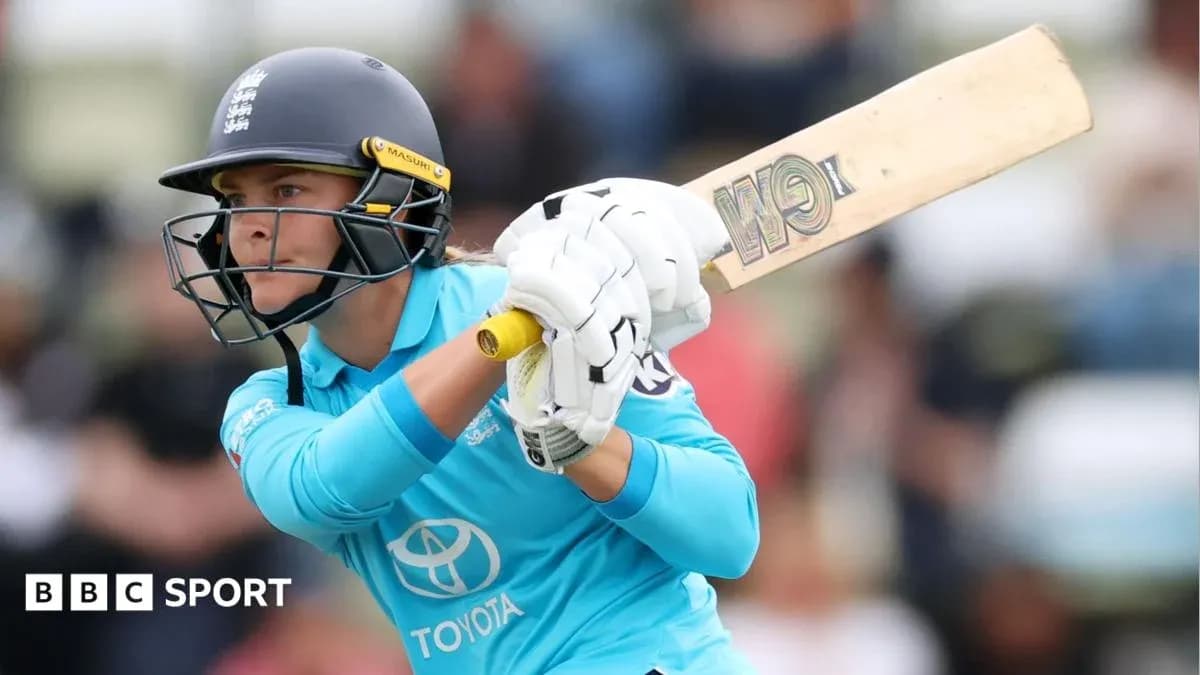
Dani Gibson, batting with intent, carved Lara McBride through the covers for her third boundary, then later stepped across her crease to scoop Orla Prendergast for four, a neat, inventive finish to the over. That shot followed a chaotic moment where Ryana MacDonald-Gay lost control of her bat in the follow-through and sent it flying, but Gibson stayed composed, picking her gap and keeping the scoreboard moving.
Her power down the ground had already drawn praise, that high backlift allowing her to hit straight through the line, and she continued to be England’s late-innings spark.
Farewell strike for Kelly as England stumble to the close
Yet every time England seemed ready to surge again, Ireland found a way to drag them back.
Arlene Kelly, in her final international, claimed a wicket that will sit nicely in the scrapbook. Ryana MacDonald-Gay, looking to go big to the leg side, picked out Cara Murray in the deep. Murray, this time the catcher rather than the destroyer with the ball, ran in from the boundary and took it smoothly. MacDonald-Gay gone for 7, England 288-8, and Ireland’s joy obvious.
Earlier, with England 286-7 and time running out, Ireland had already started to close the vise. Singles replaced boundaries, and even with four overs remaining and England still on course to top 300, the mood had shifted. Wynne summed it up succinctly: Ireland were “chipping away” and could be pleased with how they were closing out the innings, even if the chase ahead still looked “very difficult”.
Seven runs here, a quiet over there. McBride clipped for four by Gibson, but then pulling it back. McCartney finishing strongly. Murray hunting for a fifth. Every over carried tension, not freedom.
England should still post a total that asks serious questions. But what once looked like a procession has turned into a contest shaped by one leg-spinner’s spell and a fielding unit that refused to relent.
Ireland will walk off knowing they’ve given themselves a chance. The chase will be steep. The belief, after this fightback, will be real.