Botic van de Zandschulp's Epic Comeback at US Open
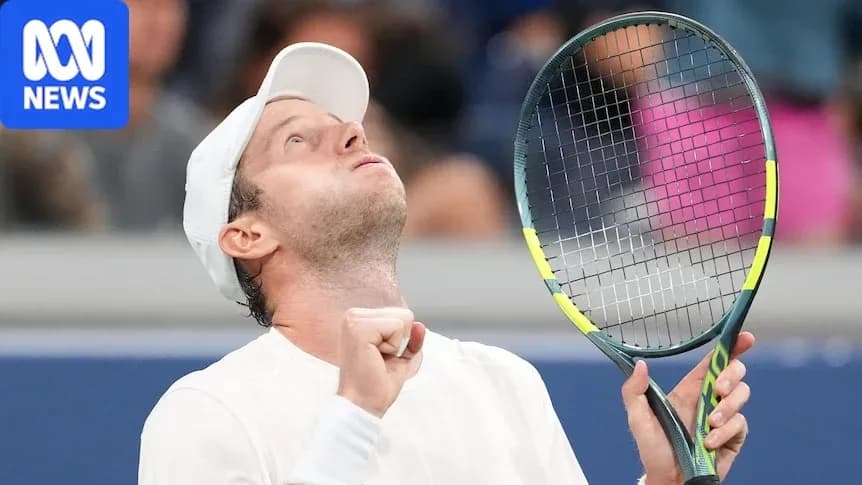
Botic van de Zandschulp walked off Louis Armstrong Stadium looking like he’d gone 12 rounds, not five sets. He also walked off a US Open survivor.
Two sets down. Match point down. Five hours and 13 minutes on the clock. When it finally ended, the 30-year-old Dutchman had dragged himself into a second US Open quarterfinal with a 3-6, 6-7(0), 7-6(7), 7-6(3), 6-4 win over French lucky loser Arthur Gea – the fourth-longest match in the tournament’s history.
From the brink to a classic
For a long time, this looked like Gea’s fairytale. Drafted into the main draw when 2022 runner-up Casper Ruud withdrew with a back injury, the Frenchman rode that second life with fearless tennis. He took the first set 6-3, then humiliated van de Zandschulp in a second-set tiebreak, 7-0, to tighten his grip on what would have been a slice of grand slam history.
Gea was one point away from it. One point from becoming the first lucky loser ever to reach a men’s singles grand slam quarterfinal.
That moment came in the third-set tiebreak. Van de Zandschulp, already beaten once in a breaker and staring at a straight-sets exit, stared down match point and refused to blink. He saved it, edged the tiebreak 9-7, and the tone of the night shifted.
The crowd sensed it. So did Gea.
The Frenchman, who had been swinging freely, suddenly had a target to protect. Van de Zandschulp, who had already knocked out Australian Alex de Minaur in a second-round upset, began to lean on his experience of these courts, the same ones where he reached his first US Open quarterfinal in 2021.
The fourth set became a grind. Neither man yielded a service game, but the Dutchman now dictated the patterns, dragging Gea into longer exchanges and forcing him to hit one more ball, then another. The pressure finally told in the tiebreak. Van de Zandschulp raced through it 7-3 to level the match and drag it into a deciding set that had seemed impossible two hours earlier.
By then, Gea’s legs and belief were fraying. Van de Zandschulp broke through in the fifth and guarded that advantage with the stubbornness of a player who had already escaped the gallows. At 6-4, it was over. A comeback etched into US Open lore.
“I think this is probably better than the first quarterfinal I made here,” van de Zandschulp said, still processing the scale of what he had done. “It hasn’t sunk in yet, but I think tomorrow it’s going to be a great feeling.”
Blockx makes Belgian history
On a day of milestones in New York, Alexander Blockx carved out a piece of his own.
Seeded 28, the Belgian defeated 24th seed Francisco Cerundolo 6-3, 4-6, 7-5, 7-5 to become the first man from Belgium ever to reach the US Open quarterfinals. It was not as long as van de Zandschulp’s epic, but it carried its own weight.
Blockx held his nerve in the tightest moments, snatching both the third and fourth sets by the same 7-5 scoreline. Each time, with the set balanced on a knife edge, he stepped forward, took the ball early, and backed his forehand under pressure. History tends to reward that kind of clarity.
His prize is a quarterfinal meeting with Karen Khachanov, who had to go the distance himself.
Khachanov goes five, Zverev waits
Khachanov, a familiar face in the latter stages of majors, was pushed deep into the night by American 14th seed Learner Tien. The Russian needed five sets to advance, grinding out a 7-5, 4-6, 6-7(6), 6-1, 6-4 win.
For two and a half sets, Tien had Khachanov on edge, taking the second and snatching the third in a tense tiebreak. Just as the upset seemed to gather momentum, Khachanov slammed the door, storming through the fourth set 6-1 and riding that surge into a controlled fifth.
By the time he closed it out, New York had seen another five-set escape act, though not one to rival van de Zandschulp’s marathon.
Men’s number one seed Alexander Zverev was scheduled to close the day’s play against Italian 21st seed Luciano Darderi, with the top half of the draw still taking shape while the night session unfolded.
But the story of the day had already been written hours earlier: a Dutchman who refused to go away, a French lucky loser who came within a point of history, and a US Open that, once again, turned a Monday in New York into something unforgettable.