Ben Shelton Reaches US Open Final, Ending 23-Year Drought for American Men's Tennis
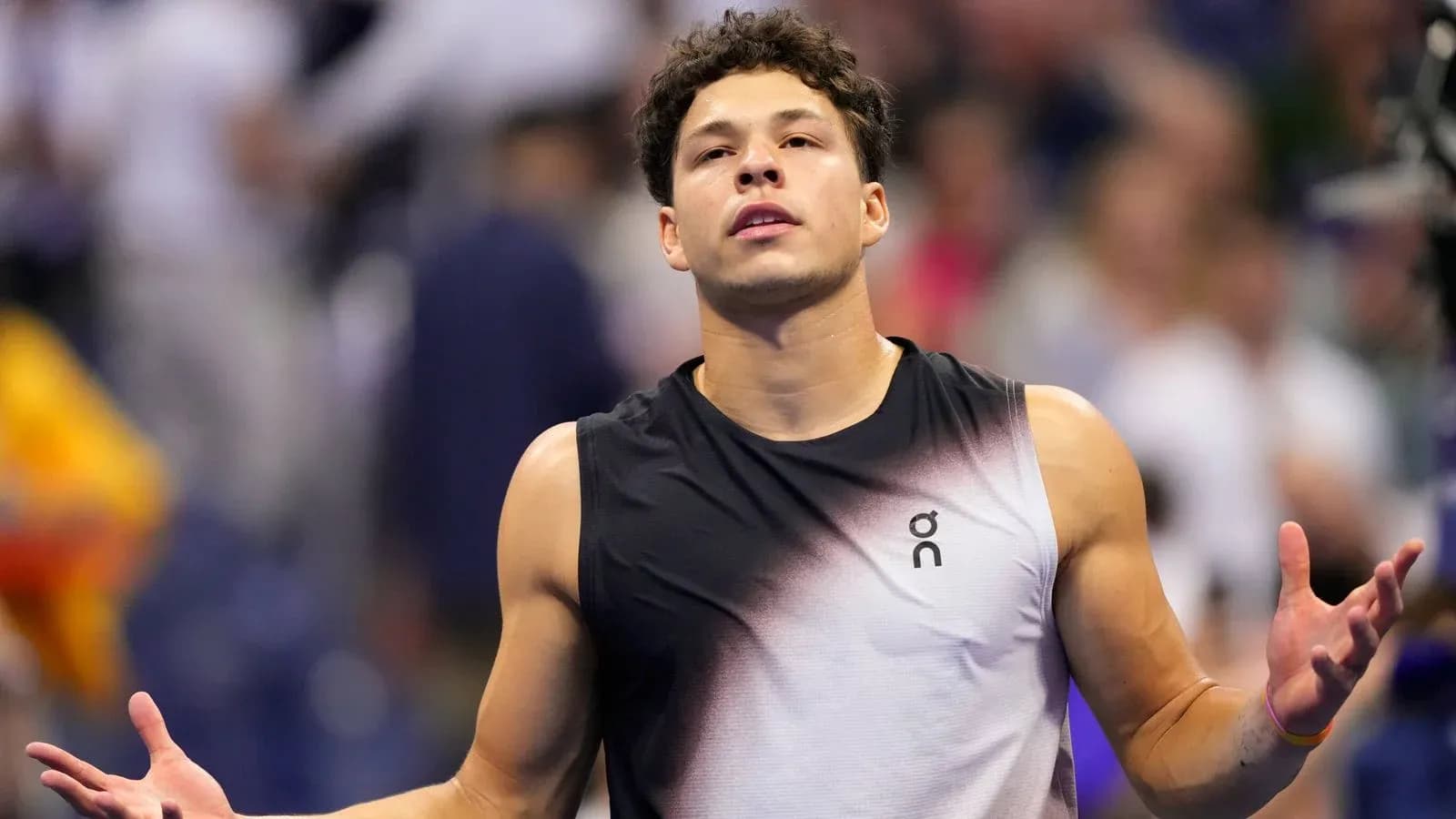
On a night heavy with memory and noise in New York, Ben Shelton walked into Arthur Ashe Stadium as the understudy and walked out as the man carrying a nation’s hope.
Twenty-three years after Andy Roddick last lifted a men’s singles Grand Slam trophy for the United States, Shelton dragged himself from a set down and past Frances Tiafoe, 4-6 6-3 6-3 7-5, to reach the US Open final and set up a Sunday showdown with Alexander Zverev.
The evening had begun in silence, with tributes marking the 25th anniversary of the September 11 attacks. It ended with a 23-year-old left-hander thundering aces under the lights and screaming into the New York night, one win away from ending a drought that has defined a generation of American men’s tennis.
“This is where we want to be,” Shelton said on court, nodding towards Tiafoe. “‘Foe’ is like a big brother to me. I know what my goal is, what my job is. I'm going for it here. Let's do this for the USA.
“One more thing. It's a difficult day to be out here playing. My thoughts and prayers go to all the families who were impacted by 9/11.”
Big brother, bigger stage
Tiafoe, the showman who helped drag US men’s tennis back into the conversation, started like a man determined to remind the younger American whose stage this used to be.
He punched out the first set 6-4, breaking for 5-4 when Shelton double-faulted at the worst possible time. Serving it out, Tiafoe lifted the crowd, lifted his level, and for a moment it felt like the older man’s experience would smother the newcomer’s surge.
Shelton looked tight. Tiafoe hammered away at the backhand, probing, waiting for errors. The pattern seemed set.
Then came the switch.
Serving with new balls at 3-3 in the second, Shelton uncorked a 125 mph serve that forced Tiafoe’s racket up almost in self-defence and knocked him backward onto the court. It was a statement more than a point. The next deliveries climbed: 144 mph, 139, 140. The stadium sound changed. So did the match.
Shelton stormed through the rest of the set to level at one apiece, and from there the younger American’s game grew taller with every rally.
Shelton takes control
The pressure finally told in the fifth game of the third set. Shelton broke, seized the initiative, and never looked back in that stanza, riding the momentum and his booming left-handed serve to a 6-3 set that flipped the entire semi-final on its head.
Tiafoe kept swinging. He kept going after the backhand, kept searching for the early knockout return. But Shelton’s defence, especially in the fourth set, turned stubborn, then suffocating. Rallies that Tiafoe used to own on this court slipped away from him, one by one.
Shelton, the eighth seed, refused to blink. He absorbed, then countered. He found first serves on the tightest points, lasering 20 aces in total and finishing with 47 winners. In the cauldron of a high-octane fourth set, he cranked up the pressure late, squeezing out the decisive break and closing the match 7-5 to seal an emotional, era-tinged victory.
Now, the American with the college swagger and the heavyweight serve stands one match from a maiden Grand Slam crown, and from rewriting a chapter that has hung over US men’s tennis since 2003.
Waiting for him is a man who has been here before.
Zverev’s relentless march
Earlier in the day, Alexander Zverev did what he increasingly does at the majors in 2024: he won, and he did it in straight sets.
The French Open champion beat Karen Khachanov 6-3 7-6 (9-7) 7-6 (8-6), surviving a pair of tense tie-breaks to reach his third consecutive Grand Slam final and his second US Open title match after finishing runner-up to Dominic Thiem in 2020.
That he is here at all is a story in itself.
The German was dragged to five sets in each of his opening two rounds, stumbling through the early days of the tournament. “After the second round at 3am, me and my team were in the dressing room actually laughing at how bad I was playing,” he admitted on court. “That sense of humour helped me.
“I have improved a little bit, otherwise I wouldn't be in the US Open final.”
“Improved a little bit” is doing some work there. Since those early marathons, Zverev has reeled off four straight matches without dropping a set, locking into the kind of groove that wins majors.
From ‘pointless’ to a Sunday final
Zverev has lived this fortnight in the shadows of the night sessions, emerging for late starts and later finishes, a man playing his own tournament on his own clock. He walked in with modest expectations, at least publicly.
“I really started off the tournament, and I was like, ‘Well, this is pointless because I'm not going to do anything here,’” he told reporters. “And here I am sitting and preparing for a Sunday final.”
He has made the most of a draw that opened up around him. Jannik Sinner never arrived in New York. Carlos Alcaraz and Novak Djokovic both fell. Zverev, 29, did not waste the opportunity.
Against Khachanov, a single break was enough to “pinch” the opening set 6-3. When he broke again at the start of the second, it looked like a routine stroll into the final.
Khachanov refused to cooperate. A Zverev double fault handed the Russian a way back into the set, and suddenly the semi-final turned into a slugfest. Zverev found himself down 5-3 in the tie-break, forced into a 35-shot rally that left both men gasping. He won that point, and the breaker 9-7, ripping the heart out of Khachanov’s resistance.
The third set followed a similar script. No breaks. No breathing room. Khachanov earned two set points at 6-4 in the tie-break, only to fire two forehands long. Zverev slammed down an ace for match point and finished the job at the first attempt.
Four straight matches, no sets lost. A place in a second US Open final. A chance at a second major of the year.
Martina Navratilova, watching it all unfold for Sky Sports, did not bother with caveats.
“What a year Zverev has had at the majors. It's been outstanding stuff,” she said. “Okay, Sinner lost early at the French Open and Alcaraz didn't play, but there are no asterisks, he still had to get through even as a favourite.
“And that has given the confidence to play better tennis after that. I think he played better at Wimbledon than he did at Roland Garros, and now he started off badly here by his own admission, but he hasn't lost a set the last four matches. He's cooking now.”
A final built for noise
On Sunday, the contrast will be stark. Shelton, the fearless newcomer riding a wave of home support and raw power. Zverev, the battle-hardened major winner, playing his third Slam final of the season and hunting down a second title.
The crowd will not be neutral. Zverev knows it, and he welcomes it.
“I think it's going to be a fantastic feeling playing, you know, a final in a sold-out Arthur Ashe and not in an empty one,” he said. “For me, a loud and energetic crowd is always great, as long as they're fair.”
Fair or not, they will be loud. An American chasing history on 9/11 weekend, a resurgent Grand Slam champion trying to turn a strong year into a defining one.
The wait has lasted 23 years. On Sunday night in New York, either the drought ends, or Zverev’s new era hardens into something even more formidable.