Barcelona's Tactical Dilemma: Right-Back and Midfield Choices
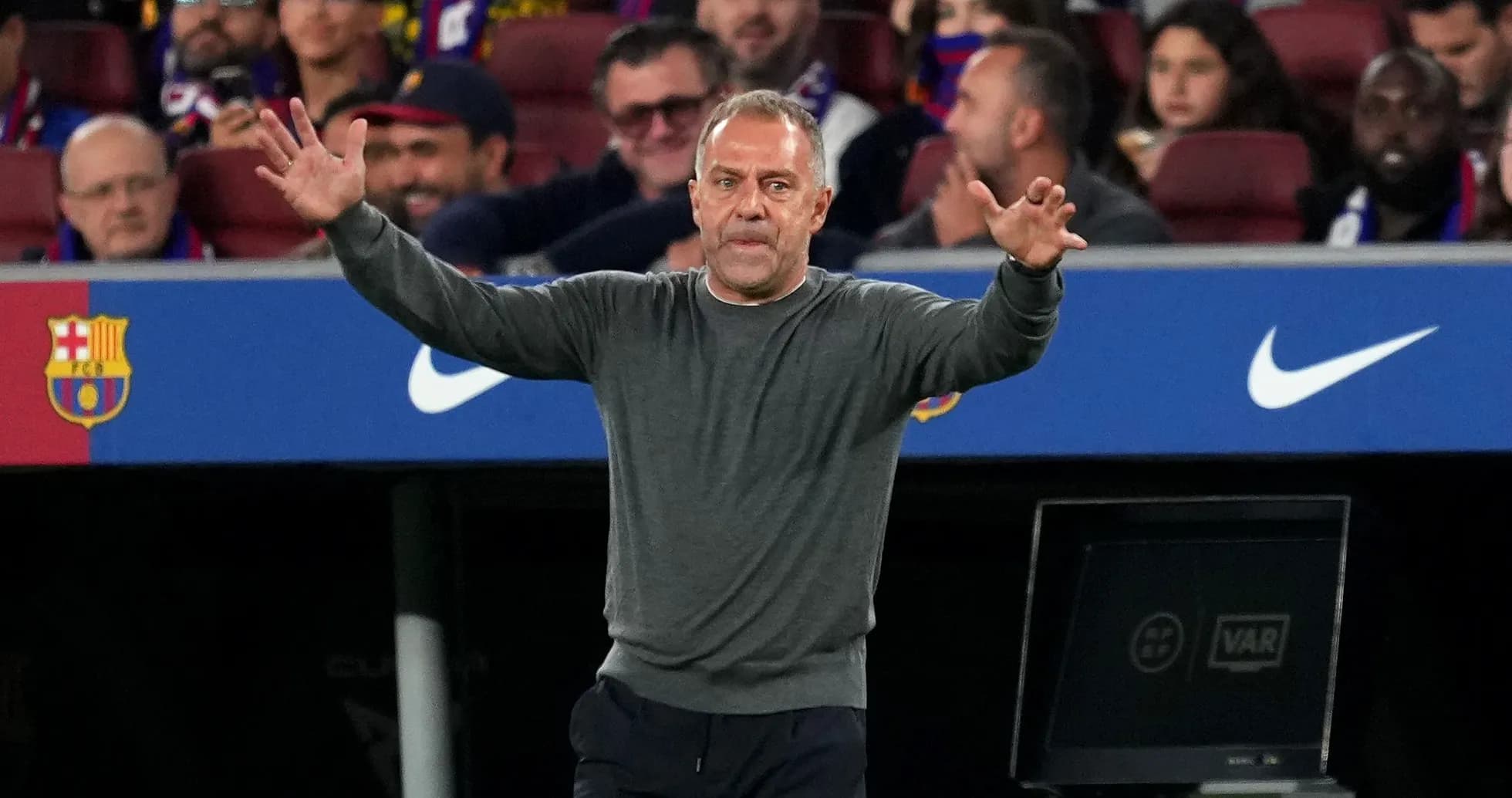
Hansi Flick stands on the brink of one of those decisions that can define a season, maybe even a dressing room.
Barcelona travel into an Atlético clash with a question that refuses to go away: who owns the right flank?
The right-back riddle
On form, the answer is simple: Brian Fariñas.
Out of position, under pressure, and with little margin for error, he has been immaculate. Against Alavés he looked assured. Against Aston Villa he looked untouchable. Two games, two statements. In a role that isn’t even his.
Yet this is Barcelona, and merit is only one part of the equation.
Eric García is back in the frame. Flick trusts him completely. That trust has survived injuries, dips in rhythm, and tactical reshuffles. If the defender convinces the medical staff and his coach that the muscle problem which kept him out of the last four matches is behind him, his chances of starting shoot up.
This is not a small call. On that side of the pitch waits Álex Baena, a constant nuisance, forever drifting, checking, darting into half-spaces. His touch is sharp, his legs even sharper. Let him turn, and he dictates. Let him run, and he punishes.
And that might not even be the worst of it.
If Diego Simeone decides to tilt his attack towards that flank, pace becomes non-negotiable. Whoever Flick picks there will not just track Baena’s movement, he may also have to live with long diagonals, direct runners and a tide of Atlético pressure aimed squarely at him.
Then there is Ademola Lookman. Not yet at last season’s explosive level, but dangerous the second complacency creeps in. One moment of space, one misread duel, and he can flip a match.
Fariñas has earned his shot. García has the manager’s unwavering faith. Between those two, Flick must choose: current form or established hierarchy.
Jules Koundé, in theory the third way, is barely in the conversation. The ankle sprain still lingers, his influence has faded in recent weeks, and everything points to him watching this one from the fringes rather than dictating it on the grass.
A hole in midfield
The other headache sits in the middle of the pitch.
Rodri’s injury has ripped out a piece of Barcelona’s core just as Frenkie de Jong returns to something resembling full fitness. Flick has leaned on the Dutchman since the day he walked through the door. Big game? De Jong usually starts. Toughest nights? De Jong is there.
Now, with Rodri sidelined, the choice becomes more delicate.
Marc Bernal looks like the logical, almost natural, replacement. Flick trusted him to step in after the break during the 3–0 demolition of Aston Villa, and the youngster repaid that faith with maturity and control. When Rodri was rested against Paris Saint-Germain, it was Bernal again who received the call. Those are not throwaway minutes; those are auditions passed.
De Jong’s recent usage tells its own story. Flick started him against Alavés, but at centre-back, giving Gerard Martín a breather. In the Champions League, De Jong began on the bench and only entered for the final 20 minutes, replacing Pedri to steady the game late on.
And yet, history with this coach matters. Flick has a habit: when the stakes rise, De Jong’s name appears in the XI. That pattern could tip the scales once more. Bernal offers structure and continuity. De Jong offers experience and authority in the fire of a high-level clash.
One shirt. Two very different profiles. Flick must decide whether to protect the balance that has worked with Bernal or to lean again on the man he trusts most in the middle.
A familiar debate on the left
Further forward, some pieces are already locked in.
On the right, Lamine Yamal is beyond discussion. He is no longer just a promising winger; he is a fixed point in Flick’s attack. On the inside channels and around him, Raphinha operates as the reference up front, stretching defences, dragging centre-backs into uncomfortable territory.
That leaves one open space: the left.
Right now, Anthony Gordon has his foot on that spot. Slowly at first, then more emphatically, he has pushed himself ahead of Karim Adeyemi in the pecking order.
Look at the matches Flick has ringed in red: both ties against Paris Saint-Germain, the Clasico, the meeting with Galatasaray. When the lights were brightest, Gordon started. Only at La Cartuja did the coach turn to the German instead, a rare exception rather than a trend.
Adeyemi’s numbers tell a harsher story. No goals, no decisive assists since 13 October, when he rounded off the 4–1 win in Istanbul at Galatasaray’s fortress. Since then, the spark has dimmed. The runs are still there, the effort too, but the final touch, the moment that changes everything, has gone missing.
Gordon, by contrast, gives Flick exactly what he demands in big games: aggression without the ball, verticality with it, and the discipline to hold his line when the team needs shape more than spectacle.
So Flick stares at his board before Atlético: a right-back slot that could reward Fariñas or reaffirm García, a midfield anchor that could accelerate Bernal’s rise or restore De Jong’s command, and a left wing where Gordon has seized momentum while Adeyemi waits for a spark that has not arrived since October.
These are not just tactical tweaks. They are judgment calls on trust, form and hierarchy.
Soon enough, the teamsheet will reveal where Flick believes this Barcelona side truly stands.