Bali International Oval: A New Era for Cricket in Indonesia
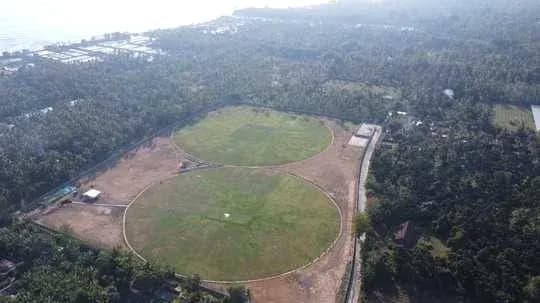
In the quiet expanse of North Bali, far from the usual tourist trail, Indonesia is building a statement of intent. The Bali International Oval (BIO), a two-oval complex now taking shape, is being positioned not as a vanity project, but as the beating heart of the country’s cricketing future.
This is not a pop-up tournament venue. It is being designed as a year-round home for the sport.
At the centre of the project sit two full-sized turf ovals, their footprints already cut into the landscape, with centre-wicket blocks beginning to form. Around them, the vision is clear: a flagship international venue wrapped around a high-performance engine room.
That engine room will be the Garuda National Cricket Academy. Operating inside the BIO complex, it is set to become the primary training base for Indonesia’s senior and age-group teams, while also opening its doors to visiting international sides, academies, coaches and curators. The ambition is unapologetically outward-looking.
The build is now moving into a critical phase. With the basic shapes in place, attention turns to the finer details that separate a field from a genuine high-performance facility: wicket maturation, surface refinement, and the kind of drainage and irrigation work that allows a ground to function 12 months a year. Specialist ground machinery will be brought in, alongside purpose-built high-performance areas, team facilities and broadcast infrastructure.
Cricket Indonesia does not see BIO as a purely national asset. The plan is to sell it to the region as a high-performance hub for the Asia-Pacific, a place where training, sports science, coach education, athlete recovery and tournament operations can live under one roof. The concept is simple: if you want to prepare properly in this part of the world, you come to Bali.
The roots of the project stretch back to January 2024, when the Asian Cricket Council held its Annual General Meeting in Bali and Indonesia was formally welcomed into the ACC family. Jay Shah, then ACC President, played a central role in those proceedings, but it was the tone of the gathering that lingered.
“When the ACC came to Bali in 2024, the message I took away was bigger than membership. Inclusive leadership had opened a pathway for Indonesia. I felt our responsibility was to build the infrastructure that would allow our players to use that opportunity for generations,” says Abhiram Singh Yadav, chairman of Cricket Indonesia.
That sense of responsibility now meets a global moment. Cricket is expanding its footprint, with the sport set to return to the Olympic Games. Indonesia wants to be ready when that door opens fully.
BIO is being developed with that horizon firmly in view. Cricket Indonesia hopes the facility will not only sharpen its national teams, but also create a genuine Olympic pathway for young Indonesian players, while drawing international teams and programmes to Bali for camps and tournaments.
“The Olympic return changes the imagination of cricket. A young Indonesian should be able to dream not only of international cricket, but of an Olympic pathway. Our infrastructure must be ready for that era,” Yadav says.
The ovals are still growing into the earth. The wickets are still hardening. But the intent is already clear: when cricket’s next era arrives, Indonesia does not plan to watch from the sidelines.