Babar Azam Presents Signed Bat to King Charles Amid England Series Struggles
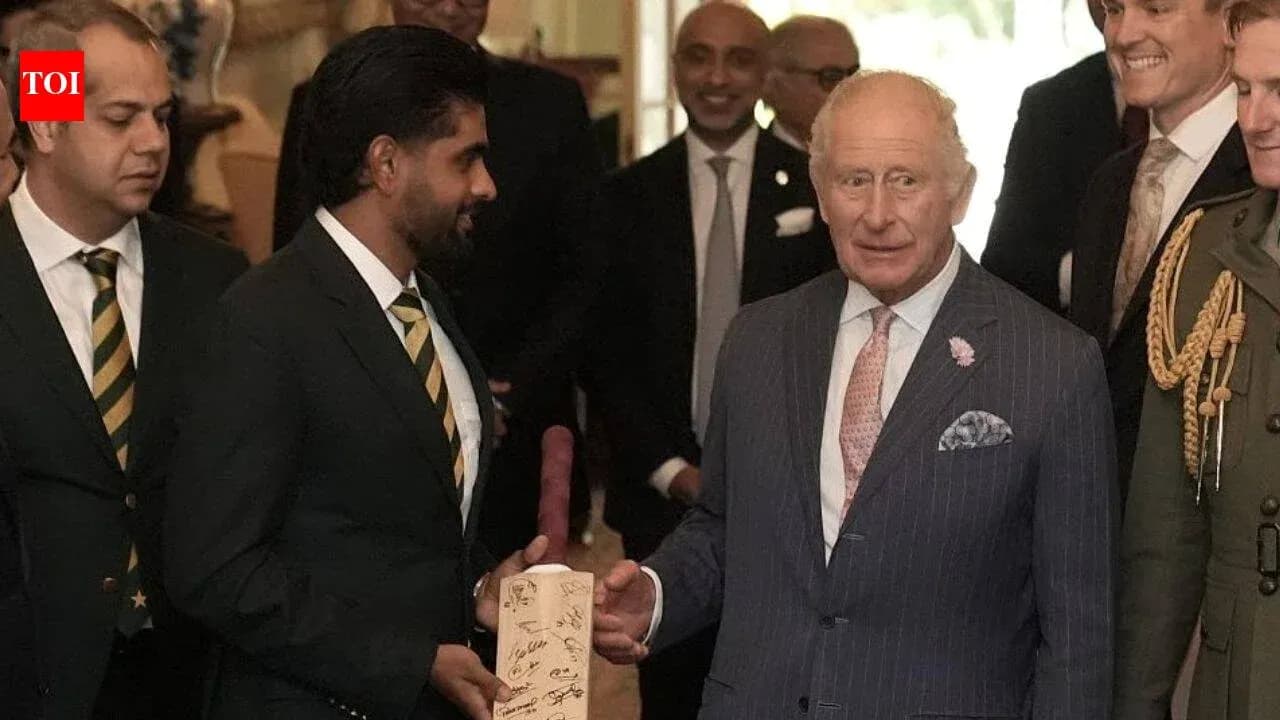
On a grey London morning, with Pakistan cricket under siege on the field, their Test captain Babar Azam walked into Clarence House carrying a different kind of responsibility — a bat, signed by every member of his beleaguered team, to be presented to King Charles III.
The meeting on September 2 brought together Babar, the touring Pakistan squad and Pakistan Cricket Board (PCB) chairman Mohsin Naqvi with the British monarch, a ceremonial high point in a tour that has so far offered little cheer elsewhere. Smiles and handshakes in royal surroundings contrasted sharply with the stark numbers on the scorecards.
Royal courtesy, brutal reality
As Babar handed over the signed bat to King Charles, Pakistan’s Test campaign in England was already in disarray. The hosts have wrapped up the three-match series with a game to spare, taking an unassailable 2-0 lead in emphatic fashion.
The margins tell their own story. An innings and 103 runs in the first Test. A 194-run defeat in the second. Across four innings, Pakistan have not once reached 200. For a side that has long prided itself on flair and fight, these are bruising days.
The collapse has triggered a sweeping response from the PCB. Seven players have been recalled to the squad, among them Mohammad Rizwan, Salman Ali Agha and injured opener Imam-ul-Haq. The shake-up has not stopped at the dressing room door.
Head coach Sarfaraz Ahmed and bowling coach Umar Gul have both been removed before the final Test, a ruthless call that underlines the scale of concern in Lahore over the team’s direction. In their place, white-ball coach Mike Hesson and bowling coach Ashley Noffke have been handed control for the third Test in Birmingham, starting September 9.
A mid-series reset. A last roll of the dice.
Captain under the microscope
Amid all this, Babar’s own position has come under sharper scrutiny. His return as Test captain, once seen as a stabilising move, now sits squarely in the glare of public and media debate.
He missed the first Test of the series with a finger injury, watching from the sidelines as Pakistan were crushed. Back at Lord’s for the second Test, he had the stage and the responsibility. The runs did not follow.
Scores of 8 and 6, in a match where Pakistan folded for 110 in the first innings and 194 while chasing 389, only deepened the questions. The elegant stroke-maker who once looked like the bedrock of Pakistan’s batting now finds himself in the longest lean patch of his Test career.
The numbers are unforgiving. Eighteen consecutive Test innings without a half-century. Since the start of 2023, a batting average below 21 across nine Tests. For a player of Babar’s stature, those figures sting.
At Lord’s, the sense of a broader struggle was impossible to ignore. Pakistan’s top order wobbled, the middle order crumbled, and the tail barely wagged. England’s bowlers hunted in packs; Pakistan’s resistance never truly formed.
Birmingham and beyond
So the team moves on to Birmingham with a new coaching setup, a reshaped squad and a captain under pressure, even as images circulate of Babar standing beside King Charles, bat in hand, representing his country far from the chaos of the middle.
The symbolism is hard to miss. Off the field, Pakistan still command respect and ceremony. On it, they are searching for identity, stability and runs.
The third Test will not change the series result. It can, though, change the narrative. For Babar, for his recalled teammates, and for a PCB that has already shown it is willing to act, Birmingham offers something more valuable than a dead rubber: a chance to prove this tour is not defined solely by collapse and crisis.