Babar Azam’s Short-Ball Struggles Continue Against England
On the flattest pitch of the series, with the game begging for a statement innings from its biggest name, Babar Azam walked straight back into the same ambush.
Pakistan, battered for most of the series, finally found some resistance in the final Test, grinding their way past 400 in the second innings. It was a defiant response on a road of a surface, a score that at least restored a measure of pride even if it may still fall short of setting England a truly awkward target.
In the middle of that fightback, Babar seemed ready to turn a lean red-ball run into a commanding hundred. He had moved to 76, timing the ball sweetly, Pakistan still 42 adrift of England’s 453. The stage was his. The conditions were his. The match situation demanded that he stay.
Instead, the same old story. The same bowler. The same method.
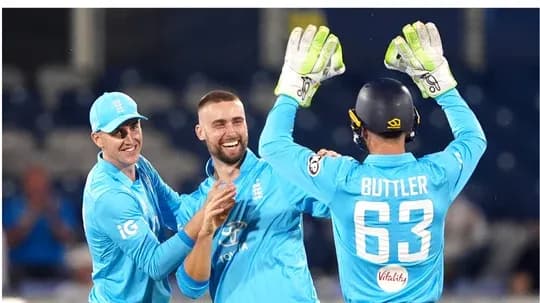
Josh Tongue, who had already removed him for seven in the first innings, went short again. England set the field, banged it in, and waited. Babar’s feet stalled, his mind jammed between options — pull, hook, or get out of the way. He did none with conviction, and he was gone.
On a pitch described as the flattest of the year, it was a gift.
Hussain’s Verdict: A “Masterclass” in Contrast
The reaction was immediate and unforgiving.
On commentary, former England captain Nasser Hussain zeroed in on the contrast at the crease. At the other end, Saud Shakeel was handling the barrage with clarity and purpose.
“You bowl short to Saud Shakeel, and he goes down straight away. You bowl short to Babar Azam, and he doesn’t know whether to pull, hook, or leave,” Hussain said. “At the moment, Saud Shakeel is giving him a masterclass.”
It was as brutal as it was accurate. While Shakeel committed to his method, Babar hovered in no-man’s land, trapped in the same indecision that has stalked his recent Test innings. For a batter of his stature, this is no longer just a poor patch. It looks like a technical and mental fault line being exposed in real time.
Fans Turn as Frustration Boils Over
Social media, never shy in its judgments, piled on.
One fan called out the sheer predictability of the dismissal: Babar “got trapped in the short ball plan and gifted his wicket after playing a fine knock,” he wrote, underlining how obvious England’s tactic had become. With more than a decade of international experience and multiple innings against Tongue alone, the expectation was that Pakistan’s captain would have found an answer by now.
Another supporter dispensed with diplomacy altogether: “ANOTHER EMBARRASSING WAY TO GET OUT, BABAR AZAM. - Literally threw his wicket away.” The capital letters did the shouting that many Pakistan fans were feeling.
Others could not believe that a player of his class, and the team’s premier batter, kept falling the same way. “You’d have thought that Babar Azam would be too experienced to have repeatedly fallen into England’s short ball trap,” one fan posted, capturing the disbelief that this flaw remains so raw and so visible.
The flatness of the Edgbaston surface only sharpened the criticism. As one comment put it, Babar “missed out on big runs. Flattest pitch of the year. He had an easy hundred for the taking. And possibly more.” The sense of waste hung over the dismissal as heavily as the disappointment.
There was even room for gallows humour. With debutant Razatullah impressing, one fan noted that the newcomer would finish the series with a better average than Babar, a pointed jab at the senior man’s slide.
The message from both former players and supporters was clear: this is no longer just about a captain out of form. It is about a leader failing to anchor his side when it needs him most.
A Flaw Every Opponent Can See
Strip away the noise, and the problem is stark.
At this stage of his career, Babar should recognise the trap the moment the field goes back and the quicks push their length shorter. Instead, each time an England seamer digs one in, his footwork seizes and his options blur. The ball climbs, the decision lags, and the dismissal feels inevitable.
Tongue’s repeated success against him only underlines the issue. This is not a one-off. It is a pattern.
England now need just 130 runs to win the third Test and complete a whitewash. In a series where Pakistan’s batting has too often crumbled, their captain’s failure to convert this innings into something decisive stands out as one of the defining shortcomings.
Until Babar confronts this weakness — not just in the nets, but in the heat of the contest, with deep men waiting for the miscued hook — opposition captains will keep drawing the same field, banging in the same length, and watching Pakistan’s premier batter walk straight into the simplest trap in the red-ball game.