Atlantic Division: A Season of Drama and Change
The Atlantic Division has never been shy about drama. This year, it may be the epicenter of the entire league.
A title defense in Manhattan. A superstar exodus in Boston. LeBron James walking into Philadelphia. Brooklyn gambling on relevance. Toronto quietly sharpening its edges.
Training camps haven’t even opened, and the ground has already shifted.
New York Knicks: Champions, at Last – and in No Hurry to Let Go
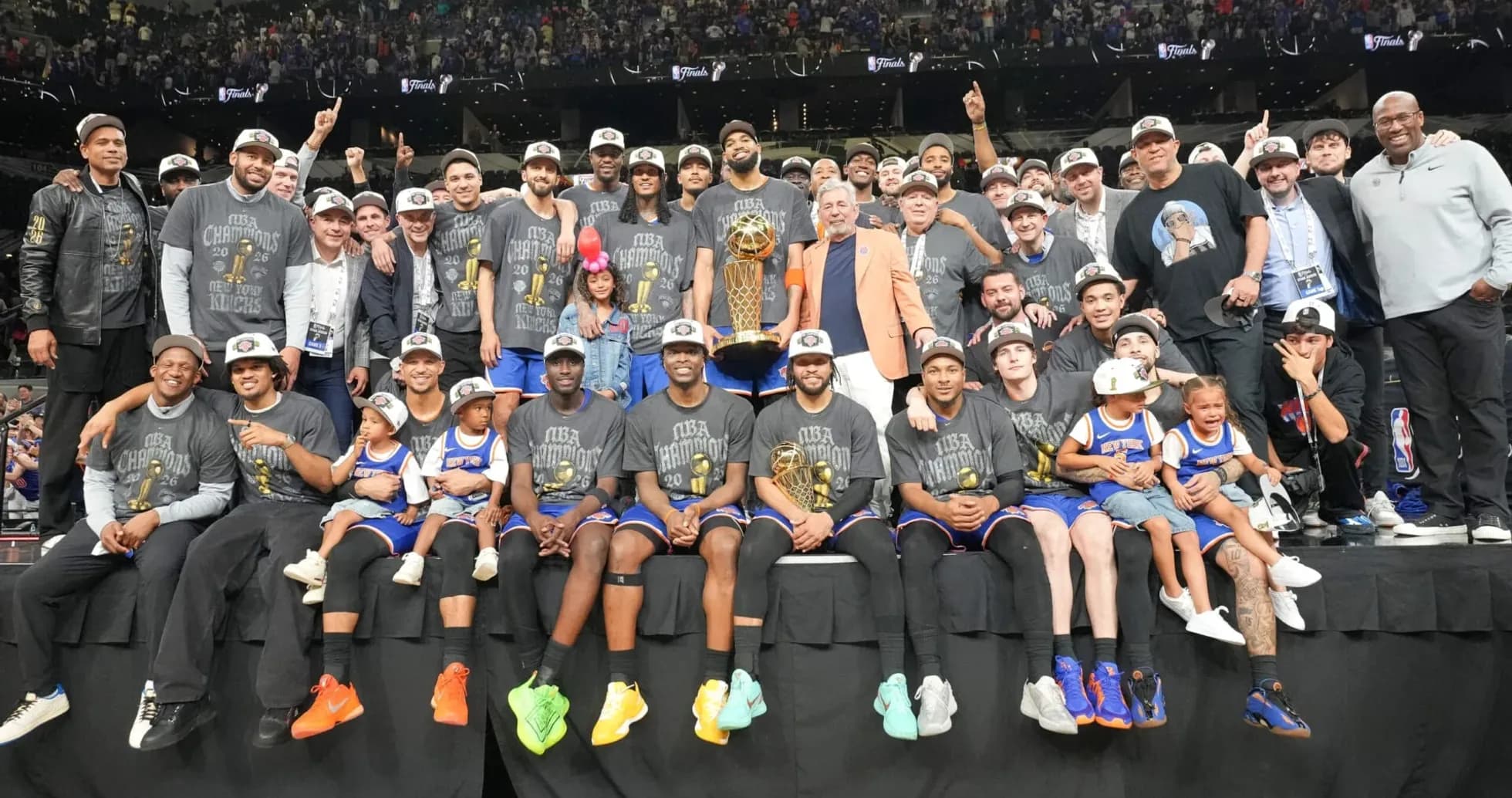
For 53 years, the Knicks lived off memories and mythology. Then came 53 wins, a 53-29 record, and finally, a parade down the Canyon of Heroes. The drought is over. The pressure, for once, is not.
New York enters 2026-27 with something rare in that city: breathing room. Nobody’s demanding a repeat on opening night. But look at the roster and it’s obvious—they’re not coasting.
Mitchell Robinson is gone, the most significant loss from the championship core, lured to Boston by a bigger paycheck. The Knicks’ response was measured, not panicked. They brought in Andre Drummond, still a force on the glass, to spell Karl-Anthony Towns and keep the rebounding edge that helped power their run.
That was essentially the offseason. No splashy overhaul. No desperation moves. Just Drummond, guard Jack Kayil, forward Tyler Nickel, and a firm belief that the group already in place can carry the weight of expectation.
Why wouldn’t they? Towns stretches the floor and punishes mismatches. OG Anunoby and Josh Hart bring the kind of two-way edge that travels in May and June. And at the center of it all is Jalen Brunson, the 2026 Finals MVP, the player who dragged this franchise out of its long winter and into the sunlight.
New York doesn’t need to promise a dynasty. It just needs to make sure the next banner doesn’t take another half-century. Right now, that wait feels like it’ll be measured in months, not decades.
Boston Celtics: Life After Jaylen
Boston’s season never really felt whole last year. Jayson Tatum missed most of the campaign, and Jaylen Brown responded with an MVP-caliber push that dragged the Celtics to 56 wins. Then came a first-round exit and, soon after, a franchise-altering decision.
Brown is gone, shipped to a division rival. In his place: a complete reconfiguration of what Boston wants to be.
The Celtics didn’t retreat. They reloaded. Mitchell Robinson arrives as the new anchor in the middle, a rim protector and lob threat who gives their defense a different dimension. Paul George joins as the marquee wing, a veteran star trying to prove there’s still another high level in his game. Mike Conley adds poise and control in the backcourt. Chris Cenac Jr. and Dillon Mitchell bring fresh legs and length to a rotation that needed both.
The cost? Brown, Dalano Banton, Chris Boucher, Max Shulga and John Tonje. The identity of the team shifts with that kind of turnover, but one thing remains the same: everything orbits Tatum.
Healthy again, Tatum steps into a season where the margin for error is thinner and the expectations are sharper. Boston will lean heavily on his scoring, his playmaking, his leadership. If George rebounds from a down year and Derrick White finds his best form again, the Celtics should be right back in the postseason mix.
They’ve lost one star to a rival. They’re betting the one who stayed is enough to keep them in the fight.
Brooklyn Nets: From Draft Room to Locker Room
A year ago, Brooklyn hoarded first-round picks like a rebuilding team straight out of a textbook. Five first-rounders, all kept, all thrown straight into the fire. The result was predictable: 20-62 and a fifth-place finish in the division.
This summer, the Nets changed the script.
Instead of piling on more rookies, they went hunting for help for Michael Porter Jr., whose workload bordered on unsustainable. The big swing: a trade for Julius Randle, a former All-NBA forward who knows New York, knows pressure, and knows what it’s like to carry an offense.
Randle gives Brooklyn a bruising, shot-creating presence next to Porter Jr. It’s a statement that the Nets are tired of simply “developing” and ready to start competing again.
They didn’t abandon youth, though. With the No. 6 pick, they grabbed Mikel Brown Jr., a polished combo guard out of Louisville. On a roster still in transition, he walks into a genuine chance at early, meaningful minutes. At No. 28, an extra first-rounder acquired in the Randle deal turned into Joshua Jefferson, another young forward to fold into the mix.
Keon Ellis and Moritz Wagner arrive to deepen the rotation, while Tyler Bilodeau adds more frontcourt depth. Nic Claxton and Ziaire Williams depart, signaling a clear reshaping of the core.
The stakes are higher now. Brooklyn doesn’t control its own first-round pick next season—the Rockets hold swap rights—so another 20-win stumble would sting in a different way. The Nets aren’t built to contend yet, but they’re no longer content to drift at the bottom.
Randle’s presence, Brown Jr.’s upside, and a front office that finally tilted toward the present give this team a different feel. For once, the future isn’t the only thing that matters.
Philadelphia 76ers: LeBron, Jaylen, Embiid – and the Weight of History
The Sixers have lived in the space between promise and heartbreak for years. Joel Embiid’s injuries have been the constant plot twist, derailing one title chase after another. Last season, another shortened campaign for their MVP big man still ended with 45 wins and a trip to the conference semifinals.
Now, the franchise has pushed all its chips in.
Jaylen Brown crossed the divide from Boston to Philadelphia, a move that would have been seismic on its own. Then LeBron James chose the Sixers over a host of other suitors, and the entire league snapped its head toward the Atlantic.
This is not a subtle pivot. This is a full-scale assault on the top of the NBA.
LeBron and Brown join Embiid, All-NBA guard Tyrese Maxey, and All-Rookie guard VJ Edgecombe to form a starting five that can stand beside any in the sport. Size, shot creation, playmaking, scoring at all three levels—it’s all there.
The supporting cast has been reshaped to match the ambition. Kentavious Caldwell-Pope arrives as the kind of 3-and-D guard who thrives next to stars. Ariel Hukporti adds size behind Embiid. Labaron Philon Jr. and Anfernee Simons deepen the backcourt options, while Dean Wade offers stretch and versatility in the frontcourt.
Out go Paul George, Kelly Oubre Jr., Quentin Grimes, Andre Drummond, Dalen Terry, Trendon Watford and Johni Broome. The roster looks different. The expectations feel familiar: championship or bust.
Two questions hover over everything. LeBron’s age. Embiid’s health. If both hold up, Philadelphia has the firepower to chase its first title since 1983. If they don’t, this grand experiment becomes another chapter in a long book of what-ifs.
For now, though, the Wells Fargo Center is the league’s main stage. Every night will feel like an event.
Toronto Raptors: Quiet, Dangerous, and Growing
While the rest of the division traded headlines, Toronto chose a different lane.
The Raptors finished with the East’s No. 5 seed last season and pushed their first-round series all the way to a Game 7. They didn’t respond with a teardown or a star chase. They opted for refinement.
Kyle Anderson joins as a steady, clever forward who can glue lineups together. Rookie guard Jaden Bradley and forward Allen Graves arrive as developmental pieces. Only Sandro Mamukelashvili departs. The core remains intact.
That core is one of the most balanced offensive groups in the league. On any given night, three—and sometimes four—Raptors can clear 20 points. They can score from the perimeter, out of the post, and in transition, while still fielding a collection of solid defenders.
Toronto is betting on internal growth to close the gap in an improved East.
Collin Murray-Boyles is at the heart of that plan. His rookie season unfolded gradually, his postseason performance quietly outstripping expectations. With polished post moves and soft touch around the rim, he looks like a long-term answer inside.
In the backcourt, Ja’Kobe Walter and Jamal Shead appear on similar upward paths, adding layers of scoring and playmaking behind the established names.
All of this orbits Scottie Barnes, the franchise pillar. With RJ Barrett beside him and a supporting cast that’s starting to come into its own, the Raptors have the depth and versatility to return to the postseason—and to be more than just a first-round cameo.
They don’t shout about it. They don’t need to.
The Atlantic Division has turned into a pressure cooker. The defending champions live in Manhattan. The most star-studded experiment in basketball resides in Philadelphia. Boston is trying to rewrite itself on the fly. Brooklyn is tired of waiting. Toronto is quietly building something durable.
Someone is going to get squeezed. Someone is going to break through.
The only certainty is this: every night in this division will feel like a measuring stick for where the league is headed next.