Arthur Gea's Historic US Open Journey Ends in Heartbreak
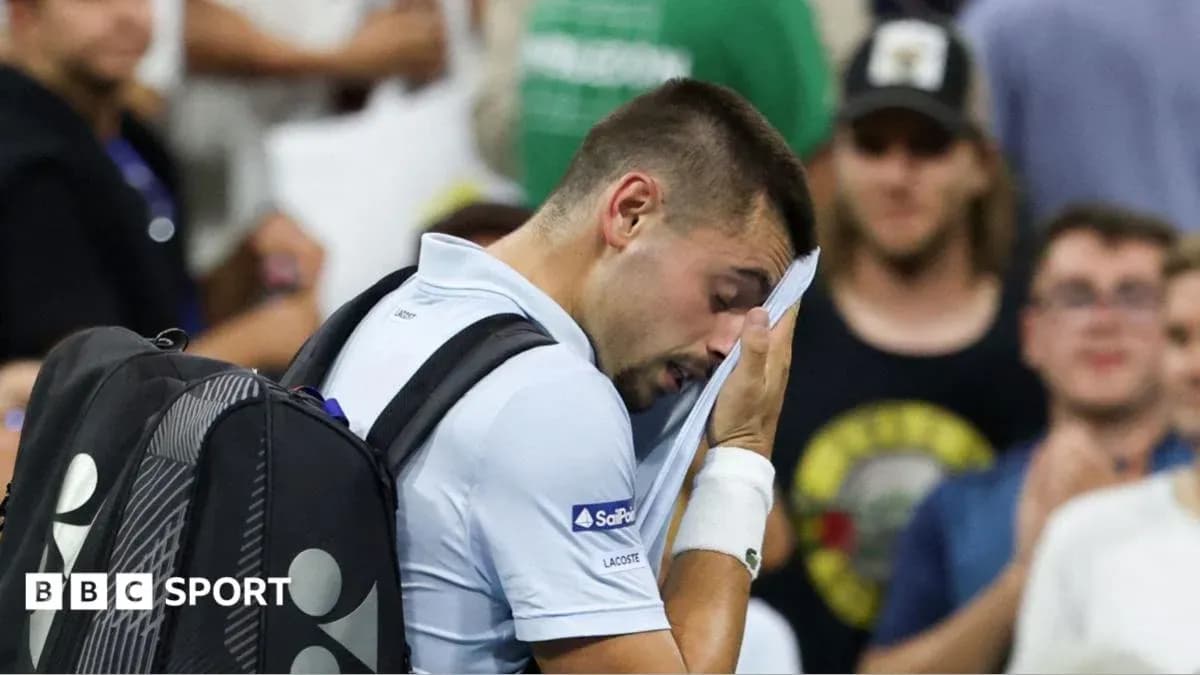
Arthur Gea stood on the baseline, one point from history. One point from becoming the first lucky loser ever to reach a Grand Slam quarter-final.
Three hours later, he was out of the US Open.
Gea’s dream turns on a single point
The 21-year-old Frenchman had Botic van de Zandschulp exactly where he wanted him: cornered in a third-set tie-break, match point on his racket, momentum, story, everything leaning his way.
He couldn’t finish it.
Gea failed to convert that match point in the breaker, then later served for the match in the fourth set and let that chance slip too. The Dutchman, who had looked buried for long stretches, clawed his way out and never stopped climbing, stealing a staggering 3-6 6-7 (0-7) 7-6 (9-7) 7-6 (7-3) 6-4 victory after five hours and 13 minutes – the fourth-longest match ever played at Flushing Meadows.
From almost miraculous to brutally ordinary, Gea’s fortnight flipped in a heartbeat.
He arrived in New York ranked 87 in the world, not high enough to make the main draw when the entry list closed. That meant qualifying. Three tense rounds, three chances, and then the door slammed in his face when he lost to American Nishesh Basavareddy in the final round.
Then came his reprieve.
When 2022 finalist Casper Ruud withdrew injured on the eve of the tournament, Gea’s name came out of the lucky loser pool. A second life. He seized it with the urgency of someone who knew how close he’d come to flying home.
He beat Juan Manuel Cerundolo of Argentina, then Zachary Svajda and Michael Zheng, both Americans, to reach the last 16. Every win pushed the story further into fairytale territory. A qualifier who didn’t qualify, suddenly on the brink of the quarter-finals of a major.
But Van de Zandschulp, ranked 70 and hardened by his own rollercoaster career, refused to play the supporting role. He trailed by two sets, stared down that match point, and still found a way to turn the match into a war of attrition. Tie-break after tie-break, rally after rally, he chipped away at Gea’s belief until the Frenchman’s legs and nerve finally wobbled.
By the time Van de Zandschulp closed out the fifth set 6-4, he looked as stunned as anyone. He admitted he had “no clue” how he had pulled off what he called a “crazy comeback”.
Gea, the 13th lucky loser in history to fall in the fourth round of a Slam, leaves with a mixture of regret and reward. The sting will last. So will the cheque: $480,000 for reaching the last 16, a huge leap from the $66,000 he thought he was earning for a qualifying exit.
Zverev back in prime time – but early
Van de Zandschulp now walks into a different kind of storm: Alexander Zverev in full New York stride.
The German top seed, 29, has been the night owl of this tournament, his previous three matches finishing at 1:55am, 2:15am and 1:09am. On Monday, he finally wrapped things up at a more conventional hour, dismissing Italian 21st seed Luciano Darderi 6-2 6-2 7-6 (7-3) to reach the quarter-finals.
For two sets, Zverev barely gave Darderi a look. The serve clicked, the forehand bit, the court seemed to shrink around him. Only in the third did the Italian manage to drag the match into a tie-break, but Zverev shut the door with authority there as well.
With the win, the French Open champion booked his second US Open quarter-final and kept his late-night routine alive in spirit, if not on the clock. He joked that he didn’t know what to do with himself because it was still before midnight, wondering aloud whether to head back to the practice courts or to a bar.
He made one thing clear: he wants the lights.
On facing Van de Zandschulp on Wednesday, Zverev said he would “request the night match for sure,” adding that he had “rented this court out from 11pm until 2am for two weeks” and hoped the tournament would keep scheduling him under the lights.
If the Dutchman can summon anything like the resilience he showed against Gea, the night session could turn into another epic.
Blockx limps, then breaks through
Earlier in the day, another young story took shape, this one written through pain.
Belgium’s Alexander Blockx, seeded 28th, admitted he was “really close” to retiring with a rib injury against Argentina’s Francisco Cerundolo. Instead, he stayed out there, grimaced through the service motion, and somehow found enough to win 6-3 4-6 7-5 7-5.
The victory made him the first Belgian man ever to reach the quarter-finals at the US Open.
From the opening games, Blockx looked uncomfortable. He said he had been struggling “from the beginning of the match,” especially on serve, and that the pain “kept getting worse throughout the match.” The third set became a tipping point: lose it, and he felt he would likely stop. Win it, and he’d keep fighting.
He won it.
Hanging on in long baseline exchanges, managing his service games with care, Blockx edged both the third and fourth sets 7-5. The scoreline doesn’t show the internal battle, but his comments did. “I was just hanging in there,” he said. “I’m glad that I kept on playing.”
If his body allows, Blockx will face Russian world number 50 Karen Khachanov in the last eight on Wednesday. That’s a big “if”, given the rib issue, but the opportunity is huge.
Khachanov had to dig deep himself, turning around a dangerous contest against 14th seed Learner Tien. The American teenager had been chasing a slice of history for the host nation, trying to help make it four home men in the quarter-finals for the first time since 1995.
Khachanov shut that door, winning 7-5 4-6 6-7 (6-8) 6-1 6-4. Once he dropped the third-set tie-break, the Russian raised his level, dominating the fourth set and keeping his nerve in the fifth to silence the home crowd.
Five-set marathons, shattered dreams, lucky losers, and battered ribs. The second week in New York has only just begun, and already the draw is littered with stories like these. The question now is who still has enough left – in the legs and in the mind – to turn survival into something bigger.