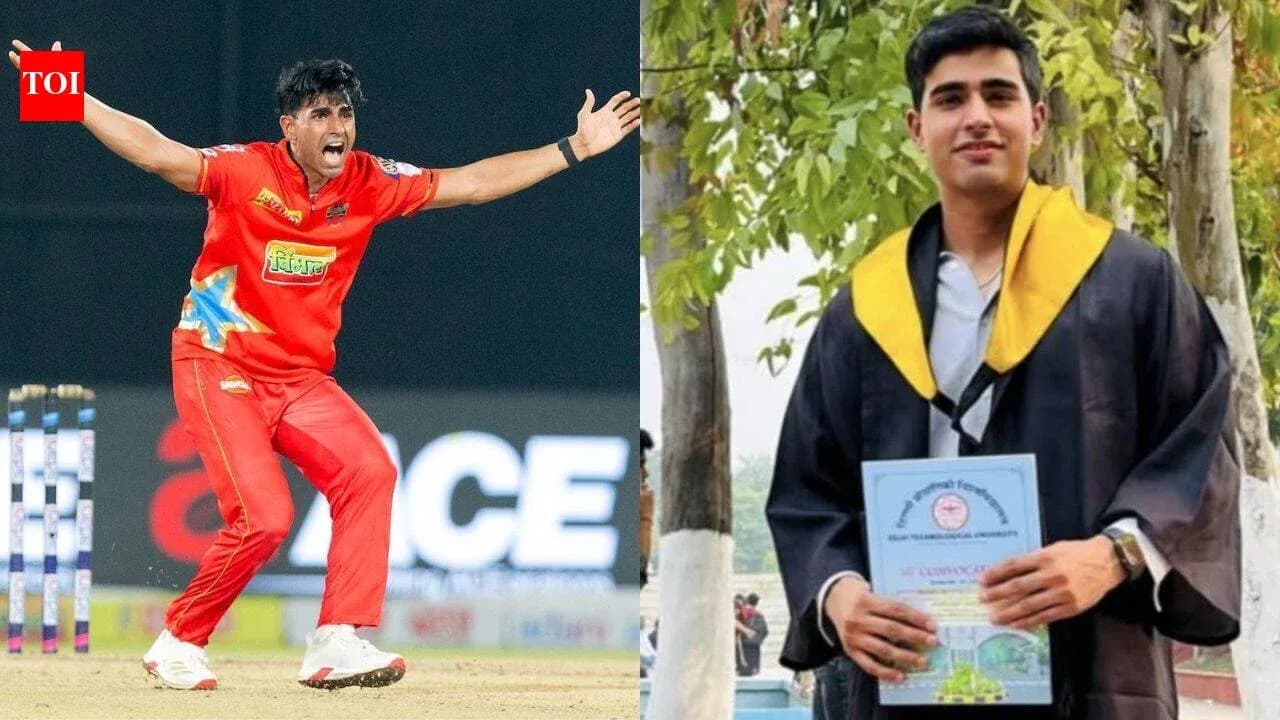
Anshuman Hooda: The Fast Bowler Who Defied Odds in Delhi Premier League
On most days, Anshuman Hooda’s world is split between two screens. One glows with Excel sheets and emails. The other is a shiny red cricket ball.
Ask him to choose, and the answer comes with a laugh. The 25-year-old from Delhi doesn’t hesitate. The ball wins.
It has to. It just delivered him a season that has turned a late-blooming quick into one of the most intriguing fast-bowling stories in the capital.
Purple Cap, new life
In the third edition of the Delhi Premier League, Hooda ripped through batting line-ups for South Delhi Superstarz, finishing as the Purple Cap winner with 22 wickets. His spells underpinned South Delhi’s title run and announced a bowler who, not long ago, had almost given up on the game.
There is no conventional junior record to leaf through. No Under-16s, no Under-19s, no neat trail through Delhi’s age-group system. Just two failed attempts at Under-23 trials and a growing sense, at one point, that the door to professional cricket had quietly closed.
“I tried for Under-23 for two years, but I couldn’t make it,” he recalls. The conclusion seemed obvious. “It would have been very difficult to directly get selected for the Ranji Trophy or first-class cricket.”
He had something else, though: a degree in Production and Industrial Engineering from Delhi Technological University, and a job at EY through campus placement. The “sensible” path sat right in front of him.
“So at that time, I thought I should quit cricket and pursue my career in engineering or something.”
That might have been the end of it.
It wasn’t.
The coach who refused to let him quit
In 2023, as Hooda prepared to step fully into corporate life, his coach, Harish Dagar, made one last push. Dagar runs the Delhi Cricket Hub academy in Paschim Vihar and trains youngsters at DTU. He had seen enough to know this was not a bowler to be shelved for a nine-to-five.
“I pleaded with him to give it one more year,” Dagar remembers. The deal was simple: four days a week at the academy for a year. If nothing happened, Hooda could walk away with no regrets.
What followed was not just a tweak in technique. It was a rebuild of a cricketer’s mind.
“I worked on his mind 80-85 per cent,” Dagar says. “I made him mentally strong. I told him never to think that he was tired or burdened. Once I worked on his mindset and the roadmap was clear in front of him, he knew what he had to do.”
The roadmap soon had a destination: the Delhi Premier League.
From roller skates to red ball
Hooda’s story does not begin with junior nets or school trophies. It begins on wheels.
As a youngster, he was a national-level roller skater. Cricket lived in the background, a familiar presence thanks to his elder brother Vikram, who played the game. The pattern of following his brother was already set: science in school, engineering at university.
Cricket, though, took a different route.
It only truly arrived in college, when he started playing for the DTU team and moved into leather-ball cricket.
“I just started playing in college,” he says. “That’s when I got into leather-ball cricket professionally, playing for the college team and all. That’s when I fell in love with bowling fast, getting wickets and the aggression that comes with it. I just loved bowling fast.”
Dagar first spotted him in 2019. Hooda was playing tennis-ball cricket then. What stood out was not a finished product, but the raw materials: fitness, arm speed, natural movement.
“His body alignment was natural. His strength was natural, and his pace was natural,” Dagar says. “But he didn't have enough strength in his body initially. That’s why I told him that if you don't maintain your fitness along with your natural pace, you will face problems.”
Hooda listened, but he also had to work. Once he joined a multinational company in 2023, his days became a juggling act: work-from-home shifts, late-night training, gym sessions squeezed into whatever time remained.
“He was also busy with his job,” Dagar says. “He would come at night, then have to go to the gym and take practice sessions. It was very hectic.”
The toll of pace – and the pull of it
Fast bowling is a brutal profession. Hooda understood that quickly.
“Fast bowling is not a very comfortable activity for the body,” he says. “You accelerate, then your whole body has to absorb the impact before you bowl. It definitely takes a toll on the body.”
He dealt with niggles, fatigue, the grind of repeating the same explosive action over and over again. The obvious question lingered: why put yourself through it when a stable engineering career is already in hand?
His answer is simple.
“It was just the love for the sport and the love for bowling fast that kept me motivated and helped me come back stronger every time.”
That stubborn love became the base on which Dagar built the rest.
Building a fast bowler, not just a fast ball
Behind the wickets column in the DPL lies the less glamorous work: periodisation, rest, strength training, workload management, diet, physiotherapy, skill development. Hooda had to learn how to own a stock ball, then add leg-cutters and off-cutters without losing pace.
The aim was clear. Not a one-off quick spell. A complete fast bowler.
The first crack in the door came with South Delhi in the 2024 DPL. Opportunities were limited at the start, but a standout spell shifted perceptions. The next season, he went further, including a five-wicket haul that forced people to pay attention.
IPL franchises started to look at him as a net bowler and trial option. The bowler who once thought of quitting suddenly had serious eyes on him.
The moment that brought it home came from a man who has seen almost everything in Indian cricket: Shikhar Dhawan, owner of the South Delhi Superstarz.
“Shikhar Dhawan himself, the team owner, surprised me,” Hooda says. “He came and we had a little conversation. He gave me some very good tips and a direction to work towards from here.”
Dhawan later praised him on social media. For a player who had spent his formative years outside the usual system, the recognition carried weight.
It told him he belonged.
Pace with purpose
Clocked at around 140 kmph, Hooda already possesses the currency that can fast-track a career.
Dagar believes there is more in the tank. Hooda wants it too.
“Definitely, speed is what I want,” he says. “If I can, I will definitely look to bowl even faster and build the strength and skills to do that, while making sure there is no compromise on accuracy and line.”
That last part matters. Pace catches the eye; accuracy keeps you in a team.
Hooda knows the next examination won’t be in a four-over burst alone. It will be in the long, hard spells of red-ball cricket.
“These are the things we prepare for,” he says. “Who bowls in a four-day or five-day game and bowls long spells with the same effort? That is what I am preparing for. If I get an opportunity, I will definitely do that.”
His ladder is clearly marked. First, cement a place in Delhi cricket. Then first-class cricket. Then the IPL. Then India.
“The eventual goal is to play and win matches for the country. That is my ultimate goal,” he says.
The choice that won’t wait forever
Away from the nets and the speed gun, another contest plays out in Hooda’s life: security versus ambition.
On one side sits an engineering degree, a multinational job, and even a promotion before the latest DPL season. On the other, a sport that offers no guarantees and no safety net, only the chance to chase something extraordinary.
For the moment, he is still straddling both.
“Currently, I have joined back,” he says of his job. “But as I have seen some substantial progress in my cricket in recent months and in this tournament, I might, in the coming times, shift my whole focus to cricket and give it my all.”
It’s a significant admission from someone who once considered quitting the game altogether. The engineer who learned to manage competing demands may soon be forced to pick a side.
His mother, a primary school teacher with the Municipal Corporation of Delhi, once wanted him to secure a job. Now, with that box ticked and wickets flowing, she is happy to see him chase cricket. His brother Vikram sees the same thing: a family that asked for stability, now willing to back a dream.
Hooda himself is clear about the direction of travel.
“I will give it my all,” he says. “Let’s see what happens ahead.”
For a fast bowler who came late to the game, won a Purple Cap, and now stands at the edge of a decision that could define his life, the next ball he chooses to bowl may be the most important of all.