Ajit Agarkar's Absence Sparks Speculation in Indian Cricket
The BCCI wanted Thursday to be about clarity. It ended up creating more questions.
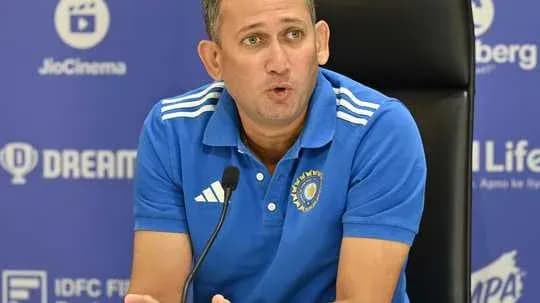
In Mumbai, Agarkar’s own city, the Board held a high-powered review meeting that drew the game’s top decision-makers into one room. One figure, though, was missing – the man currently holding one of the most scrutinised jobs in Indian cricket: chairman of selectors Ajit Agarkar.
His absence was impossible to ignore. The BCCI moved quickly to insist there was nothing more to it.
“Today, he was out of station, so he could not be a part of the meeting. The meeting was called at very short notice, and our chairman of the selection committee, Ajit, was not in town. So he could not join the meeting, and he was in an area where he could not join online either, despite our best efforts,” BCCI secretary Devajit Saikia said.
On paper, that should have been the end of it. A logistical issue, nothing more. Yet the timing, the context, and the recent history around Agarkar meant the story refused to die.
Only a few days earlier, Agarkar had chaired an online selection committee meeting to pick the T20I squad for the three-match series against Afghanistan. He was visible, available, leading the process remotely without a hitch. On Thursday, though, even a virtual presence was ruled out.
Saikia stressed that the Mumbai meeting had nothing to do with team selection.
“Today, we did not have any selection meeting. There was no such discussion in today’s meeting,” he said, trying to draw a hard line under the speculation.
The line did not hold.
Social media lit up, feeding off the vacuum created by Agarkar’s no-show. Rumours about his future flew around with familiar speed and very little restraint. Some accounts went as far as to claim he was on his way out as chairman of selectors.
On record, the BCCI is saying the opposite. When the Board secretary speaks “with absolute clarity”, as he did, the official position is obvious: Agarkar’s absence, they insist, is circumstantial, not political.
Yet the curiosity persists.
It has been simmering ever since the Rohit Sharma episode, when reports emerged that the selectors had told the former captain to retire, only for the BCCI to step in. That incident dragged the selection committee into the spotlight and raised uncomfortable questions about who really calls the shots in Indian cricket.
Against that backdrop, any sign of instability around the chairman of selectors was always going to be magnified.
For now, the message from those in and around the corridors of power is that there is no change on the horizon. Agarkar is currently said to be overseas. Multiple sources maintain that the selection committee is expected to remain intact and that he will complete his term, which runs until next July.
There is even talk that he could be given an extension through to the 2027 World Cup, scheduled for October-November that year. That, however, has not been independently verified, and remains in the realm of possibility rather than certainty.
Saikia, for his part, made it clear he did not want to fuel the noise.
“I do not want to give any fodder to the speculators,” he said, drawing a firm line between official communication and the swirl outside.
The immediate signs suggest Agarkar will be back in full public view soon enough. He is expected at the Duleep Trophy final starting September 6 in Chennai, a five-day red-ball fixture that traditionally serves as a stage for selectors to run the rule over domestic talent. He is likely to be there with a couple of his colleagues, watching closely from the stands.
At the same time, two other selectors are expected to be in Delhi, keeping an eye on the T20I series against Afghanistan. The work of the panel, at least on schedule, rolls on.
Agarkar has hardly been hiding in recent weeks. During the just-concluded Test series in Sri Lanka, television cameras found him again and again in the stands, his reactions dissected almost as much as the players in the middle. His presence was constant, his profile unmistakable.
On Thursday, it was the opposite. He was hard to miss because he wasn’t there at all.
In a system where every selection, omission, and offhand remark is pored over, the empty chair of the chairman of selectors can say almost as much as a packed press conference. The BCCI insists that chair remains his, at least until next July.
The real test will come not in a meeting room in Mumbai, but in the months ahead, when the next big call lands on Agarkar’s desk and the cameras, once again, search him out.