Abhishek's Ruthless Chase in T20I Opener
The first swing told the story. So did the last.
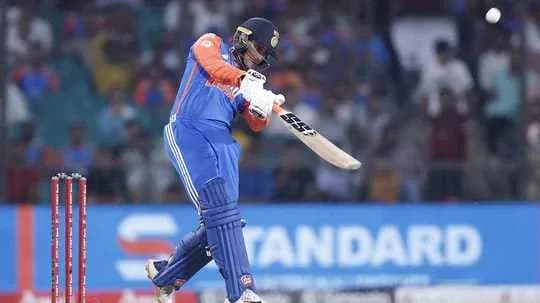
Abhishek opened his account with a soaring inside‑out six over cover off Fazalhaq Farooqi, and from that moment Delhi knew this chase would be ruthless, not tense. Afghanistan’s 156 in the T20I series opener was never going to be a fortress on this surface, but the left-hander turned it into a target that felt almost trivial, dismantling a seasoned attack with a 32-ball demolition that blurred the line between power and precision.
He truly slipped into overdrive after losing his opening partner at the start of the third over. Any hint of a reset vanished the moment Azmatullah Omarzai entered the frame. First came the lofted blow, high and straight, deep into the long-off stands. Then the adjustment: rocking back, rolling his wrists, and thumping a short ball through square leg in the same over. Omarzai had barely finished his follow-throughs; the ball was already at the fence.
Farooqi’s return brought no relief. The fifth over became a personal statement. Abhishek marched onto the front foot, picked up a slower short ball early and launched it over the on side for six, then carved a flat-batted four to the off-side boundary. Twenty-six runs leaked away. Afghanistan’s most experienced seamer suddenly looked short of ideas and shorter still on answers.
The pace attack, stripped of surprise and variation, simply could not tie him down. Every length that missed by a fraction was punished by a man seeing the ball like a balloon. By the time Ibrahim Zadran finally turned to spin, the damage was already deep and the rhythm firmly Abhishek’s.
Mohammad Nabi arrived to restore control. He left with his figures bruised. Two crisp boundaries closed out a Powerplay that read 82 for 1, Abhishek responsible for 41 of those off just 15 balls. When Rashid Khan, Afghanistan’s trump card, entered the contest, he too was greeted with an imperious inside-out boundary over cover. The message was blunt: no one was safe.
There was, though, a glimpse of the other side of his game. Noor Ahmad found a couple of sharp, turning deliveries and Abhishek met them with something rarely seen in this format – a textbook forward defence, bat close to pad, as if briefly transported into a Test match. Respect offered, calculation intact.
His fifty arrived almost quietly, a single tucked to the leg side off Rashid. The calm lasted one ball. Next over, Abhishek advanced down the track, whipped a six over midwicket, then dragged another fierce blow out to deep cover to turn Rashid’s over into a 15-run raid on Afghanistan’s most seasoned spinner.
With no safe haven left, Afghanistan ran out of plans. Noor, who had drawn that earlier defence, now felt the full force. A short ball disappeared over deep midwicket. The fuller one that followed was launched even higher and further, sailing over deep extra cover for a towering 83-metre six that showcased not just power but range.
By the time the assault ended, the numbers read like a career résumé rather than a single innings: 82 runs, seven sixes, seven fours, and a place as the second-fastest batter to reach 6000 T20 runs. His 14th fifty in fewer than 25 balls set another mark, pulling clear of Suryakumar Yadav’s tally of nine. Records fell in the time it usually takes others to find their timing.
Yet this was not blind slogging. It was a methodical teardown of every option Afghanistan tried. Against pace, he plundered 28 off nine balls at a strike rate of 311.1. Against spin – the very core of Afghanistan’s identity – he took 54 off 23 at 234.78. He read length early, used his feet with intent, and refused to let even a marginally loose delivery escape unpunished. When the field came up, he went over it. When it spread, he pierced it.
All of it carried a deeper weight than the scorecard could show.
Abhishek walked into this series under scrutiny. A lean run had sharpened the debate, especially with India’s bench stacked at the top of the order. Sanju Samson’s experience waited in the wings. Vaibhav Sooryavanshi’s fearless strokeplay hovered as a live option. Every low score made his inclusion feel less like certainty and more like a test of the management’s conviction.
His T20 World Cup at home had started in brutal fashion: three ducks in a row before he finally settled in the second half of India’s title defence. The scars of that start had not fully faded. Since then, runs had come in drips, not waves. Across his previous six T20I innings, he had only two scores in double figures, with 16 his best. Across the last 10 T20Is in this World Cup cycle, he had managed 191 runs. The numbers invited questions.
India, though, did not flinch. With three of the country’s most dangerous T20 openers competing for two spots, Abhishek’s name kept appearing on the teamsheet. The faith was clear. The response, in Delhi, was emphatic.
From the balcony, Varun Chakaravarthy, who has faced this version of Abhishek often in domestic cricket, watched on with a mixture of recognition and sympathy. He knew exactly what Afghanistan’s spinners were going through. “I have personally bowled against them, I know how hard it is. I feel for their spinners,” he said later, distilling 32 balls of mayhem into one simple truth.
For Afghanistan, it was a chastening reminder of what an in-form, fearless opener can do on a true pitch. For Abhishek, it felt like something else entirely – a night when pressure loosened its grip, when numbers turned, and when one innings, carved in clean hits and cold-blooded clarity, might just have redrawn the pecking order at the top of India’s T20 tree.