Abhishek Sharma's 30-Ball Masterclass Shines in Delhi
The floodlights had barely taken full effect at Arun Jaitley Stadium when Abhishek Sharma turned a routine dead rubber into a record-breaking spectacle.
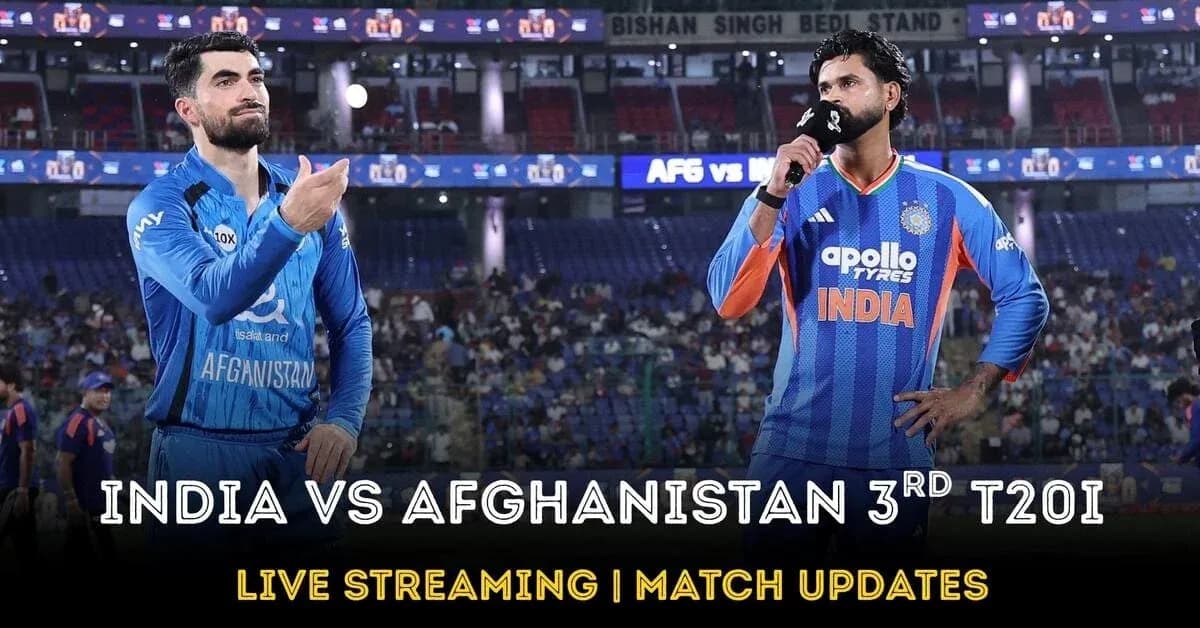
On a humid Delhi evening, with clouds rolling in and the air thick, Afghanistan captain Ibrahim Zadran won the toss, pointed to the pitch and chose to bowl. It felt like a sensible call. Some help early on, a chance to finally put India under pressure, and maybe salvage something from a series already gone.
What followed was carnage.
India flipped the script with the bat
Shreyas Iyer had said at the toss that India wanted to bat first anyway. “A fun challenge,” he called it. Two comfortable chases in the first two T20Is had come off the back of their top order. Now the same group had to set the tone while setting a target.
The XI underlined that intent. Yash Thakur replaced Arshdeep Singh in the pace attack, but the batting remained untouched: Abhishek Sharma, Sanju Samson, Ishan Kishan, Iyer, Tilak Varma and all-round depth through Axar Patel, Shivam Dube and Nitish Kumar Reddy. No debut yet for Vaibhav Sooryavanshi, who again watched from the sidelines.
Afghanistan made two changes of their own. Noor Rahman and Abdullah Ahmadzai came in for Gulbadin Naib and Noor Ahmad, with Mujeeb ur Rahman and Rashid Khan still at the heart of the spin unit. Zadran spoke of early assistance for the bowlers and a desire to “keep things easier” after losing the first two games.
For the first over, that script held. Fazalhaq Farooqi landed his lines, India crawled to 5 without loss, Samson scratching around, Abhishek just loosening up.
Then the switch flipped.
Abhishek detonates the powerplay
Azmatullah Omarzai ran in for the second over. By the time he walked back, India were 22 for 0 and Abhishek was already on 20 from eight balls. A swivel over deep square leg for six, a sliced four down the ground, a booming hit over deep extra cover. The tone was no longer cautious. It was confrontational.
Farooqi’s next over disappeared for 23. Abhishek lofted straight for six, then went fine, then square, then top-edged yet another boundary. India 45 for 0 after three, Abhishek 42 off 13, the ground suddenly alive.
Samson joined in against Mujeeb, clearing his front leg and sending one straight back over the bowler’s head. But this was Abhishek’s storm. Mohammad Nabi, Afghanistan’s old hand, walked in to restore calm in the fifth over. He was mauled instead. Samson launched him for back-to-back sixes, brought up 9,000 T20 runs, then Abhishek ripped into him: fifty up, a cut for four, a final blow for six. Twenty-nine runs off the over. India 85 without loss after five.
Rashid Khan entered. The contest everyone had been waiting for. Abhishek has hurt Rashid before in T20 cricket, and he did it again. After a sighter, he hammered consecutive fours through the off side and then lifted Rashid over the rope at sweeper. At the end of the powerplay, India were 100 for 0. Abhishek 76 off 22. Samson almost a spectator on 24.
The pressure had not just told. It had crushed.
A record falls
The assault did not ease. Abdullah Ahmadzai’s first over went for nine. Mujeeb’s next went for 15. Abhishek climbed into anything remotely short or full, sending one over long-on, then another straight back over the bowler. At 93 off 28, the crowd knew what was coming.
Ahmadzai returned for the ninth. Samson nudged a single. Abhishek launched a six to move to 99. Then, with the entire stadium holding its breath, he simply pushed down the ground for one. Third T20I hundred. Reached in 30 balls. The fastest century by a batter from a Full Member nation.
Helmet off. A meditation pose in the middle of a roaring Delhi crowd. A modern T20 image, but with an old-school swagger.
By the time Rashid finally ended the innings on 108 off 34 – a thick outside edge on a googly, Rahmanullah Gurbaz doing the rest behind the stumps – India were 142 for 1 in the 10th over. Abhishek’s innings contained nine fours and 11 sixes. It felt like more.
He even reviewed the dismissal, despite a clear edge and a loud spike on UltraEdge, as if unwilling to let this night end. The technology confirmed what everyone had heard. The walk back came, the ovation followed, and Afghanistan could finally breathe.
Samson steadies, Rashid bites back
With Abhishek gone just before drinks, the innings needed a different gear. Samson had already found his range, and he stayed on the front foot. He lifted Mujeeb over long-off for six, nudged the gaps, and moved calmly to another T20I fifty – his second in as many games in this series.
Tilak Varma, however, never settled. A moment’s hesitation cost him. Rashid fielded off his own bowling and nailed the non-striker’s stumps with a direct hit. Tilak gone for 2 off 5. A classic Rashid intervention, changing the mood with one piece of fielding.
Iyer arrived and scratched around early, working just a single off his first two balls. Rashid tightened the screws in his third over, conceding only three and removing Tilak. Mujeeb finished his spell with India 164 for 2 after 13, Samson on 50 from 34, Iyer beginning to find touch with a couple of soft-handed twos.
Afghanistan, though, had already absorbed the heaviest blow. Their bowlers had been targeted, their plans shredded, their captain’s decision to bowl first turned back on him by a top order that has dominated the series.
Afghanistan’s challenge grows steeper
This has been the story of the tour. Afghanistan’s batters have fought in patches – Omarzai’s 64 in the opener, Zadran’s 37 and late swings from Nabi and Rashid in the second T20I – but the starts have been brittle. Early wickets, stalled scoring, and too much left for the middle and lower order.
Now they face a different kind of examination. Chasing under lights against Jasprit Bumrah and a fresh Yash Thakur, with Ravi Bishnoi and Axar Patel waiting, will test both technique and temperament. Gurbaz, in particular, walks into a personal battle; he has a strike rate of just 37.50 against Bumrah and is coming off back-to-back ducks in this series.
India, meanwhile, have their blueprint clear. Abhishek’s powerplay numbers since 2024 – a strike rate of 191.27, better than even Travis Head among batters with at least 750 balls in that phase – are no longer just a statistic. They are a warning. Tilak’s split scoring rates against pace and spin, Bishnoi’s control, Dube’s all-round utility, Nitish’s extra overs: all of it feeds into a side shaping itself for bigger assignments, including the Asian Games.
Afghanistan chose to chase, hoping to keep things simpler. Instead, they now stare at the kind of target that demands risk from ball one.
The series is already India’s. The night, though, belongs to Abhishek Sharma. The only question left is whether Afghanistan’s batters can stop his 30-ball masterpiece from becoming the defining image of a clean sweep.