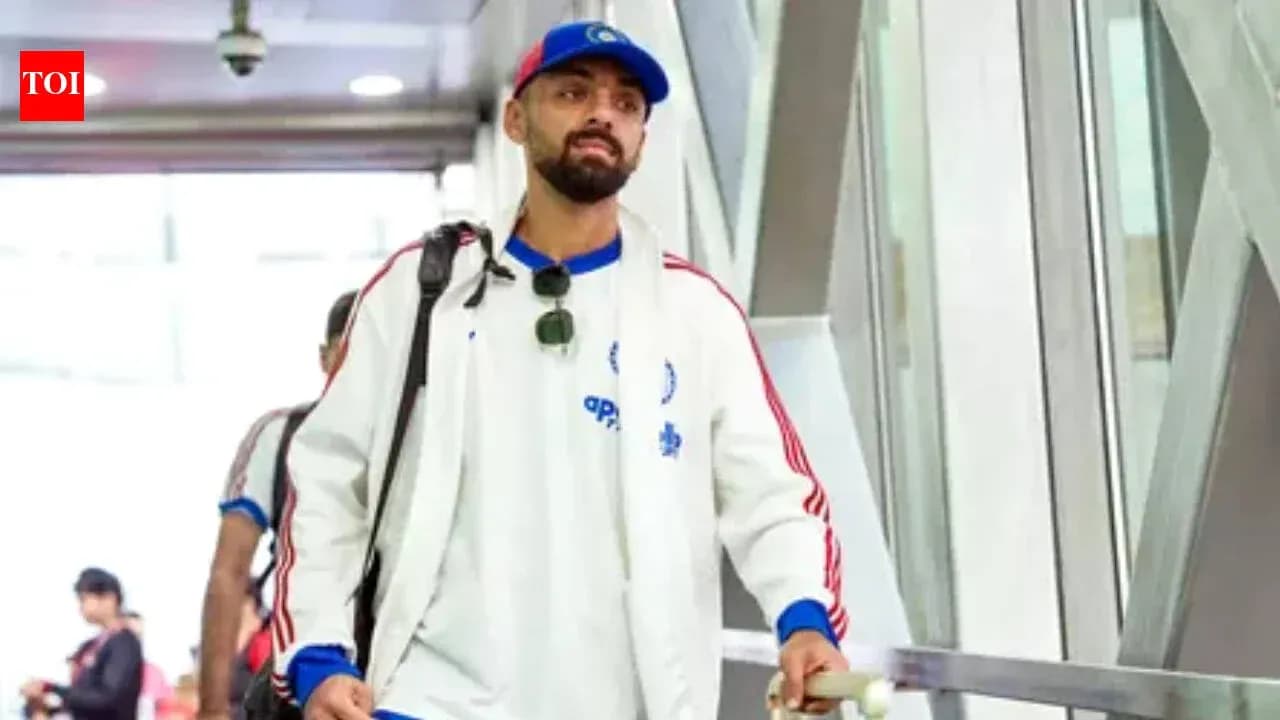
Varun Chakravarthy: Late Bloomer Embraces New Challenges
For most international cricketers, 35 is the stage when the calendar starts to feel heavy and the body begins to answer back. Varun Chakravarthy doesn’t see it that way.
The man who debuted for India at 29 insists he is only halfway through his career.
"At this stage of my career, I still feel I'm in my first half of my career because I started cricket very late. So I still feel there's a long way to go," he told TimesofIndia.com in an interaction facilitated by equipment manufacturer ASICS.
Given the year he has just lived, it is hard to argue with his sense of momentum.
In 12 breathless months, Chakravarthy has ridden the full spectrum: a T20 World Cup title on home soil, finishing as India’s joint-highest wicket-taker with 14 wickets; an IPL season where he bowled with hairline fractures in his left hand and toe; and then, finally, a full stop from his own body — the first muscle injury of his career, a Grade 2 left hamstring strain that sent him into weeks of rehabilitation.
Now he is back, fit in time for a congested stretch that will test both body and mind: three T20Is against Afghanistan, a historic one-off international against Japan, and the Asian Games in Aichi-Nagoya, where defending champions India enter straight into the quarterfinals.
For a player who measures time differently, it all feels like the next chapter rather than the closing pages.
Learning How To Be Injured
Pain was never new to Chakravarthy. The type of pain was.
"This is actually my first ever muscle injury. So all of my injuries have been impact injuries and other accidents that have happened on field," he said.
That difference matters. A blow to the hand or a cracked toe comes with a clear story: ball hits bone, scans confirm damage, time heals. A torn hamstring is more insidious. It challenges trust as much as tissue.
The BCCI Centre of Excellence in Bengaluru became his base camp. Long days, repetitive drills, the quiet grind of a player trying to stitch himself back together.
"The expertise at CoE helped me and people helped me to gain my confidence. Every person working there helped me," he explained. "Definitely, I spent a lot of time there and did a lot of running and did a lot of strength training, which helped me."
For a mystery spinner, rhythm is currency. Without it, the variations don’t bite, the deception loses its edge. Medical clearance is one thing; believing your body will hold when you pivot hard at the crease is another.
"Yeah, it will take some time to gain confidence. But once you gain confidence, you just start becoming more expressive and that's how it is," he said, sounding more like an architect fine-tuning a design than a cricketer returning from injury.
He refuses to treat those weeks away as a void.
"When you're away, you can start sharpening your skills. You can upskill yourself, which you don't get much time to do when you're playing continuously."
In a format where careers can change in a single over, that mindset may be his biggest asset.
The Spinner Who Starts From The Feet
Mystery spin usually gets framed in slow-motion replays of wrists, fingers, and release points. Chakravarthy starts the story much lower.
"For a bowler, shoes are the biggest equipment they can have. Batters, they have many other equipments, but for a bowler, it's the shoes only," he said.
His association with ASICS is now official, but it did not begin on a contract sheet. He had already shifted to their shoes around 2022, long before signing a deal in January 2026.
What stands out is how clinically he dissects something most players treat as background.
"As a spinner, your feet start becoming little broader as in it starts changing shape once you pivot because the spinners have to pivot more after landing. So broad shoes in the toe area that is very important," he explained.
Then comes the rest of the checklist: a supportive heel counter, lighter weight. Simple details, but for someone whose action demands repeated, violent pivots, they are non-negotiable.
It fits the broader picture of Chakravarthy the cricketer. The former architect looks at his game like a project: analytical, process-driven, always chasing marginal gains. The mystery isn’t magic; it’s engineered.
Eyes On Japan, Mind On Sport
The Asian Games, starting September 19, bring something Chakravarthy has never experienced, even after a World Cup win — a proper multi-sport village.
"It's my first time in Japan. I've never been to Japan and any games also. So all I've played is ICC tournaments and ACC tournaments," he said, the excitement unmistakable.
He is not just ticking off a new country. He is hungry for new habits.
"I'm very much looking forward to meeting other athletes also from other different sports and all those things," he said. "I want to see how a 100-metre athlete prepares himself, how a badminton professional prepares himself or herself."
Cricket’s calendar rarely allows for this kind of cross-pollination. Squads fly in, play, fly out. Hotels, buses, nets, repeat. The Games crack that routine open. Sprinters, shuttlers, wrestlers, gymnasts — all preparing in their own bubbles, yet in the same space.
For Chakravarthy, that is not a curiosity trip. It is research.
On the field, too, Japan will be a departure from the familiar. The pitches at Korogi Sports Park are expected to behave differently from Indian surfaces, and the spinner knows preconceived plans can quickly look foolish on new soil. Adaptability will matter more than reputation.
For a 35-year-old who still insists he is only in his first half, that suits him just fine.